
Narita vs Haneda (vs Kansai): Which Airport to Fly Into for Japan — Transfer Times, Costs & the New 2027 US Nonstops
Haneda is 14 km from Tokyo Station and ¥520 by monorail; Narita is 60 km out and ¥3,140 on the N'EX but has the cheap fares and the LCCs. Terminals, airlines, last trains, the Narita–Haneda transfer, when Kansai is the smarter entry — and United's 2027 nonstops to Osaka and Okinawa.
If you're booking flights to Japan and staring at two options — Narita or Haneda — the short answer is this: Haneda is closer to central Tokyo and better for shorter trips or late arrivals, while Narita often has more international routes, more low-cost carriers, and sometimes significantly cheaper fares. Neither is "bad." They just fit different itineraries.
This guide breaks down the practical differences between Narita and Haneda so you can pick the right one, plan the transfer that actually matches your first day in Japan, and avoid the classic mistake of booking a cheap Narita flight only to spend the savings on a taxi at midnight. We'll cover access times, costs, terminals, airlines, dining, the third option — Kansai — and how to slot all of this into a real self-guided itinerary.
✈️ Quick Answer: Narita vs Haneda
Tokyo has two major airports, and both handle international flights. Haneda sits inside the city of Tokyo itself, roughly 14 km south of Tokyo Station — about 30 minutes and ¥520 by monorail. Narita is about 60 km east of central Tokyo in Chiba Prefecture — 53–60 minutes and ¥3,140 on the Narita Express — so the distance really does change your travel time and cost. If you're torn on similar prices, take Haneda.
Haneda → Tokyo
~30 min · ¥520–720
Narita → Tokyo
53–60 min · ¥3,140
Taxi
HND ¥6–8k · NRT ¥20–30k
Cheap fares & LCCs
Usually Narita
If your flight lands during the day and you're staying in Shinjuku, Shibuya, or anywhere on the JR loop, either airport works fine. If you land late, or you're only visiting Tokyo for a shorter trip, Haneda is usually the smarter pick. Honestly, the airline picks you as much as you pick the airport. Most travelers just take whatever their preferred carrier offers on their dates.
Where Each Airport Actually Is
Whichever airport you land at, you can send the big suitcase straight to your hotel from the arrivals hall — our luggage forwarding guide covers the counters, rates and cut-off times.
Haneda Airport (Tokyo International Airport, HND)
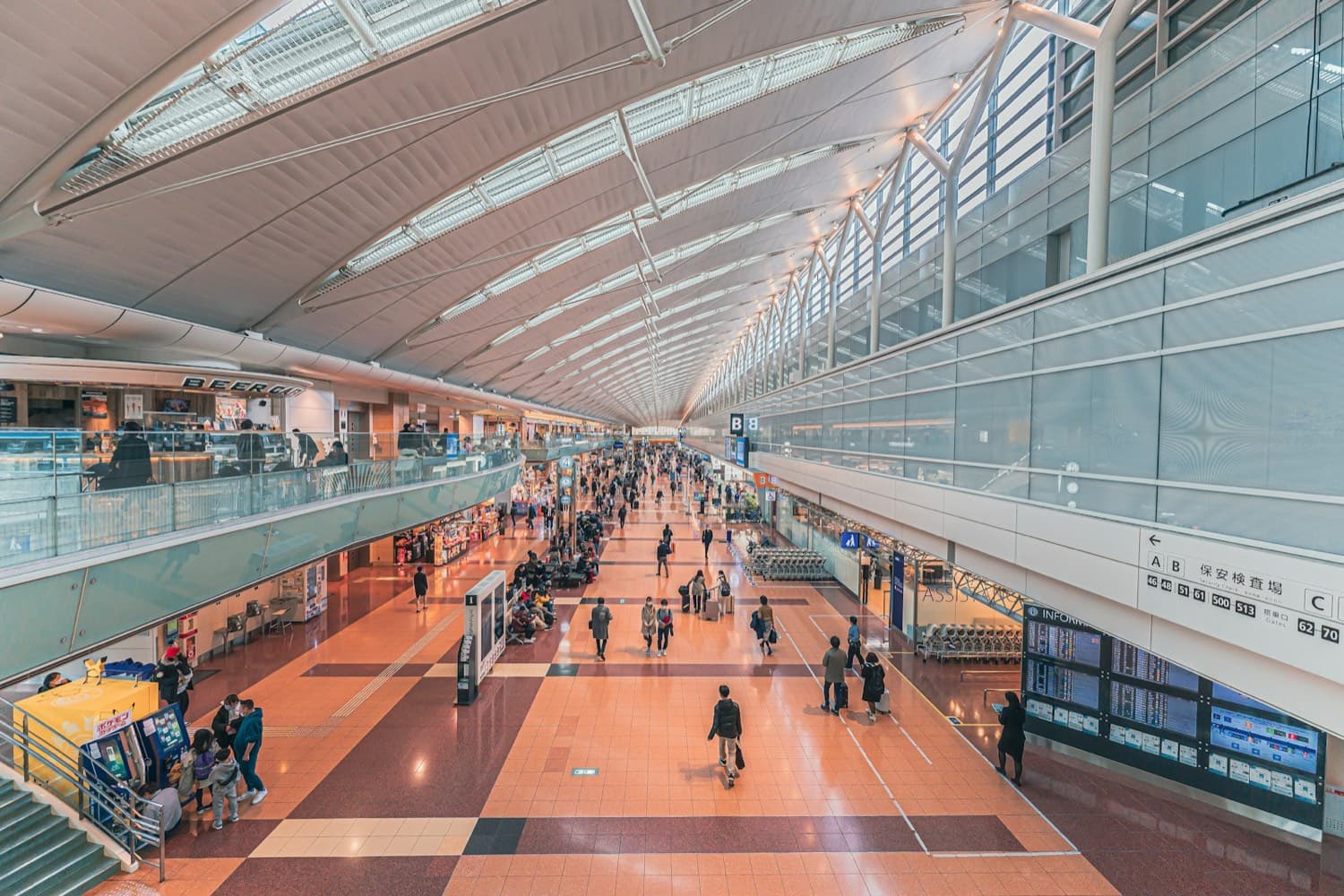
Haneda Airport, also known as Tokyo International Airport, is located in Ota ward, Tokyo, 14 km south of Tokyo Station. That's the crucial fact. You can be in downtown Tokyo in about an hour — often less — after clearing customs.
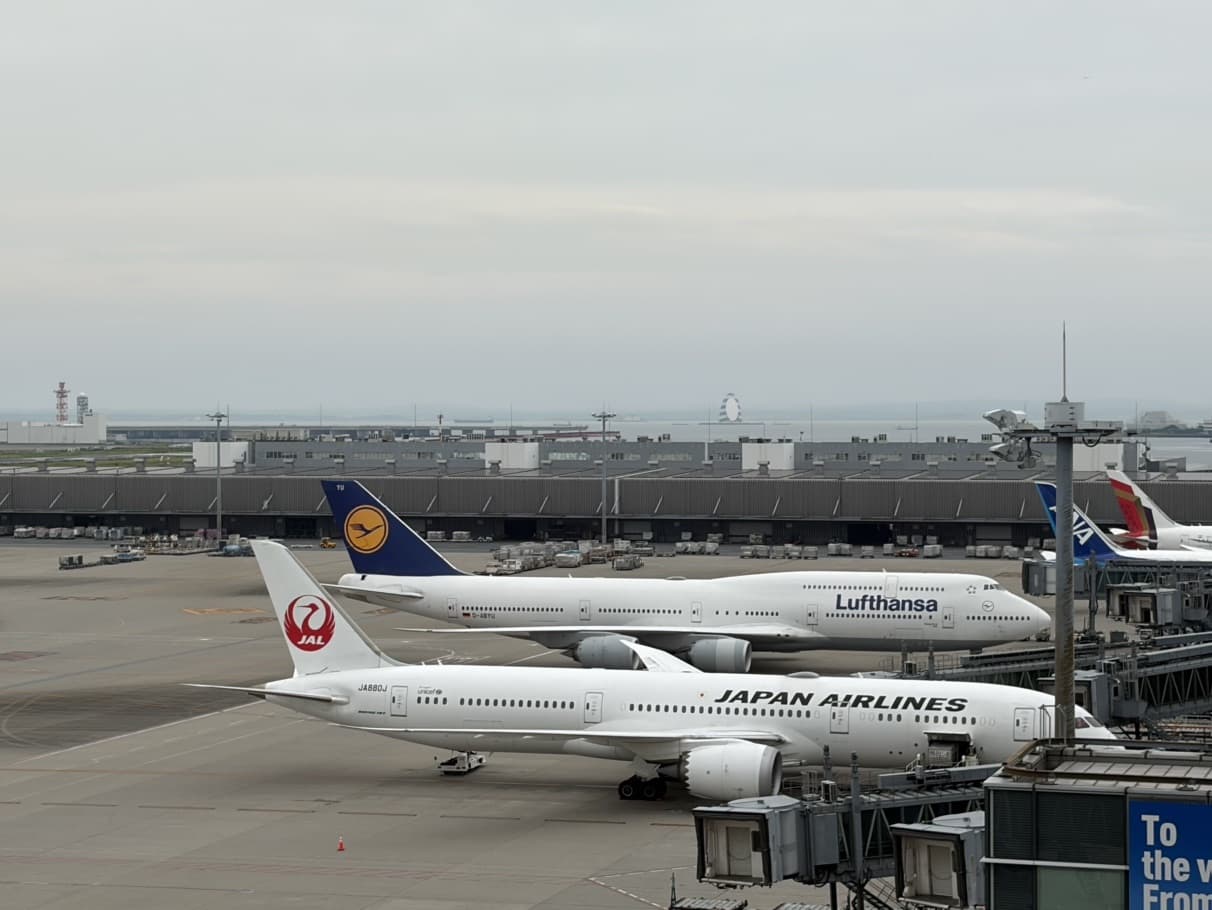
Haneda is a hub for All Nippon Airways and Japan Airlines, and it's also an operating base for domestic carriers like Skymark and StarFlyer. In 2024 it handled around 85.9 million passengers, making it one of the four busiest airports in the world.
Narita International Airport (NRT)
Narita is out in Chiba, past the eastern edge of the Tokyo sprawl. It's Japan's biggest hub for international destinations by route count — around a hundred airlines serving roughly 130 cities. If you're chasing a specific carrier or a specific city pair — especially something in Southeast Asia or a low-cost carrier route — Narita often wins.
Narita and Haneda: Terminals at a Glance
Haneda's three passenger terminals
Haneda has three passenger terminals: T1, T2, and T3. With the commencement of international services from Terminal 2 in March 2020, the former International Terminal was renamed Terminal 3, and Terminal 2 was expanded to handle international departures and arrivals in addition to its original domestic role.
In plain English: T1 and T2 are mostly domestic flights (JAL at T1, ANA at T2), and T3 is the main international terminal — though some international flights, mainly ANA's, now also use T2. Free shuttle buses connect all three terminals outside security.
Narita's terminals
Narita operates three passenger terminals as well, designed around the three major airline alliances: SkyTeam airlines fly out of Terminal 1's North Wing, Star Alliance airlines use Terminal 1's South Wing, and oneworld airlines fly out of Terminal 2. Terminal 3 is the low-cost carrier terminal, home to airlines like Jetstar, Jeju Air, and Spring.
Check your alliance before you head to the airport for departure. Getting off the train at the wrong terminal is annoying, especially with heavy luggage.
Which Airlines Fly Where
This is where things get practical. Not every carrier serves both airports.
Airlines at Haneda
All Nippon Airways and Japan Airlines both hub at Haneda, and after the 2020 slot expansion, a lot of long-haul flights from North America and Europe moved here. Delta Air Lines withdrew from Narita altogether to concentrate its Tokyo flying at the more conveniently located Haneda. British Airways, Singapore Airlines, United, American and most flagship carriers now run a Haneda service too.
Airlines at Narita
Narita still has serious range. SkyTeam carriers include Air France, China Airlines, KLM, Korean Air, Vietnam Airlines, and Virgin Atlantic; Star Alliance includes Air Canada, Air China, Air India, Air New Zealand, All Nippon Airways, Asiana, EVA Air, Lufthansa, Singapore Airlines, and United; oneworld includes American Airlines, British Airways, Cathay Pacific, Japan Airlines, Malaysia Airlines, and Qantas. Then there are the LCCs — Jetstar, Peach, Zipair, Spring, Scoot — which almost always mean Narita.
So if you're comparing flight options on a booking site, don't be surprised when the cheap fare says NRT and the pricier one says HND. That's normal.
💬 From our Japan travel team
Both airports work well as a start point for a self-guided trip, but hotels and trains in Tokyo, Kyoto, and Osaka fill up fast in spring and autumn, so it pays to lock in your dates before you commit to a specific airport. Our self-guided tours handle the hotel and rail bookings and give you 24/7 on-the-ground support during the trip, so if your flight arrives at Haneda at 11 pm or Narita at 6 am, we'll have your first-night transfer sorted. Feel free to get in touch and we'll match the route to your flight, not the other way around.
Getting from Haneda to Central Tokyo
Haneda's biggest selling point is how easy it is to reach Tokyo. Two rail lines run right into the terminals.
Tokyo Monorail
Haneda Airport is directly connected to the Keikyu Line and the Tokyo Monorail. The Tokyo Monorail runs from all three terminals to Hamamatsucho Station, where you transfer to the JR Yamanote Line. The line runs 17.8 km from Monorail Hamamatsucho in central Tokyo to Haneda Airport Terminal 2.
The Tokyo Monorail fare is ¥520 for adults and ¥260 for children. Under 20 minutes to Hamamatsucho on the fastest services, then a short Yamanote ride to Shimbashi, Tokyo (¥720 and about 30 minutes all in), or Shibuya. The monorail is covered by the Japan Rail Pass, so pass holders ride it free.
Keikyu Line
The Keikyu Line is the other option and our usual pick for Shinagawa or points south: ¥330 and about 20 minutes to Shinagawa — where the Tokaido Shinkansen stops, which matters if you're heading straight on to Kyoto or Osaka. Some Keikyu trains continue through to Asakusa via the Toei Asakusa subway line without a transfer if you catch the right one. Keikyu is not covered by the JR Pass.
The Keikyu and Tokyo Monorail platforms are at B1F of the terminals. Signs are clear in English.
Limousine bus and taxi
An Airport Limousine bus also runs from Haneda to Shinjuku, Tokyo Station (¥1,200, 40–55 minutes), and major hotels. It's slower than the train but easier with heavy luggage, especially for families.
A taxi from Haneda is realistic in a way it isn't from Narita — expect roughly ¥6,000–8,000 to central Tokyo depending on hotel location and traffic, up to about ¥11,000 with the late-night surcharge.
Getting from Narita to Central Tokyo
Narita is further, so plan around it.
Narita Express (N'EX)
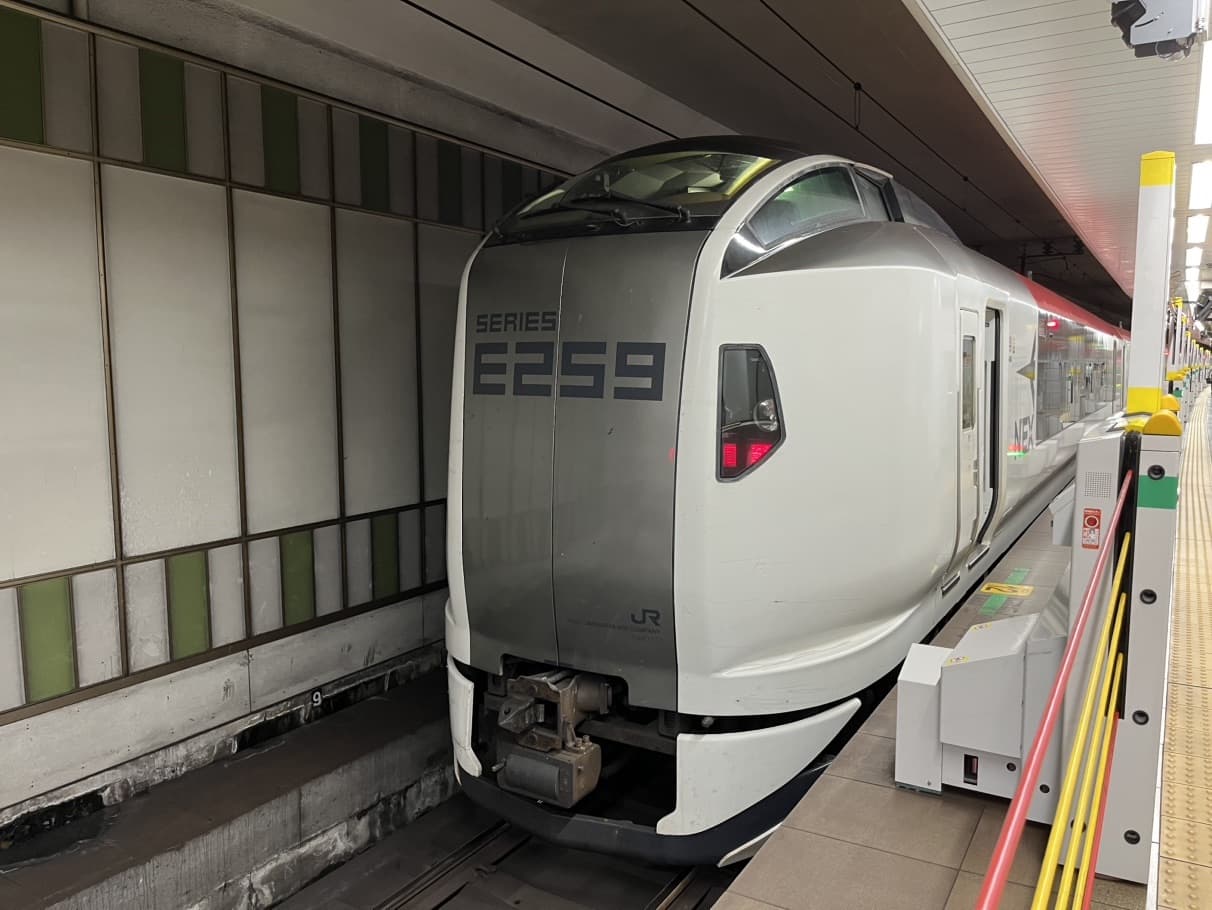
The Narita Express is the flagship option and often the best if you're going to Tokyo Station, Shinjuku, Shibuya, or Yokohama. N'EX is a fast, comfortable limited express that directly connects Narita Airport with Tokyo, Shinagawa, Shibuya, Shinjuku and Yokohama — the fastest run from Narita Airport Station to Tokyo Station takes 53 minutes, most take about an hour. No transfers, dedicated luggage space, and power outlets at every seat.
A one-way adult ticket from Narita Airport to Tokyo Station is ¥3,140 in the ordinary car (Green Car higher), with fares to Shinagawa, Shibuya or Shinjuku slightly above that. JR East also sells a discounted N'EX Tokyo Round-Trip Ticket for foreign passport holders — ¥5,200 adult since the March 14, 2026 fare revision (up from ¥5,000), valid 14 days.
Keisei Skyliner
The Skyliner runs to Ueno instead of Tokyo Station: Narita Airport to Nippori in 36 minutes and Keisei Ueno in 41, for about ¥2,570, then another 15 minutes to Tokyo Station on JR including the transfer. Fast if you're staying near Ueno, Asakusa, or northeast Tokyo. The cheaper Keisei Access Express and Main Line trains take 60–100 minutes for ¥1,260–1,400.
Narita Airport limousine bus
The airport limousine bus is the calmest way in from Narita, especially with big bags. Buses to Tokyo Station take about 90 to 100 minutes (¥3,100), with a cheaper Airport Bus TYO-NRT at ¥1,500 in about 65 minutes. They also run to Shinjuku, Ikebukuro, and major hotels around the city — great if you're jet-lagged and don't fancy hauling suitcases through Tokyo Station.
JR Pass and the Narita Express
You can use your Japan Rail Pass on the N'EX, but you'll have to consider whether you want to validate it so early into your trip or simply buy a ticket. If you're taking the shinkansen the next day anyway, activating on arrival day makes sense. If you're spending several days in Tokyo first, hold off — our JR Pass calculator shows the break-even.
Haneda vs Narita on Cost and Time
Fares are usually the tiebreaker. Here's the shape of it:
💴 Airport to central Tokyo — every option
| Airport | Option | To | Time | Adult fare |
|---|---|---|---|---|
| Haneda | Tokyo Monorail + JR | Tokyo Station | ~30 min | ¥720 (monorail ¥520) |
| Haneda | Keikyu | Shinagawa | ~20 min | ¥330 |
| Haneda | Limousine bus | Tokyo Station / Shinjuku | 40–55 min | ¥1,200–1,400 |
| Haneda | Taxi | Central Tokyo | 30–45 min | ¥6,000–11,000 |
| Narita | Narita Express | Tokyo Station | 53–60 min | ¥3,140 |
| Narita | Keisei Skyliner | Ueno | 41 min | ~¥2,570 |
| Narita | Keisei Access Express / Main Line | Nippori / Asakusa | 60–100 min | ¥1,260–1,400 |
| Narita | Airport Bus TYO-NRT / Limousine bus | Tokyo Station | 65–100 min | ¥1,500 / ¥3,100 |
| Narita | Taxi | Central Tokyo | 60–90 min | ¥20,000–30,000+ |
💡 Fares are 2026 adult one-way prices; add roughly ¥3,000 per person to a Narita fare when comparing it with a Haneda flight. A Welcome Suica from the airport machines covers the monorail, Keikyu, Keisei and the subway.
So while a Narita flight might be significantly cheaper on paper, add roughly ¥3,000–4,000 per person for the transfer and it can even out. Do the math before you book.
Travel time reality check
Haneda to downtown Tokyo: about an hour door to door on the train, including bag pickup. Narita to central Tokyo: budget 90 minutes to two hours on the N'EX with baggage. On Google Maps it looks quick; in practice, add buffer time for the walk from your gate to the station — and register for Visit Japan Web before you fly, because the QR lanes at both airports (and Kansai) are where the real minutes are saved.
Traveling Between Narita and Haneda
If you fly into one and out of the other — this actually happens more than you'd think, especially on award tickets — allow real time. Direct limousine buses run between the two airports, taking 1h 30min to 1h 50min, with a fixed adult fare of ¥3,600.
There's no direct train between the two, so you'd need to transfer among the Keikyu, JR, subway, or Keisei lines (Keisei and Keikyu do run some through-trains via the Asakusa subway line, about 90 minutes). The bus is usually the least painful option.
The Third Option: When Kansai (KIX) Is the Smarter Entry
The Narita-or-Haneda question assumes Tokyo comes first. It doesn't have to. Kansai International Airport (KIX) sits on an island in Osaka Bay and is the natural gateway to Osaka, Kyoto, Nara, Kobe and Himeji — and most Japan itineraries end there anyway. Flying into Tokyo and out of Kansai (or the reverse, an "open-jaw" ticket) removes a 2.5-hour shinkansen backtrack and, once the fares are similar, is almost always the better shape for a first trip.
💴 Kansai Airport to the cities
| Option | To | Time | Adult fare |
|---|---|---|---|
| JR Haruka | Osaka Station / Shin-Osaka | 45–50 min | ¥2,380–2,540 (discount one-way ¥1,800 for visitors) |
| JR Haruka | Kyoto | ~70 min | ~¥3,000 |
| Nankai Rapi:t | Namba | 35–40 min | ¥1,520 e-ticket / ¥1,670 |
| Nankai Airport Express | Namba | 45–50 min | ¥970 |
| Limousine bus | Osaka / Kyoto | 45–60 / 100 min | ¥1,300–1,800 / ¥2,600 |
| Taxi | Central Osaka | ~50 min | ~¥15,000 (¥18,000 late night) |
💡 The Haruka is covered by the Japan Rail Pass. Kansai has the same Visit Japan Web joint kiosks as Haneda and Narita.
Kansai's weak spot has always been direct flights from North America — until now.
New for 2027: United's Nonstops to Osaka and Okinawa
In August 2026 United announced the largest international expansion in its history, and two of the ten new routes are Japanese. From March 27, 2027, United will fly Los Angeles to Osaka (Kansai) daily and San Francisco to Okinawa (Naha) three times a week on a Boeing 777-200ER — making it, in its own words, the only airline to serve Osaka from two continental US cities, and the only US carrier flying nonstop to Okinawa.
For West Coast travelers that changes the arithmetic. A Kansai arrival puts you in Kyoto within about 70 minutes of the gate, you can do the Golden Route in reverse and fly home from Haneda, and Okinawa — which until now meant a domestic connection through Tokyo — becomes a nonstop beach add-on. Check the Okinawa typhoon calendar before you pick August or September for it, and see our seasons guide for which end of Japan is at its best when you land.
Facilities, Airport Lounges, and Dining Options
Both airports do the basics well. Free Wi-Fi, English signage, luggage forwarding counters, ATMs, pharmacies — and the Welcome Suica vending machines and eSIM pick-up counters right in the arrivals halls.
Shopping and dining options
Haneda's Terminal 3 has a mock Edo-period shopping street, Edo Koji, on the upper level with ramen counters, tempura shops, and sushi. It's genuinely worth going early if you have a long wait. Terminal 3's dining runs late for departing flights.
Narita has more shopping spread across its terminals, and Terminal 2 has a solid range of restaurants past security. Terminal 3, the LCC terminal, is much simpler — think food-court energy.
Airport lounges
Both offer the usual airline lounges. At Narita, the ANA Suite Lounge welcomes ANA and Star Alliance first-class passengers with same-day international boarding passes, while business-class and premium-economy passengers plus Star Alliance Gold members use the ANA Lounge. Priority Pass works at various lounges in both airports.
New runways and expansion
Haneda's international footprint has grown a lot. Runway D opened in 2010, which was when international flights meaningfully returned to Haneda after decades of being a domestic hub connecting the capital with cities across Japan. In January 2019, Japan reached an agreement with the United States on new routes for airplanes using Haneda, adding 50 more international flight slots and boosting the total to 130 a day. Haneda has four runways, arranged in two parallel pairs. That capacity is why more airlines have shifted long-haul flights over from Narita.
When to Choose Narita and When to Pick Haneda
Here's how we usually think about it.
✅ Choose Haneda if…
- • You're landing late at night or leaving very early
- • You're only in Tokyo for a shorter trip — 3 or 4 days
- • Your hotel is in central Tokyo (Shinjuku, Shibuya, Ginza, Shinagawa)
- • You value the extra hour of sleep more than a small fare difference
- • You're flying a legacy carrier's premium cabin
✈️ Choose Narita if…
- • Your route only exists from Narita (a lot of Southeast Asia and LCC routes)
- • The fare difference is meaningful — often the case with low-cost carriers
- • You're heading straight to Chiba, Ibaraki, or Narita town for a night
- • You have a JR Pass ready to activate and want to use the Narita Express
If you're truly torn between Narita and Haneda on similar prices, take Haneda. If Kyoto and Osaka are the heart of the trip, look at Kansai before either.
Common Mistakes to Avoid
- Booking two flights into different airports without checking the transfer. Landing at Narita and departing Haneda the next morning is doable, but add real hours for the crossover.
- Assuming a late Narita arrival means "no problem." The Narita Express, Skyliner, and limousine bus all stop running by around 22:30–23:00. Miss the last train and you're looking at a very expensive taxi or an airport hotel.
- Not checking which Haneda terminal you actually depart from. With T2 now handling some international flights alongside T3, double-check your boarding pass.
- Activating a JR Pass on arrival day just to save on the N'EX. Do the sums first. If you're not taking a shinkansen that week, it's not worth it.
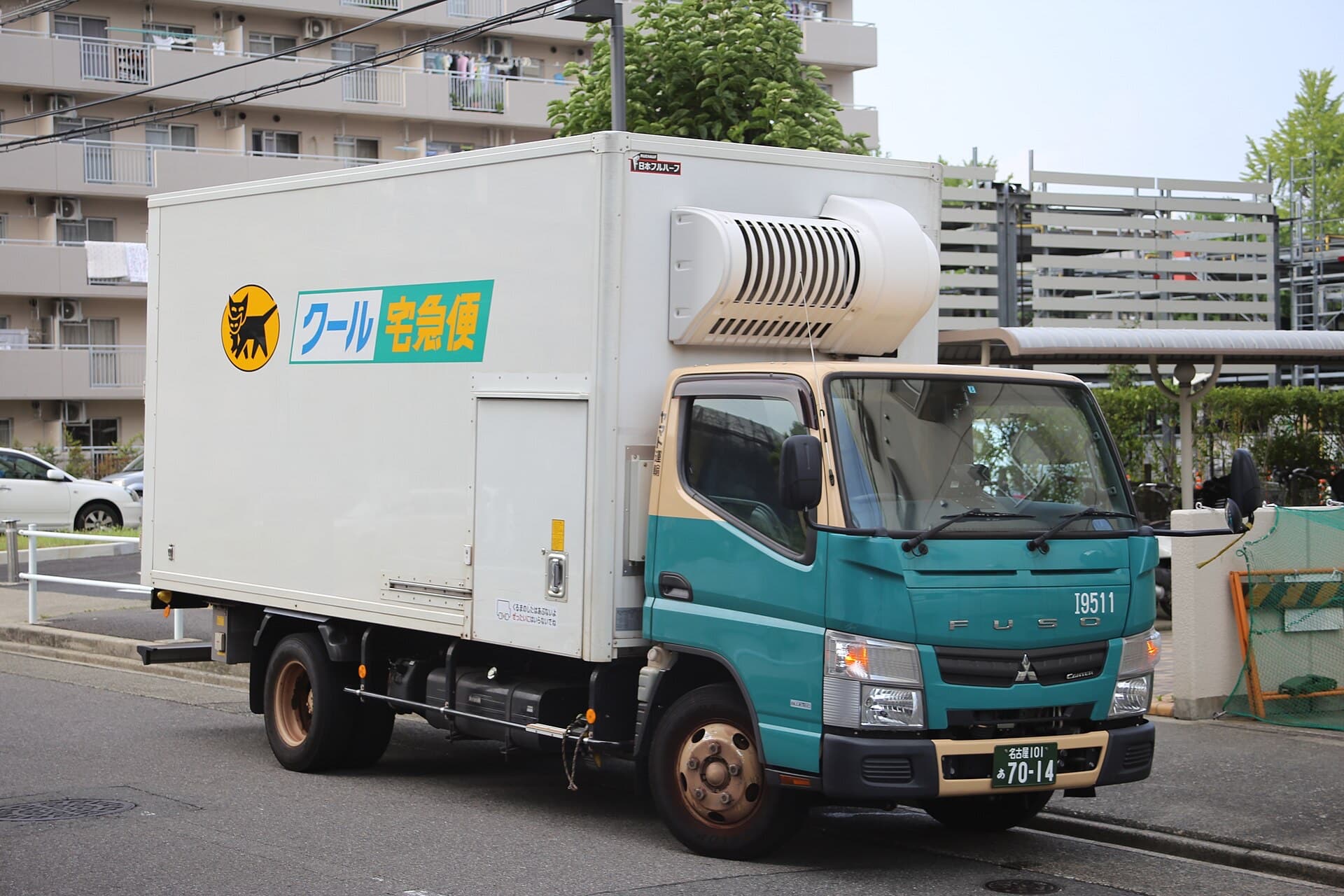
- Ignoring luggage forwarding. Sending your suitcase from the airport to your hotel (or straight to Kyoto) via Yamato's takkyubin counters is a lifesaver, especially at Narita — see our luggage guide.
- Forgetting the departure side. Japan's departure tax is built into your ticket, but the tax-free refund counters are at the airport — allow time before an early flight.
Slotting This Into a Real Self-Guided Itinerary
The airport choice ripples through the first and last days of your trip. A few templates that work well:
- Classic 10-day Tokyo–Kyoto–Osaka loop: Fly into Haneda late afternoon, taxi or Keikyu to your hotel, jet-lag day in Tokyo. Fly home from Kansai — much easier than backtracking. Our 10-day itinerary is built exactly this way.
- Two-week deep dive with a rural stop: Land at Narita, use the N'EX to Tokyo Station, spend 4 nights in the city, then shinkansen out to your onward destination. Return via Haneda if your carrier offers it.
- Short 5-day Tokyo trip: Both flights into and out of Haneda. Keep the transfer time under an hour on each end and spend the saved time in the city — our Tokyo itinerary fills the days.
- West Coast, Kansai first (from 2027): LAX to Kansai, Kyoto and Osaka first, shinkansen up to Tokyo, home from Haneda.
💬 From our Japan travel team
Our self-guided tours build in free days in Tokyo, Kyoto, and Osaka, so if you already have your flights locked into Narita or Haneda we can shape the rest of the route around them without rebuilding the itinerary. If you haven't booked flights yet, just ask and we'll tell you which airport pairs best with the trip you're planning. It's a small decision that saves a lot of hassle on arrival day.
Tools That Actually Help
- Google Maps for door-to-door transfer times — usually accurate for Tokyo trains.
- Navitime or Jorudan for exact train times and platforms.
- The official Limousine Bus site for airport bus schedules and online booking.
- JR East's N'EX page for reserved-seat booking up to a month ahead.
- Yamato Transport counters at both airports for luggage forwarding.
Keep screenshots of key bookings offline — airport Wi-Fi can be patchy right after landing.
Not sure which airport suits your route through Japan? Get in touch through Plan My Trip on our self-guided tours site, and we'll suggest the tours that best fit your dates and plans.
FAQ: Narita vs Haneda
Is Haneda always better than Narita?
No. Haneda is closer and usually faster to reach Tokyo, but Narita has more international routes, more LCCs, and often cheaper fares. If your flight, timing, and hotel location favour Narita, take it.
Can I use the JR Pass from Haneda?
Yes — the Tokyo Monorail from Haneda to Hamamatsucho is covered by the Japan Rail Pass, as is the Yamanote Line from there. The Keikyu Line is a private railway and is not covered (¥330 to Shinagawa).
How late do the trains run from Narita?
The last Narita Express and Skyliner services typically depart around 22:00–23:00. If your flight lands after 22:00 and immigration is slow, plan for the limousine bus, a taxi (¥20,000+) or an airport hotel.
Which airport is better for Kyoto?
Kansai International (KIX) — the JR Haruka reaches Kyoto in about 70 minutes for around ¥3,000. From Narita or Haneda you transit through Tokyo Station or Shinagawa for the shinkansen, roughly 2 hours 15 minutes more.
Which US cities will fly nonstop to Osaka and Okinawa in 2027?
United launches Los Angeles–Osaka (Kansai) daily and San Francisco–Okinawa three times a week from March 27, 2027, alongside its existing San Francisco–Osaka service.
Are there hotels at the airports?
Yes, both Narita and Haneda have on-site hotels — useful for very early departures or late arrivals. Book ahead in peak seasons.
Can I switch airports mid-trip if I change flights?
Yes, but budget 2–3 hours for the cross-Tokyo transfer with luggage, and remember the limousine bus between the two airports (¥3,600, about 1h 30min–1h 50min) is the simplest route.
Not Sure Whether Narita, Haneda or Kansai Fits Your Dates?
We build routes that work with your actual arrival airport — hotels and rail booked, a Suica waiting at the airport, and 24/7 support once you're on the ground. Tell us where you want to go, and we'll match the airport, not the other way around.
Fares are 2026 adult one-way prices from the operators and japan-guide.com; airline route details per United's announcement of August 25, 2026 and subject to change. Last updated: August 31, 2026.
Related Articles
Luggage Forwarding Japan: The Practical Guide to Takkyubin for Self-Guided Travelers
14 min read
Visit Japan Web 2026: Is It Still Required? How to Get Your QR Code & What Changed at Haneda, Narita and Kansai
13 min read
Welcome Suica 2026: No Deposit, 28 Days, and the Balance You Never Get Back
12 min read