

Okinawa Typhoon Season 2026: Month-by-Month Risk & How to Plan a Trip That Bends
Okinawa averages about 7.7 typhoon approaches a year, with the peak in August and September. Here is when the risk actually spikes, which storms 2026 has already produced, and how to build a self-guided Okinawa trip that a passing storm can't wreck.
Planning an Okinawa trip for 2026? Here's the honest version: the typhoon season is real, it has already been noisy this year, and it does not have to wreck your holiday. It just changes how you plan it.
Okinawa is the most typhoon-exposed part of Japan — the prefecture averages about 7.7 typhoon approaches a year against the mainland's three to four. But millions of people visit every summer without incident, and even a direct hit rarely holds a single island hostage for more than a day or two. What actually ruins trips is not the weather; it is an inflexible itinerary, a stack of non-refundable island hotels, and no travel insurance. Get those three right and the season becomes a variable you manage, not a threat you fear.
This guide is the Okinawa-specific companion to our national Japan typhoon season 2026 overview and the live Japan typhoon forecast 2026 tracker. It covers what the 2026 outlook actually says for the Ryukyus, when the approach risk peaks, which storms have already formed, and how to fold all of that into a self-guided route that bends instead of breaks.
Quick Answer: Okinawa Typhoon Season 2026
- Season runs May–October, peaks August–September. Okinawa is Japan's highest-risk region, at roughly 7.7 typhoon approaches a year.
- 2026 opened early: six typhoons had formed by late May, about three above the normal pace, and forecasters call for an above-average year across the basin.
- Most trips see only a wet day or two on one island. The real killers are inflexible itineraries, non-refundable island hotels, and no travel insurance.
- October is the sweet spot: approach risk drops sharply and Naha averages its clearest, sunniest weather of the year.
💬 From our Japan travel team
Okinawa is often called "Japan's Hawaii" — a string of beautiful islands and clear-water beaches that is a summer favourite for domestic Japanese travellers, not just overseas visitors. If you are connecting by air from abroad, remember that flights and ferries to and from Okinawa are among the first services cancelled when a typhoon is near, so once a storm looks likely to overlap your dates, start checking typhoon updates and airline/ferry operation notices before your trip even begins — not only after you arrive. And whatever the season or destination, take out travel insurance and be ready for disruption; it is the cheapest protection you can carry.
Should You Go to Okinawa in 2026?
Update, September 15: a tropical depression south-east of Japan is expected to become Typhoon No. 25 (Dujuan) and strengthen into a "strong" typhoon by September 17. The Japan Meteorological Agency's September 14 forecast takes it north towards the Ogasawara Islands around September 18 and south of the Japanese mainland on September 19, rather than towards Okinawa — but some Japanese reporting has flagged an Okinawa approach over the Silver Week weekend, and a track this far out can still move. If you are due in Okinawa between September 18 and 23, check the JMA typhoon page every morning and keep your ferry days flexible.
Update, September 7: Typhoon Krovanh (Typhoon No. 24) has passed. It formed south of Japan on September 1, tracked north towards Amami, U-turned south on September 4, drifted east past Okinawa, and weakened to a tropical depression over the sea south of Kyushu around September 5–6. Unlike Dolphin and Saudel it never carried a typhoon-force wind zone, so the islands saw rough seas, ferry cancellations and on-off heavy rain rather than a shutdown — but it did so for the best part of a week, which is the point the rest of this section makes. Outer-island ferries are returning to schedule; check the operator's page the day before you sail. The moisture it fed north is now driving record rain on the Pacific side of Honshu, which is a mainland problem rather than an Okinawa one.
Before it, Typhoon Saudel crossed Okinawa and the Amami islands on August 25–26 — blackouts, cancelled flights and ferries, two minor injuries — before heading west to China, following Typhoon Dolphin's near-miss on August 7. Those two hit the islands hard for about a day and left the mainland alone, which is the pattern the rest of this section describes. Krovanh is the other pattern: not violent, but slow, and slow is what actually eats travel days.
Yes — with adjustments. If your dates land between late October and early June, you are effectively outside the risk window and can plan like it. If you are locked into August or September, you are travelling at the peak and need to build the trip around the season rather than pretend the sky will cooperate.
The distinction that matters is not "typhoon or no typhoon." It is whether one storm can take down your whole week. A trip with refundable hotels, a floating day, and a couple of inland or northern nights shrugs off a passing system. A trip with five non-refundable beach nights and a tight return connection does not.
Okinawa Typhoon Season at a Glance
Under the Japan Meteorological Agency's 1991–2020 climate normals, Okinawa Prefecture records roughly 7.7 typhoon approaches a year — the highest of any region in Japan. In JMA's terms, an "approach" means a storm's centre passing within 300 kilometres of a weather station somewhere in the prefecture.
That 300-kilometre radius covers a lot of ocean, and Okinawa is not a single place. The prefecture is a 635-kilometre arc of islands stretching from Okinawa-jima in the north down to Yonaguni, which sits closer to Taiwan than to Naha. A storm can track just south of Miyako, batter it with wind and rough seas, and still leave the main island in sunshine — and it will still count as one "approach" in the statistics.
So read the headline figure with context. Many of those roughly eight annual approaches are peripheral passes that spoil a boat trip on one island while another stays clear. Most do not shut Okinawa down, and some never touch the main island at all. Our national Japan typhoon season 2026 guide rounds the southern-Japan figure to six or seven a year; 7.7 is the precise number for the Ryukyus specifically.
The 2026 Forecast: Why This Year Skews Higher
Heading into 2026, the seasonal outlooks broadly agreed on an above-average year. Weathernews projected roughly 27 to 29 tropical storms or typhoons forming across the Northwest Pacific over the full season. On the insurance side, Tropical Storm Risk (TSR) issued an early forecast of activity above the 30-year average — about 27 named storms, 18 typhoons, and 11 severe typhoons for the basin.
Those basin-wide totals line up with the broader picture we track on the national Japan typhoon forecast 2026 page, which frames the year at roughly 28 named storms with around 14 expected to approach Japan. Keep in mind those approach counts are national: Okinawa's own exposure is captured better by the 7.7-per-year normal above, not by the countrywide figure. (For the nationwide picture, see our evergreen typhoon season in Japan guide.)
Translation for travellers:
An above-average basin and a track pattern leaning toward Japan mean you should build in flexibility for an August, September, or October trip — not that you should panic-cancel anything.
What sets 2026 apart is less the count than the track pattern. The La Niña-like tendency that held through 2025 has been fading, with conditions trending toward El Niño. In El Niño years, typhoon tracks tend to shift northeast — toward eastern China, Korea, and Japan — rather than curving into the southern Philippines and Vietnam. The practical read: landfalls in Japan and Korea run above normal while the Philippines sees near- or below-normal activity, and Okinawa sits squarely in that recurving corridor.
The season is also front-loaded and back-heavy. Six typhoons had already formed by late May — about three more than the normal pace for that point — before formation eased back toward normal in June. Later in the year, forecasters flag the potential for the El Niño to strengthen, which would push sea-surface temperatures higher in the eastern Pacific and make the strongest storms of 2026 more likely from September onward.
Month-by-Month Okinawa Typhoon Risk
The season is not evenly spread. Here is how the risk builds and fades across the Ryukyus, based on JMA's monthly normals.
Okinawa typhoon risk by month (based on JMA 1991–2020 normals)
| Month | Risk Level | What to Expect | Plan |
|---|---|---|---|
| May – early June | Low, rising | Season opens; the odd early storm near the Nansei Islands | Fine to travel; start watching JMA once a storm forms |
| June | Moderate | Elevated risk concentrated near the Nansei Islands; rainy-season overlap | Book refundable island nights; keep a buffer day |
| July | Moderate | Fewer storms than the peak, but late-July systems can linger into August | Good window; stay flexible late in the month |
| August | High (~2.2/mo) | Peak by count; hot, humid, frequent approaches | Refundable everything; sequence the south early |
| September | Highest (~1.9/mo) | Fewer storms but bigger, wetter ones; autumn rain front amplifies rainfall | Highest-caution window; build in floating days |
| October | Moderate, declining (~1.1/mo) | Risk drops sharply; Naha's clearest, sunniest month | The sweet spot for flexible dates |
September deserves a special note. By then the autumn rain front — akisame zensen — is usually parked over the archipelago, and an approaching typhoon's outer rainbands feed straight into it. The result is heavy, drawn-out rainfall that can fall well away from the storm's centre, and Japan's worst flooding events tend to cluster in September. August produces more storms by count; September produces the bigger, wetter, more disruptive ones.
October is the quiet reward. Approaches drop to about one a month, the storms that do form tend to move slowly and stay rarer, and Naha records its clearest, sunniest weather of the year. If your dates are flexible, this is the window to aim for. Travelling in the thick of it instead? Our month guides for Japan in August 2026 and Japan in September 2026 cover those weeks in full, and where to go in Japan in summer 2026 maps out the lower-risk alternatives.
The 2026 Season So Far
The year did not ease in gently. Five storms are worth knowing about, presented here as reported.
Super Typhoon Sinlaku (April)
Sinlaku became the season's first typhoon on April 10 and rapidly intensified into a Category 5 within days, with winds around 175 mph (280 km/h). It caused catastrophic damage across the Northern Mariana Islands — Saipan and Tinian in particular — after coming ashore as a Category 4. Okinawa was spared, but it was an early warning shot.
Severe Tropical Storm Jangmi (late May – early June)
Jangmi — known in the Philippines as Domeng — was the one that hit Okinawa directly. After enhancing the southwest monsoon over the Philippines in late May, it tracked across the Ryukyu Islands and into mainland Japan in early June.
In Okinawa the storm injured at least 16 people and cut power to nearly 48,000 homes across Okinawa and Kagoshima prefectures, and more than 400 flights — mostly All Nippon Airways services in and out of Okinawa — were cancelled. It then carried on northeast, passing closest to the main island on the Monday night and the Amami region by Tuesday, before reaching the Kyushu, Shikoku, Kinki, Tokai, and Kanto regions through midweek. Tokyo felt it too.
Typhoon Bavi (July)
Bavi was the big one for the Sakishima group. It threaded between the Miyako and Ishigaki island groups on July 11 before accelerating toward China's Zhejiang–Fujian coast, with violent winds, heavy seas, and storm surge across the southern Ryukyus. In Okinawa Prefecture it was linked to 12 minor injuries and the evacuation of nearly 83,000 people — Ishigaki took the brunt, while Naha and the main island further north got off comparatively lightly.
Bavi is a clean illustration of why the "Okinawa Prefecture" label misleads. Same prefecture, wildly different storm on Ishigaki versus Naha a few hundred kilometres apart. Always check the forecast for your specific island, not the prefecture headline.
Typhoon Dolphin (August 7)
Dolphin passed close enough on August 7 to shut Naha Airport, with more than 500 flights cancelled, roughly 16,920 households losing power and five people injured. It was a near-miss rather than a direct hit, and it still cost most travellers on the island a full day.
Typhoon Saudel (August 25–26)
Saudel crossed Okinawa and the Amami islands on August 25–26, bringing blackouts, cancelled flights and ferries and two minor injuries before heading west to China. Like Dolphin, it hit the islands hard for about a day and left the mainland alone.
Typhoon Krovanh (September 1–6)
Krovanh is the season's counter-example, and the more instructive one. It formed south of Japan on September 1, ran north towards the Amami islands, reversed course south on September 4, and finally weakened to a tropical depression south of Kyushu around September 5–6, after six days in the islands' sea area. No typhoon-force wind zone ever developed, so Naha Airport did not shut the way it did for Dolphin — but ferries to the outer islands, rough seas and repeated bands of heavy rain ran on and off for the better part of a week, and the storm's moisture fed a stalled front that brought record rainfall and landslide alerts to Yakushima and heavy-rain warnings from Kanto to the Kii Peninsula.
The travel lesson is the one most itineraries get wrong: a weak, slow storm can cost you more days than a strong, fast one. Dolphin took a day. Krovanh has been rearranging outer-island plans since September 1. When you see a forecast track that loops or stalls, assume the disruption window is measured in days, not hours — and put the outer islands early in the trip, not last, so you have room to rebook.
How to Actually Plan Around It
This is where self-guided travel beats a packaged tour. You are the dispatcher — you can move a night, flip a leg, or sit tight, and no coach schedule stops you.
Sequence It Around the Peak
The single most effective move is sequencing, and the right direction depends on which side of the peak you are travelling. Through August and the first half of September you are inside it: bank Okinawa early and finish north, so that if a storm rolls in during week two you are already inland or up in Hokkaido. From mid-September onward, once the peak has passed, the reverse is the safer order — Hokkaido or Tohoku first, Okinawa last, giving the season's pattern room to settle. Either way, an inland or northern anchor — Kyoto, Osaka, or a Hokkaido loop — is far more forgiving than any coast. Our Hokkaido tour package guide lays out the low-risk northern end of that routing.
Build a Floating Day
Leave slack in the schedule. One buffer day per week is the best insurance policy you can carry — if the weather holds it becomes a slow morning or an extra beach afternoon rather than lost time, and if a storm passes it absorbs the disruption instead of the rest of your trip.
Book Refundable Everything
Hotels first, flights second where the fare gap is reasonable. Ferries are the worst offenders for cancellations, so if you are island-hopping in the Yaeyamas, treat every boat as a maybe. Rental cars are more forgiving than people expect: if your airline officially cancels a flight because of a typhoon, most Okinawa car-rental firms will waive the cancellation fee — but you need the airline's official cancellation certificate. Cancel voluntarily before the airline calls it and the standard fees usually apply. The lesson: wait for the airline to make the call.
Get Insurance With a Weather Clause
Not optional in typhoon season. Read the wording — you want trip disruption and cancellation triggered by a named tropical storm or a typhoon warning, not a vague "natural disaster" clause. Cheap policies routinely exclude the exact scenario you are buying the cover for.
Tools to Use — and the Warnings to Know
Skip the general weather apps for the decisions that matter. Three sources do the real work.
Japan Meteorological Agency (JMA)
Your primary source. The English typhoon tracker refreshes hourly once a storm is within 300 km of Japan and shows the official position, forecast track, and cone of uncertainty — far more reliable than a consumer app that lags or flattens the cone.
Joint Typhoon Warning Center (JTWC)
The US-run tracker for the same basin. JMA tracks usually run five days out, some services stretch to ten, and the two agencies sometimes draw slightly different cones. Checking both keeps you from over-reacting to a single model's worst-case line.
NHK World
For English-language emergency coverage. During major storms it runs continuous updates and flags it fast if conditions worsen unexpectedly — useful when a track shifts overnight.
Learn two terms while you are at it. A Typhoon Warning (暴風警報, bōfū keihō) is issued when destructive winds are expected within about six hours. A Special Warning (特別警報, tokubetsu keihō) is the top tier, reserved for situations where catastrophic damage is likely — rare, but worth recognising. You will see the Japanese on JMA and phone alerts and hear it on NHK, so it helps to recognise the characters. Under any warning, outdoor activity and driving should stop. For the live track of whatever is spinning right now, our Japan typhoon forecast 2026 tracker keeps the current tools in one place.
What a Typhoon Day Actually Looks Like in Okinawa
Roughly 12 to 24 hours out, Naha Airport starts cancelling flights and the buses stop; the ferries were usually pulled a day earlier, and the monorail runs reduced service or shuts entirely. Most shops and restaurants close for the duration. Then the wind arrives, does its thing, and moves on — and often the sky clears within hours.
Here is the part few people mention: the days right after a typhoon can be spectacular. The passing storm stirs and flushes the water, and once the seas settle the visibility can be exceptional. If your trip overlaps the tail end of a system, the diving and snorkelling a day or two later can be the best of the whole season.
Indoor Backups
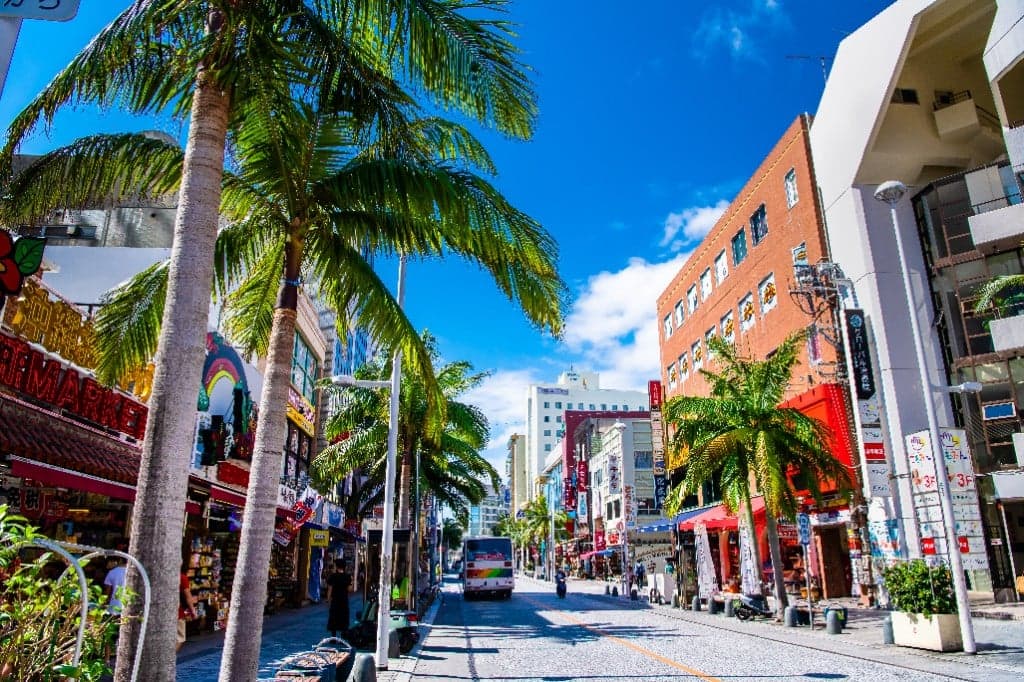
A storm day does not have to be a wasted day. Arcades, aquariums, and shopping centres cluster within walking distance of Kokusai-dori in central Naha, and the Churaumi Aquarium up north is the marquee option once travel is safe again. Shuri Castle and the prefectural museum round out an easy indoor day.
Staying Safe
If a storm is bearing down, stay inside your hotel; lobby and lower floors are safest. Stock food, water, and any medication at least 24 hours ahead — convenience stores and supermarkets sell out fast — and keep your passport, insurance documents, and some cash in a waterproof bag. Charge every device and battery while the power is on, watch the JMA track, and contact your airline and rental company early if you think your flight is at risk.
Common Mistakes Travellers Make
- Booking non-refundable resort packages for August. The February price looks great for a reason.
- Treating "Okinawa" as one place. A storm can shut down Ishigaki while Naha stays sunny — check the island's forecast, not the prefecture headline.
- Stacking outdoor days back-to-back. If four of your five days are beach and snorkelling, one storm erases most of the trip. Fold in Shuri Castle, the aquarium, or a museum day.
- Driving through a warning. When a Typhoon or Special Warning is in force, most rental firms prohibit driving and you are liable for any damage — and it is genuinely dangerous.
- Skipping the return-flight buffer. If your last night is on Ishigaki and you fly home via Naha the next morning, one cancelled inter-island hop can cost you the international connection. Sleep in Naha before the flight out.
Two Sample Itineraries
The Cautious August Trip
Fly into Tokyo. Spend four nights across Tokyo and Kyoto, then hop down to Naha for four: two on Okinawa-jima for Churaumi, Kokusai-dori, and Shuri Castle, and two more on Miyako or Ishigaki, with a buffer night back in Naha before you fly out. If a typhoon hits the Okinawa leg, you have already banked the mainland; if it hits the mainland leg, Okinawa is untouched.
The Flexible October Trip
Fly straight into Naha. Five nights in the southern islands with a rental car and refundable hotels, then fly to Osaka for six nights across Osaka, Kyoto, and a Hiroshima day trip. October means lower approach risk, less humidity, and usually the clearest skies of the year in Okinawa.
How Okinawa Compares to the Rest of Japan
For perspective, here is where Okinawa sits against the rest of the country.
Rough hierarchy of typhoon exposure for trip planning
| Region | Approaches / Year | What It Means |
|---|---|---|
| Okinawa & the Yaeyama Islands | ~7.7 | Japan's highest-risk zone |
| Kyushu (Kagoshima, Fukuoka) | High | Second-most exposed region |
| Pacific coast of Honshu (Tokyo, Osaka, Nagoya) | ~3–4 | Usually just heavy rain and transit delays |
| Sea of Japan coast, north of Niigata | Low | Largely sheltered |
| Hokkaido | Lowest | Rarely takes a direct hit |
The single highest-risk geography is Okinawa and the Yaeyamas; the lowest is the Sea of Japan side north of Niigata. A Tokyo–Kyoto–Osaka circuit almost always finishes on schedule even in September, so if you are travelling with someone anxious about storms, an inland mainland loop is genuinely low-risk. For the full national breakdown, see our Japan typhoon season 2026 guide.
Want a typhoon-aware Okinawa itinerary?
We design self-guided trips that work with the season — flexible island legs, indoor-friendly backup days, and south-first or north-last sequencing — without locking you into a group tour. Tell us your dates and we'll tell you the smartest split.
Planning Your Self-Guided Okinawa Trip
This is exactly the trade-off self-guided travel handles better than a group tour. A packaged coach cannot swap your Ishigaki nights for an extra day in Kyoto when a Bavi-style system rolls in. You can.
If you would rather not stitch together the JMA tracker, refundable-hotel searches, ferry timetables, and typhoon-aware sequencing yourself, that is what selfguidejapan.com is built for — routes designed to bend with the weather, with the flexibility left in your hands. When you are ready to sketch out dates, get in touch and we'll map out a typhoon-aware plan around your exact trip.
FAQ
When does typhoon season start and end in Okinawa?
It generally runs May to October, with occasional storms outside that window, and the peak is August and September. If your dates fall between late October and early June, you are effectively in the calm period.
Has 2026 been worse than average so far?
It opened early — six typhoons had formed by late May, about three above the normal pace — and forecasters (including TSR) call for an above-average basin. Sinlaku reached Category 5 in April, Jangmi struck Okinawa in early June, Bavi passed through the Sakishima islands in July, Dolphin closed Naha Airport on August 7, Saudel crossed the islands on August 25–26, and Krovanh looped around Okinawa for a week from September 1.
Is October safe for an Okinawa trip?
Statistically much safer than August or September. Approach frequency drops to roughly one a month, and Naha averages its sunniest, clearest weather of the year. Carry travel insurance anyway — late-season storms still happen.
What happens to my flights if a typhoon hits?
Airlines usually cancel 12 to 24 hours ahead. If the airline officially cancels, you can typically rebook without a fee, and most Okinawa rental firms will waive their cancellation charge if you show the airline's cancellation certificate. Ferries cancel earliest, sometimes a day or two out.
Are the outer islands riskier than the main island?
The Yaeyamas (Ishigaki, Iriomote, Yonaguni) and Miyako sit further south, closer to the typhoon corridor, so they catch hits the main island misses and vice versa. Ferry cancellations there tend to be more disruptive than road closures on Okinawa-jima.
Can I still dive or snorkel after a typhoon passes?
Often yes, and often better than before. Give the sea 24 to 48 hours to settle; post-storm visibility can be exceptional. Local dive shops make the call based on the actual conditions on the day.
Plan an Okinawa Trip That Bends With the Weather
Skip the guesswork. We sequence your islands, keep the bookings flexible where it matters, and build in the buffer days — so a passing storm costs you an afternoon, not the whole trip.
Typhoon approach normals, the 2026 seasonal outlook, and the storm details above draw on JMA climate normals plus forecaster and news reporting current at the time of writing, and are subject to change — always confirm the latest track on JMA before you travel. Last updated: September 7, 2026.
Related Articles
Narita vs Haneda (vs Kansai): Which Airport to Fly Into for Japan — Transfer Times, Costs & the New 2027 US Nonstops
15 min read

Japan Typhoon Season 2026: Aug–Sep Peak — Should You Cancel? (Month-by-Month Risk)
15 min read
Kyushu Typhoon Season 2026: A Practical Planning Guide for Self-Guided Travelers
12 min read