
Tokyo Fireworks Festivals 2026: Sumida, Katsushika & Edogawa Dates + Viewing Spots
Tokyo's 2026 summer shows are done. Omagari (29 Aug) and Tsuchiura (7 Nov) are still ahead — plus every Tokyo date, station access, free viewing spots and paid-seat realities for planning 2027.
Last updated: 2026-06
Looking for a Tokyo fireworks festival in 2026? Here's the short version: the next big one is the Sumida River Fireworks on Saturday, July 25, followed by Katsushika on July 28, then a double-header on August 1 (Edogawa and Itabashi, same night, opposite sides of the city) and the all-ticketed Jingu Gaien show on August 8. Every one of them is reachable on a regular metro ticket, and most are free if you claim ground early.
This page covers only Tokyo. For Nagaoka, Omagari, and the national calendar, see our full Japan fireworks 2026 guide. Below you'll find each Tokyo festival's confirmed date, the stations that actually work, free viewing spots locals use, and what paid seats cost when they exist.
Quick Answer: Tokyo Fireworks 2026
Tokyo's 2026 summer season is over. Sumida River (Jul 25), Katsushika (Jul 28), Edogawa and Itabashi (Aug 1) and Jingu Gaien (Aug 8) have all been held, as has Adachi back on May 30. Two of Japan's three great competitions are still ahead this year: Omagari, Saturday 29 August in Akita, and Tsuchiura, Saturday 7 November in Ibaraki. Tokyo's 2027 dates are published from around March.
Next Show
Omagari 8/29
Biggest
~20,000 shells
Then
Tsuchiura 11/7
Cost
Mostly free
Tokyo Fireworks 2026: The Schedule at a Glance
Confirmed 2026 dates for Tokyo's major hanabi taikai
| Date | Festival | Location | Shells | Paid Seats |
|---|---|---|---|---|
| Sat Jul 25 | Sumida River Fireworks | Asakusa / Kuramae | ~20,000 | Yes + free banks |
| Tue Jul 28 | Katsushika Noryo (60th) | Edogawa riverbank, Shibamata | ~20,000 | Yes + free banks |
| Sat Aug 1 | Edogawa Fireworks | Edo River, Tokyo/Chiba border | ~14,000 | Yes + free banks |
| Sat Aug 1 | Itabashi Fireworks (67th) | Arakawa, near Toda Bridge | ~13,000 | Yes + limited free |
| Sat Aug 8 | Jingu Gaien Fireworks | Jingu Stadium, central Tokyo | ~10,000 | Ticket-only |
| Sat May 30 | Adachi Fireworks (held) | Arakawa riverbank | ~13,000 | 2027 next |
All evening shows run roughly 19:00–20:30. One hard rule for all of them: bad weather usually means cancellation, not postponement (Jingu Gaien is the exception — it slides to August 9). Check the official site the morning of, and keep our typhoon season guide in mind for early-August dates.
Sumida River Fireworks — Saturday, July 25, 2026
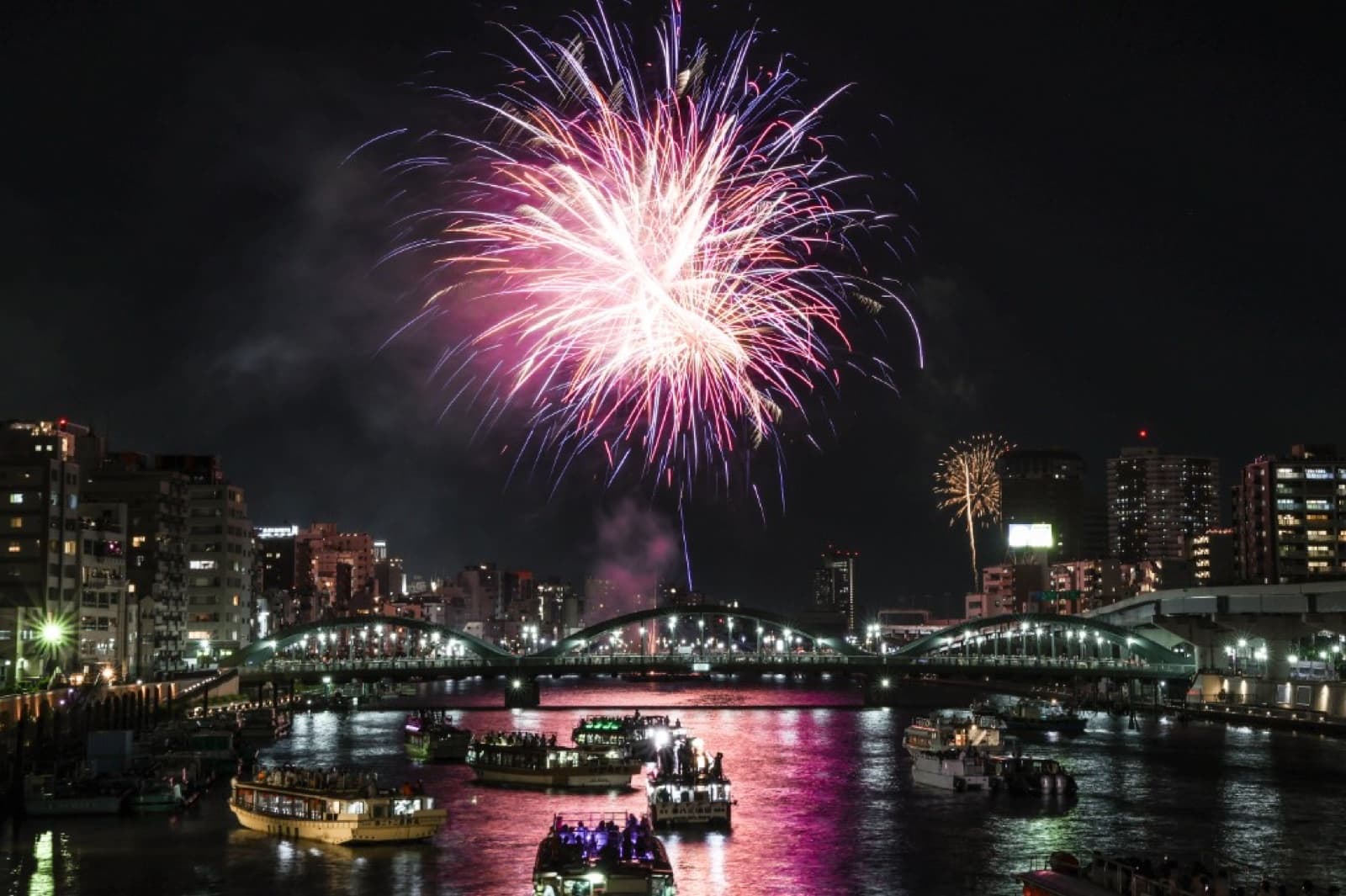
The headliner. Dating back to the Edo period and held every last Saturday of July, the Sumida River Fireworks Festival fires roughly 20,000 shells in 90 minutes (19:00–20:30) from two launch sites: the Sakura Bridge area (Venue 1, ~9,350 shells) and the Komagata Bridge area (Venue 2, ~10,650 shells), both near Asakusa. The image everyone chases — fireworks bursting beside an illuminated Tokyo Skytree — is real, and it's why nearly a million people pack the riverbanks.
Access
Venue 1: about 15 minutes on foot from Asakusa Station (Ginza Line, Hibiya Line via Tobu, Toei Asakusa Line, Tobu Skytree Line). Venue 2: about 5 minutes from Kuramae Station on the Toei Asakusa Line. Every entrance will be heaving — pick your station before you leave the hotel and commit.
Free Spots vs Paid Seats
The riverbanks are free, and paid reserved seating is sold along the river (recent sponsor-seat pricing has run from roughly ¥7,000 for a single chair to about ¥25,000 for a five-person sheet area — confirm on the official site when 2026 sales open). For a calmer free view, head toward the Skytree side: Shiori Park has a distant line on one launch site, and the north end of Oyokogawa Water Park near Honjo-Azumabashi Station is a quieter local pick.
Why pick Sumida
- • The Skytree backdrop — Tokyo's most photogenic hanabi
- • Easiest access of any festival on this list
- • Asakusa's food stalls and yukata crowds all afternoon
The trade-off
- • The biggest crowds in Japan's fireworks calendar
- • Real riverside spots gone by mid-afternoon
- • Buildings block views on many streets — scout first
Crowd advice: arrive by 15:00–16:00 for a genuine riverside spot, spend the wait at Senso-ji, and after the finale let the first wave of the crowd go — Asakusa's izakaya are a far better holding pattern than a 40-minute platform queue.
Katsushika Noryo Fireworks — Tuesday, July 28, 2026
Three days after Sumida, the 60th Katsushika Noryo Fireworks Festival launches around 20,000 shells from the Edogawa riverbank by Shibamata — matching Sumida's scale with a fraction of the international crowd, partly because it falls on a weekday. The setting is old shitamachi Tokyo: you walk to the river through Shibamata's retro temple street, past Shibamata Taishakuten, with food stalls the whole way.
Access
About 10 minutes on foot from Shibamata Station (Keisei Kanamachi Line). From central Tokyo, ride the Keisei Main Line to Keisei-Takasago and change to the one-stop Kanamachi branch. It's further out than Asakusa, which is exactly why the atmosphere stays local.
Free Spots and Paid Seats
The riverbank is free and wide — even arriving 1–2 hours ahead usually gets you a workable patch on the grass, though closer means earlier. Reserved seats facing the launch area have recently sold for roughly ¥2,000–¥3,500 per seat — the cheapest paid hanabi seats of Tokyo's majors — with general sales typically opening mid-June and selling out within days. If you want a guaranteed close-up for the least money, this is the festival to book.
Crowd advice: being a Tuesday show, the rush builds late as locals arrive after work. Get there before 17:30, eat your way down the temple street, and you'll be settled before the first shell at 19:20.
Edogawa Fireworks — Saturday, August 1, 2026
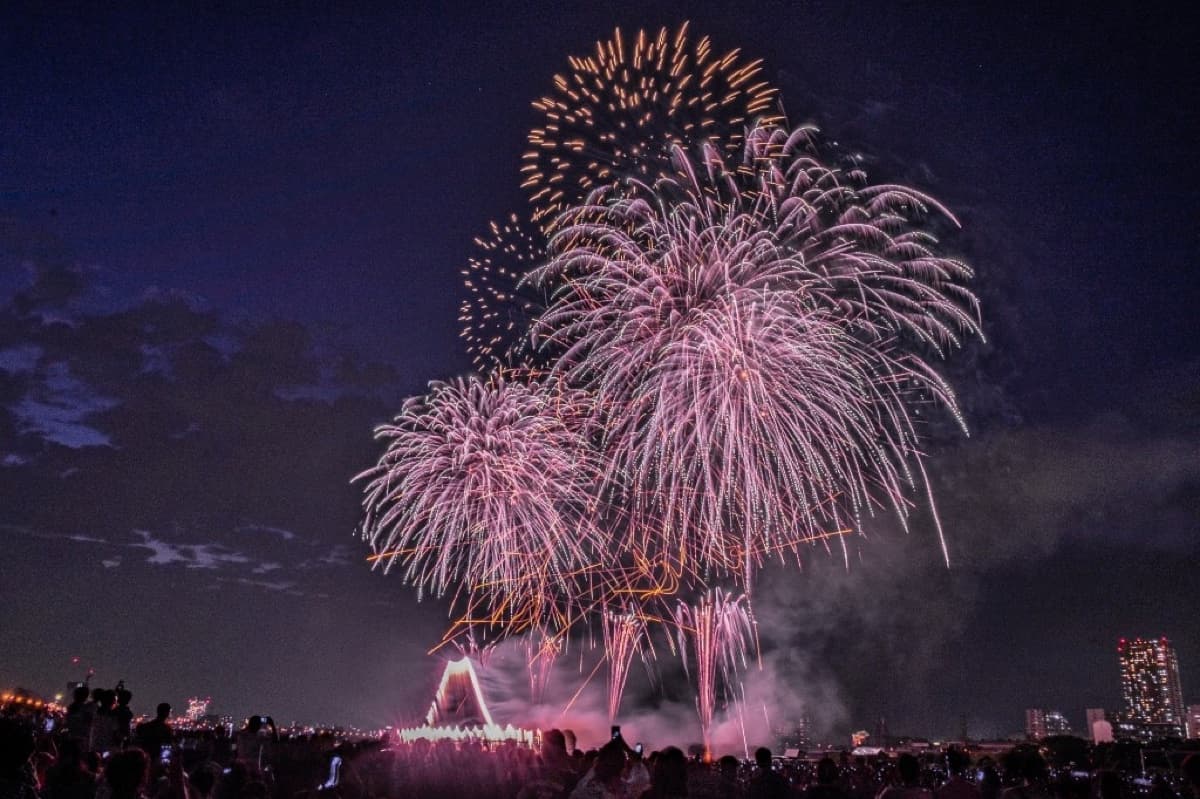
The one locals rave about. Held on the Edo River where Tokyo meets Chiba, it's effectively two shows at once — Edogawa-ku on the Tokyo bank, Ichikawa City on the Chiba side, trying to outdo each other across the water with around 14,000 shells from 19:15 to 20:20. The opening is the stuff of legend: 1,000 fireworks in the first five seconds, then eight themed segments capped by the record-breaking "Mt. Fuji" display. Over a million spectators, all watching for free.
Access
A 25-minute walk from JR Koiwa Station (Sobu Line) or 15 minutes from Shinozaki Station (Toei Shinjuku Line). Both routes turn into slow rivers of people after 17:00 — build that into your timing.
Free Spots and Mat Rules
The grass banks are enormous and free, but picnic-mat politics are serious: sheets may only be placed from the afternoon of the day before, and anything earlier gets removed by security patrols. Arrive by mid-afternoon on the day and you'll still find a fair spot — the bank is long, so walking five extra minutes upstream thins the crowd noticeably.
Crowd advice: do not sprint for Koiwa or Shinozaki at the finale. Sit for 30 minutes, then walk to the next station along the line. The crush at the two nearest stations is the worst part of an otherwise brilliant night.
Tokyo Tours That Fit a Hanabi Night
View all →Itabashi Fireworks — Saturday, August 1, 2026
Same night as Edogawa, opposite corner of Tokyo. The 67th Itabashi Fireworks Festival fires about 13,000 shells from 19:00 to 20:30 over the Arakawa near Toda Bridge — and like Edogawa, it's a twin event, with Toda City's Todabashi Fireworks running simultaneously on the Saitama bank. One ticket-friendly tip: reserved seats (recently around ¥4,500–¥6,000) go on sale in mid-June, so 2026 sales open almost immediately — book now if you want a seat.
Access and Free Viewing
About 20 minutes on foot from Ukima-Funado Station (JR Saikyo Line) — though one-way pedestrian routing on the night can stretch that well past an hour at peak. For the free areas, locals favor Takashimadaira Station (Toei Mita Line) instead. Free space has been trimmed in recent years to the upstream/west side of the venue and fills hours before launch, so treat Itabashi as an arrive-early or buy-a-seat event.
August 1 Dilemma: Edogawa or Itabashi?
Pick Edogawa for scale, the five-second 1,000-shell opening, and generous free banks. Pick Itabashi if you're staying on the west/north side of Tokyo, or if you'd rather pay ~¥4,500–¥6,000 for a guaranteed seat than camp on grass for hours. You cannot do both — they overlap almost exactly.
Jingu Gaien Fireworks — Saturday, August 8, 2026
Tokyo's most central show and its most unusual: about 10,000 fireworks launched from inside Jingu Stadium, 19:30–20:30, set to music with live artist performances beforehand. This is the city-skyline hanabi — no riverbank, no picnic mat, stadium seats instead.
Tickets — There Is No Real Free Option
All seating — in Jingu Stadium itself or the neighboring Chichibunomiya Rugby Stadium — is reserved and paid. 2026 prices weren't published at the time of writing; 2025 tickets started from about ¥7,000. You can technically stand somewhere within a kilometer and hope for an angle between buildings, but if Jingu Gaien is your pick, buy a ticket. Unusually for hanabi, severe weather postpones this one to Sunday, August 9 rather than cancelling it.
Access
About 5 minutes on foot from Shinanomachi Station (JR Chuo-Sobu Line) or National Stadium Station (Toei Oedo Line) — the easiest access of any show on this page. Gates open mid-afternoon, with music from late afternoon, so it works as a full evening out.
Adachi Fireworks: Already Held (May 30) — Mark 2027
Searching for Adachi hanabi 2026? The 48th edition was Tokyo's season opener and has already passed: it was held Saturday, May 30, 2026, 19:20–20:20, with about 13,000 shells over the Arakawa riverbank, a 20-minute walk from Kitasenju Station. The festival moved from July to late May to dodge heatstroke season — a real consideration, as our Japan heatwave 2026 guide explains.
Two takeaways for planners: first, if you're visiting in late May 2027, pencil Adachi in — it's the rare big hanabi you can see in mild weather. Second, a weather warning: Adachi was cancelled outright in both 2024 and 2025 due to storms, so never build a trip around any single fireworks date.
How to Plan a Tokyo Fireworks Night
The Timeline That Works
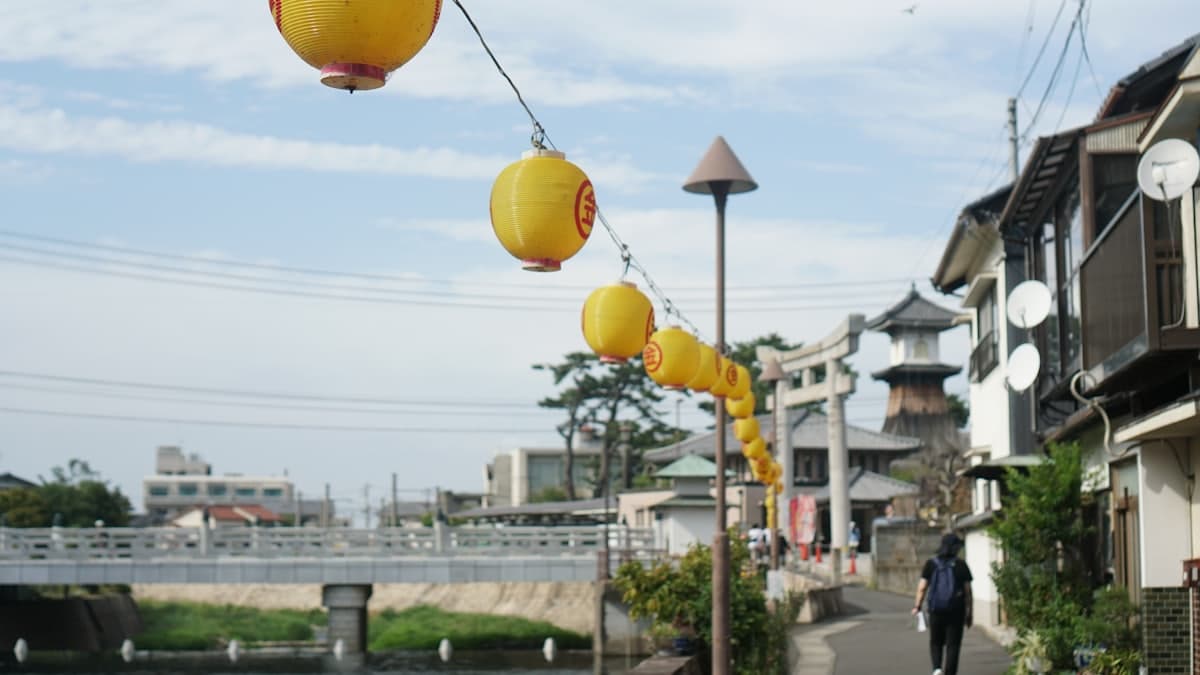
15:00–16:00: arrive at the area, claim ground with a cheap tarp from a 100-yen shop. 16:00–18:30: food stalls, shrine visit, konbini run for drinks and ice. 19:00ish: first shells. After the finale: wait 30 minutes, then walk one station further than the obvious one. That last move is the single best crowd hack in this article.
Pack Smart, Beat the Heat
Late July and early August evenings in Tokyo stay hot well after dark. Bring water (more than you think), a hand fan, mosquito repellent, snacks, a small flashlight, and trash bags — bins are rarely provided, and carrying your rubbish home is the rule. A yukata rental in Asakusa adds a lot for not much money, especially for Sumida.
Build It Into a Bigger Trip
A fireworks night slots neatly into a standard first-timer route — see our 7-day Japan itinerary for the skeleton. Around these dates Tokyo is in full festival mode: our guides to Japan in July 2026 and Japan in August 2026 cover what else is on, the summer festivals roundup maps the matsuri calendar, and if you're traveling into mid-August, check our Obon 2026 guide — trains and hotels tighten sharply that week. In Kansai that same window? Osaka's Tenjin Matsuri (July 24–25) ends with its own river fireworks — see our Tenjin Matsuri 2026 guide.
Summer-Ready Self-Guided Tours
Flexible itineraries with free evenings — easy to drop in a hanabi night.
Thinking of timing a summer trip to Tokyo around the fireworks festivals? Get in touch through Plan My Trip on our self-guided tours site, and we’ll suggest the tours that best fit your dates and plans.
FAQ: Tokyo Fireworks Festivals 2026
What is the next fireworks festival in Tokyo in 2026?
The Sumida River Fireworks Festival on Saturday, July 25, 2026, 19:00–20:30 — about 20,000 shells launched near Asakusa. After that: Katsushika on July 28, Edogawa and Itabashi on August 1, and Jingu Gaien on August 8.
Are Tokyo fireworks festivals free?
Mostly yes. Sumida, Katsushika, Edogawa, and Itabashi all have free riverbank viewing if you arrive early; each also sells paid reserved seats. Jingu Gaien is the exception — it is effectively ticket-only, with all seating reserved and paid.
Which Tokyo fireworks festival is best for first-time visitors?
Sumida River, for the Tokyo Skytree backdrop and easy Asakusa access — if you can handle the biggest crowds of the season. If you would trade the famous skyline for breathing room, Katsushika (July 28) offers a comparable 20,000-shell show with a far more local feel.
What happens if it rains on a fireworks night?
Most Tokyo hanabi are cancelled rather than postponed — Adachi's show was lost to weather in both 2024 and 2025. Jingu Gaien is the outlier: severe weather pushes it to the next day (August 9 in 2026). Always check the official site the morning of the event.
Do I need to book paid seats in advance?
Yes — weeks ahead. Katsushika's reserved seats (roughly ¥2,000–¥3,500) and Itabashi's (roughly ¥4,500–¥6,000) go on sale in mid-June and sell out fast; Jingu Gaien's stadium tickets (from about ¥7,000 in 2025) also move quickly. Free riverbank viewing needs no booking, just a 2–3 hour early arrival.
Self-Guided Tours for Fireworks Season
Tokyo-centric routes (GR001, GR009) with evenings free for Sumida or Edogawa, plus TH001 and TH002 for travelers anchoring a longer summer trip around festivals.
Destinations Mentioned in This Article
Related Articles
Sumida River Fireworks Festival 2026: A Self-Guided Traveler's Playbook
11 min read
Edogawa Fireworks Festival 2026: A Self-Guided Traveler's Guide to Tokyo's Biggest August Hanabi Night
13 min read
Japan Fireworks 2026: Your Self-Guided Guide to the Best Hanabi Taikai
14 min read