
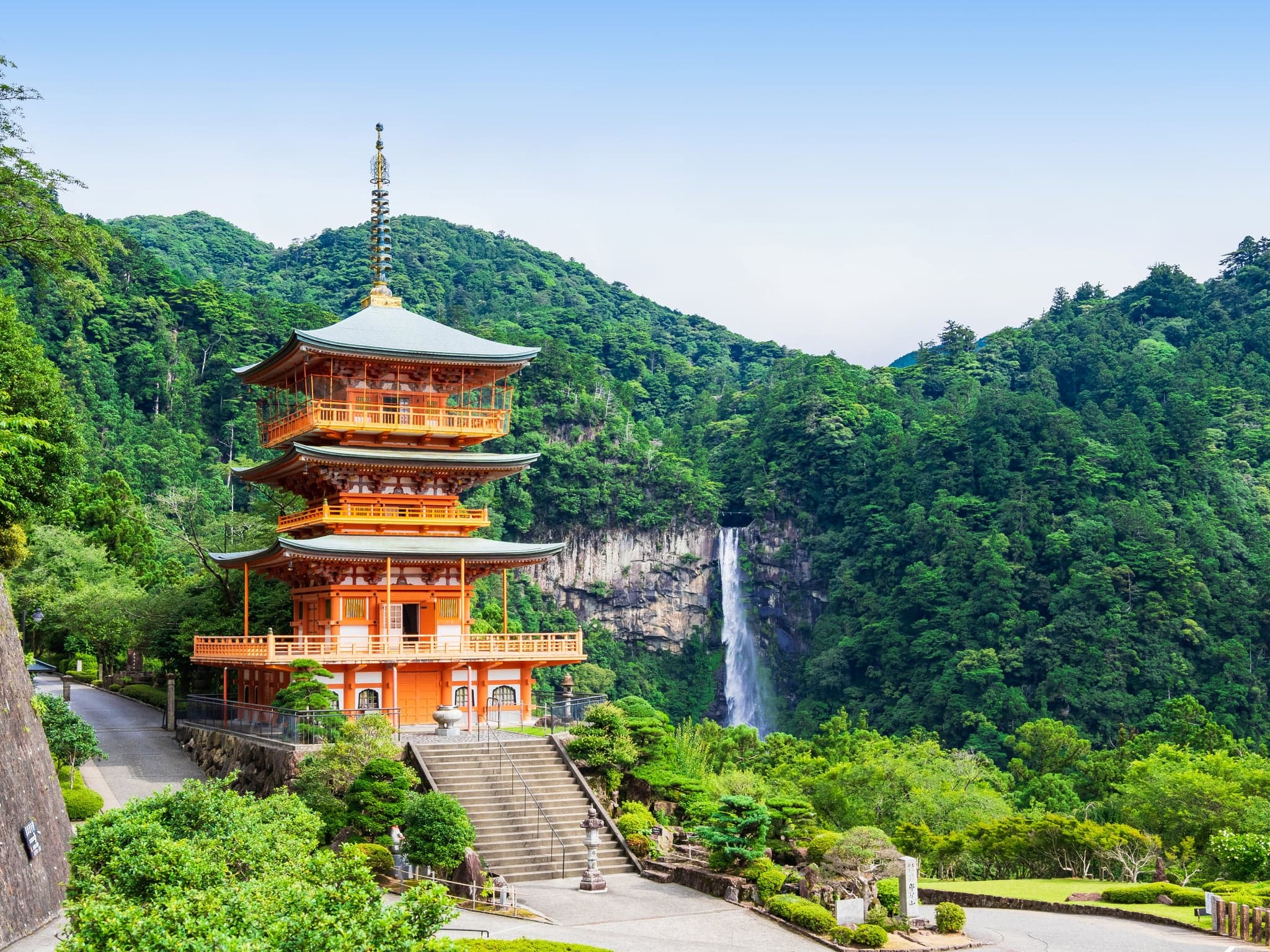
Walking Japan: The Complete Guide to Self-Guided Walking Tours
Kumano Kodo, Nakasendo, Michinoku Coastal Trail — how self-guided walking tours actually work, what a typical day looks like, and which route matches your fitness level.
The best version of Japan isn't visible from a bullet train window. It's the cedar-lined mountain paths of the Kumano Kodo pilgrimage, the Edo-period post towns of the Nakasendo Way, the rice fields and fishing villages of the Michinoku Coastal Trail.
Walking Japan is how you discover the country beyond Tokyo and Kyoto — the rural Japan where elderly farmers offer you tea and mandarins, where natural hot spring baths wait at the end of every hiking day, and where Japanese culture reveals itself slowly, one mountain pass at a time.
🥾 Quick Answer: Self-Guided Walking Tours
You walk independently on a fully planned route. Accommodations pre-booked, your big case forwarded ahead on two or three named days, GPS navigation provided, 24h English support by phone. Walk 8–25km/day depending on fitness. Onsen ryokan most nights. Roughly $260–560 per person per day, depending on route and season.
🗺️ Navigation
GPS app + offline maps
🧳 Luggage
Transferred daily
♨️ Stay
Onsen ryokan nightly
💴 Cost
~$260–560/day
What Is a Self-Guided Walking Tour in Japan?
A self-guided walking tour gives you a fully planned route — accommodations booked, luggage transferred between stops, detailed navigation provided — but you walk alone (or with your own travel companions) at your own pace. No tour group. No guide walking ahead of you. Just you, the trail, and the Japanese countryside. For the city-to-city version of the same format — hotels and Shinkansen booked, days free — see how self-guided Japan tours work. If you are over 60 and want the honest walking load of each route before you commit, see our guide to Japan tours for seniors.
Pre-booked accommodations at traditional inns (ryokan, minshuku, guesthouses) along the route
Luggage forwarding — your suitcase is sent ahead on the transfer days your itinerary names, so you walk with just a daypack
GPS route app with turn-by-turn navigation, waypoint photos, and distance markers
Detailed route notes: each day's walking distance, elevation, estimated time, lunch options
24-hour emergency phone support in English from local guides who know every km of the trail
Rail tickets or bus passes for any non-walking transport segments
You're independent but never abandoned. If you take a wrong turn, the app redirects you. If you twist an ankle, you call the support line and they coordinate pickup. If you want to skip a hard section and take the bus instead, the route notes tell you exactly how.
A Day on a Japan Walking Tour (Hour by Hour)
Breakfast at your ryokan
Full Japanese spread: grilled fish, miso soup, rice, pickled vegetables, tamagoyaki. More food than you think you need. You'll be grateful by noon.
Luggage handoff
Leave your suitcase at the front desk with the pre-filled shipping label. The inn staff handle the rest — your bag arrives at tonight's accommodation by mid-afternoon. Walk out with a daypack: water, rain jacket, snacks, phone.
Start walking
Open the route app, confirm your position on GPS. The path leads through a village, past a Shinto shrine with moss-covered lanterns, and into the forest.
Mountain pass
A small tea house (or at least a vending machine — they're everywhere in Japan). Hot coffee, ¥130. Sit on a bench overlooking a valley of cedar trees. No one else is here.
Lunch in a small town
One soba noodle shop and a family-run café. Handmade buckwheat noodles with mountain vegetables, ¥900. On days with no restaurant, the notes warn you to grab onigiri from the last convenience store.
Arrive at today's inn
~15km walked. Elevation gain: +400m. Your suitcase is already in the room. The innkeeper shows you to the hot spring baths.
Onsen
Soaking in a hot spring after a day of walking through the mountains is the single greatest physical sensation in travel. Your legs stop aching within minutes.
Dinner
A multi-course meal: river fish, wild mountain herbs, handmade tofu, seasonal specialties. Japanese cuisine at its most regional and authentic.
Futon. Lights out.
Tomorrow you do it again.
Best Walking Routes in Japan
⛩️ Kumano Kodo Pilgrimage Trail
38km over 3–4 days • UNESCO World Heritage • Moderate
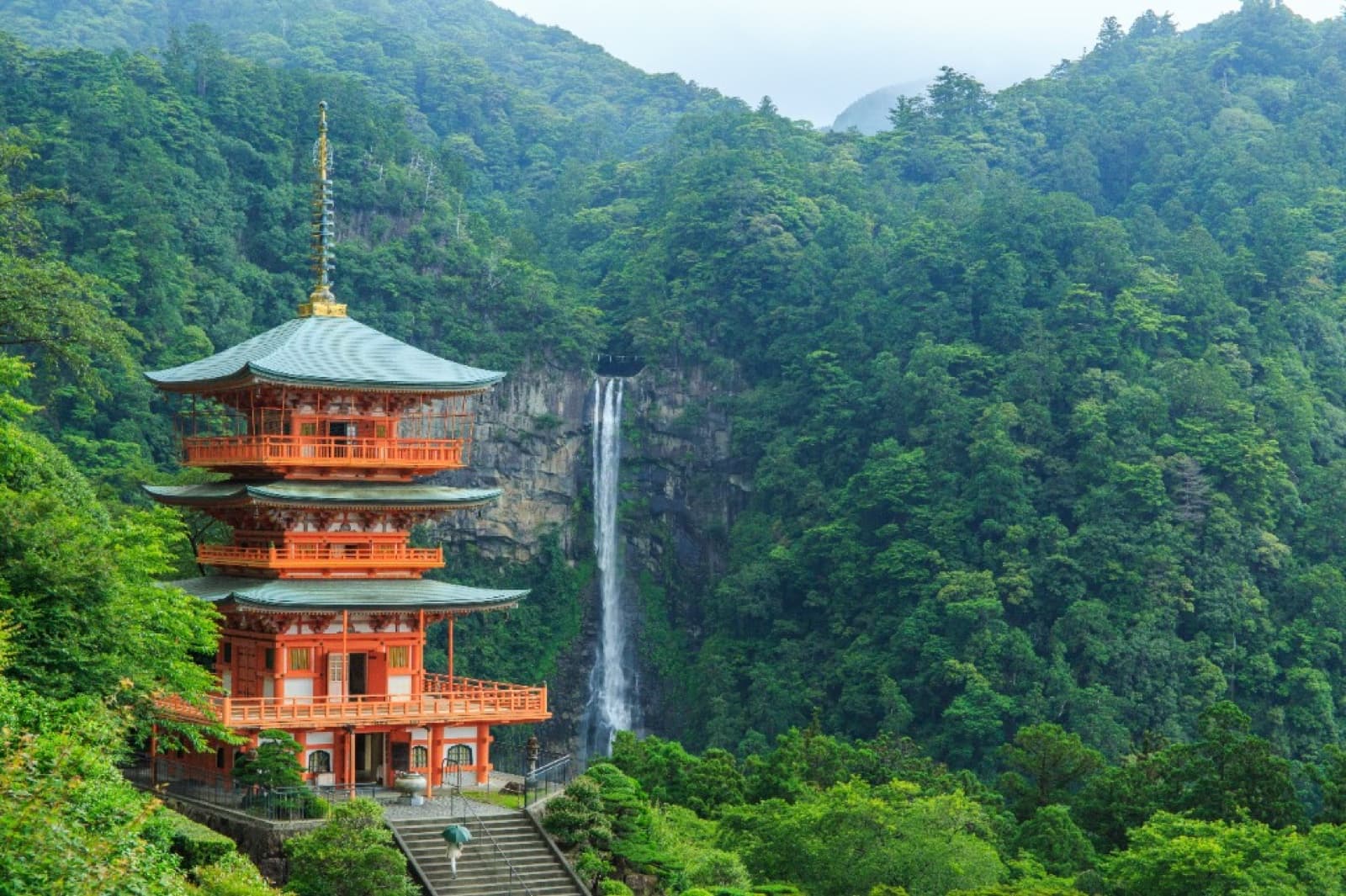
The most famous walking route in Japan. This ancient pilgrimage network on the Kii Peninsula has been walked for over 1,000 years — one of only two pilgrimage routes in the world with UNESCO World Heritage status (the other is the Camino de Santiago).
The Nakahechi Route is the classic path: dense forest, waterfalls, ending at the grand Kumano Hongu Taisha shrine. The trail is well-maintained with stone steps and cedar-lined paths, though the constant stairs make it harder on the knees than the distance suggests.
Highlight: Hosshinmon-oji to Kumano Hongu — downhill 3-hour walk even beginners enjoy
Toughest: Ogumotori-goe pass (+800m in one day). Bus skip available.
Best: Apr–May, Oct–Nov. Avoid Jun–Aug (heat + leeches). Accommodation: mountain onsen ryokan. Yunomine Onsen is UNESCO World Heritage.
🏯 Nakasendo Way: The Kiso Valley
60km over 4–5 days • Edo-period post towns • Beginner–Moderate
One of Japan's five great Edo-period highways, connecting Kyoto to Tokyo through the mountains. The Kiso Valley section preserves post towns that look almost exactly as they did 300 years ago.
The highlight: The 8km Magome → Tsumago walk over Magome Pass (2–3 hours). The single most popular day walk in Japan for visitors. Walk from Magome to Tsumago (not the reverse) — it's mostly downhill this direction.
Insider tip: Magome's tourist office runs a same-day luggage transfer to Tsumago in the walking season — you do not need a package to use it, and most visitors don't know it exists. Confirm the fee and the operating dates with the office before you rely on it.
Accommodation: historic inns in Narai-juku and Tsumago (5–8 rooms, book ahead for October). Samurai-era architecture, futon sleeping, kaiseki dinners.
🌊 Michinoku Coastal Trail
3–5 day highlight sections • Tohoku coast • Moderate–Strong
Japan off the beaten path — rebuilt fishing villages, dramatic sea cliffs, and almost zero foreign tourists. Created after the 2011 earthquake and tsunami as a path of recovery and remembrance.
The food advantage: Sanriku coast seafood is twice the size and half the price of Tokyo. Sea urchin bowls for ¥2,000. Fresh oysters pulled from the bay that morning.
Accommodation: minshuku (family-run guesthouses). English rarely spoken — this is where having a self-guided package with pre-booked stays and English route notes makes the difference.
🛕 Shikoku Pilgrimage (Highlights)
5–7 day curated sections • 88-temple circuit • Moderate
The full 88-temple circuit runs over 1,400km and takes six to eight weeks on foot — 25–33km a day, sustained, at or above the top of the Strong band in the fitness table below. Self-guided tours cover curated highlight sections — the most scenic temples, mountain forests, crystal clear waters, with transport between distant sections. Pilgrimage walking combined with cultural heritage discovery.
Self-Guided vs Guided: Which Is Right for You?
| Self-Guided | Guided Group | |
|---|---|---|
| Pace | Yours. Stop when you want. | Group's average speed |
| Freedom | Detour to a café, linger at a viewpoint | Fixed schedule |
| Group size | Solo (see our solo tours guide), couple, or your own group | 8–16 strangers |
| Navigation | GPS app + route notes + 24h phone | Guide leads the way |
| Luggage | Both: transferred between inns | |
| Price | ~$260–560/day | Typically 1.5–2× self-guided |
| Best for | Quiet immersion, independence | First-timers wanting company |
Most of our Japan walking trips are self-guided because that's what walkers actually prefer — the silence, the independence, the feeling of discovering rural Japan on your own terms. But if you want a local guide for specific days (a historian at Kumano Kodo, a naturalist in Tohoku), we can arrange that too.
Fitness Levels: How Hard Is Walking in Japan?
| Level | Daily Distance | Recommended Route |
|---|---|---|
| Beginner | 8–12km | Nakasendo / Kiso Valley — mostly paved, one pass |
| Moderate | 12–18km | Kumano Kodo Nakahechi — well-maintained, lots of stairs |
| Strong | 18–25km | Michinoku Coastal Trail, highland routes |
💡 You Don't Have to Walk Every Day
Self-guided tours often include rest days — travel by train to the next region, explore a castle town, soak in hot springs. The hybrid approach (walk 3 days, rest 1 day, walk 2 days) is one of the biggest advantages over rigid group tours that march every single day.
Walking poles are recommended for any route with significant elevation. Japanese mountain paths often involve uneven stone steps that are harder on knees than flat trails of equivalent distance.
What's Included in a Self-Guided Walking Holiday
🧳 Luggage & Accommodations
Your suitcase travels ahead on Japan's nationwide takkyubin courier network rather than inn to inn every morning: the itinerary names the two or three transfer days, and you keep a small overnight bag for the nights in between. Long hauls run next-day or later, so you and the case travel apart for a day or two. Walk with a 3–5kg daypack. Accommodations range from onsen ryokan with kaiseki dinners to simple minshuku. Breakfast is included daily and dinner on several nights; most lunches are extra. Dietary needs accommodated with advance notice.
📱 Route App & 24h Support
GPS app works offline — critical in rural Japan where signal drops in mountain valleys. Shows your position, distance to next waypoint, elevation profile, and photos of tricky junctions. 24-hour English phone support connects you to local guides who can coordinate transport, medical help, or alternative plans.
Best Time for Japan Walking Trips
🌸 Spring (Mar–May)
April and May are the best overall window. Cherry blossoms on the trails, mild weather, clear skies. Kumano Kodo and Nakasendo at their peak. March is the shoulder: JMA's 1991–2020 normal blossom date is March 24 in Wakayama but April 11 in Nagano, so late March can catch blossom on the Kii Peninsula while the Kiso Valley is still bare.
🍁 Autumn (Sep–Nov)
Typhoon season peaks in August and September — leave a spare day, as trains stop while a storm passes. Mountain foliage follows in October–November, spectacular in the Kiso Valley and highland routes. October is busiest — book 3–4 months ahead.
☀️ Summer (Jun–Aug)
Tsuyu, the rainy season, covers the first half — JMA's 1991–2020 normals put it at about 6–7 June to 19 July in Kinki and Kanto-Koshin, later in Tohoku. After it lifts, lowland routes are hot and humid; mountain trails stay refreshing for the fit. Avoid Kumano Kodo all summer (leeches and heat).
❄️ Winter (Dec–Feb)
Snow closes many mountain trails. Some coastal routes remain walkable. Beautiful but requires experience and proper gear.
For more on timing, see our Best Time to Visit Japan guide.
Japanese Food on the Trail
Walking tours in Japan are secretly food tours. Every night's dinner is a discovery — wild boar stew in the Kii Peninsula mountains, fresh river trout in the Kiso Valley, a 12-course kaiseki dinner at a ryokan using only ingredients from within 30km.
Lunches on the trail range from handmade udon noodles at a village shop (¥700–1,000) to convenience store onigiri eaten on a mountain pass with a view. Both are excellent. Japanese cuisine in rural areas is seasonal, local, and nothing like city restaurant food.
🍡 Trail Snacks Worth Knowing
Mochi rice cakes from roadside stalls. Manju (sweet bean paste buns) at temple gates. And the bottomless vending machines that appear even in the most remote locations.
For more food tips, see our Japan Street Food Guide and What Is a Ryokan? guide.
Walking Tours in Japan: FAQ
What happens if I get lost or injured on a self-guided walking tour in Japan?
The GPS app works offline — essential in mountain valleys where the signal drops — and shows your position, the distance to the next waypoint, and photos of tricky junctions, so a wrong turn is easy to correct. If something more serious happens, you call the 24-hour English phone line and local guides who know the trail coordinate pickup, medical help, or an alternative plan. To skip a hard section, the route notes tell you exactly where to catch the bus instead.
How fit do I need to be for a walking tour in Japan?
It depends on the route. Beginner is 8–12km a day on the Nakasendo through the Kiso Valley — mostly paved, one pass. Moderate is 12–18km a day on the Kumano Kodo Nakahechi, well maintained but with lots of stairs. Strong is 18–25km a day on the Michinoku Coastal Trail and highland routes. Self-guided tours often include rest days, and walking poles are recommended for any route with significant elevation: many Japanese mountain paths have uneven stone steps, harder on knees than flat trails of equivalent distance.
What is the best walking route in Japan?
There is no single best route — pick by fitness and interest. The Kumano Kodo on the Kii Peninsula is the most famous: a UNESCO World Heritage pilgrimage network walked for over 1,000 years, about 38km over 3–4 days on the Nakahechi. The Nakasendo through the Kiso Valley (60km, 4–5 days) suits beginners, with preserved Edo-period post towns. The Michinoku Coastal Trail on the Tohoku coast sees almost zero foreign tourists, and self-guided tours also cover curated 5–7 day sections of Shikoku's 88-temple pilgrimage.
When is the best time for walking tours in Japan?
Spring (April–May) is the best overall season — cherry blossoms on the trails, mild weather, clear skies, and the Kumano Kodo and Nakasendo at their peak. Autumn (October–November) is the other strong window: fall foliage in the mountains, spectacular in the Kiso Valley and highland routes. October is busiest, so book 3–4 months ahead. Summer is hot and humid on lowland routes, and the June–July rainy season is the worst of it — avoid the Kumano Kodo then (heat and leeches), though mountain trails stay refreshing for the fit. Winter snow closes many mountain trails; some coastal routes stay walkable with proper gear.
How much does a self-guided walking holiday in Japan cost?
Our self-guided walking itineraries run roughly $260–560 per person per day, twin share. The 12-day Nature & Trails: Historic Paths & Sacred Kii is $3,900–5,000 per person; the 11-day Sacred Trails & Hot Springs of the Kii Peninsula is $4,200–5,100; the 12-day Alpine Wonders of Central Japan is the priciest at $5,100–6,600. That covers hotels and onsen ryokan, breakfast daily and dinner on several nights, luggage delivery, shinkansen and limited-express tickets, the offline GPS app and route notes, and 24-hour English support. Local trains and buses, accommodation tax and most lunches are extra.
How does luggage transfer work on a walking tour in Japan?
Not every night — that is the part most people get wrong. Our itineraries include two or three luggage transfers over the whole trip, on named days: on the 11-day Sacred Trails & Hot Springs of the Kii Peninsula the case goes Tokyo to Kawayu Onsen and then Kawayu Onsen to Osaka, and the 13-day coastal route adds one leg. Long hauls run next-day or later on the takkyubin courier network, so you and the case travel apart for a day or two. Walk with a 3–5kg daypack — water, rain jacket, snacks, phone — and keep a small overnight bag for the nights in between. Your itinerary marks which days are which. On the Nakasendo, Magome's tourist office also runs its own same-day transfer to Tsumago in the walking season.
Start Planning Your Walking Tour
Japan's walking trails connect you to a side of the country most visitors never experience. Our self-guided tours handle accommodations, luggage, navigation, and support — so you can focus on the walking.
Last reviewed: August 2026. Tour prices are per person, twin share, and taken from the current catalogue; confirm on the tour page before booking.
Related: What Is a Ryokan? | 14-Day Japan Itinerary | Best Time to Visit Japan
Related Articles

BluePlanet Travel Team
Japan Travel Experts