
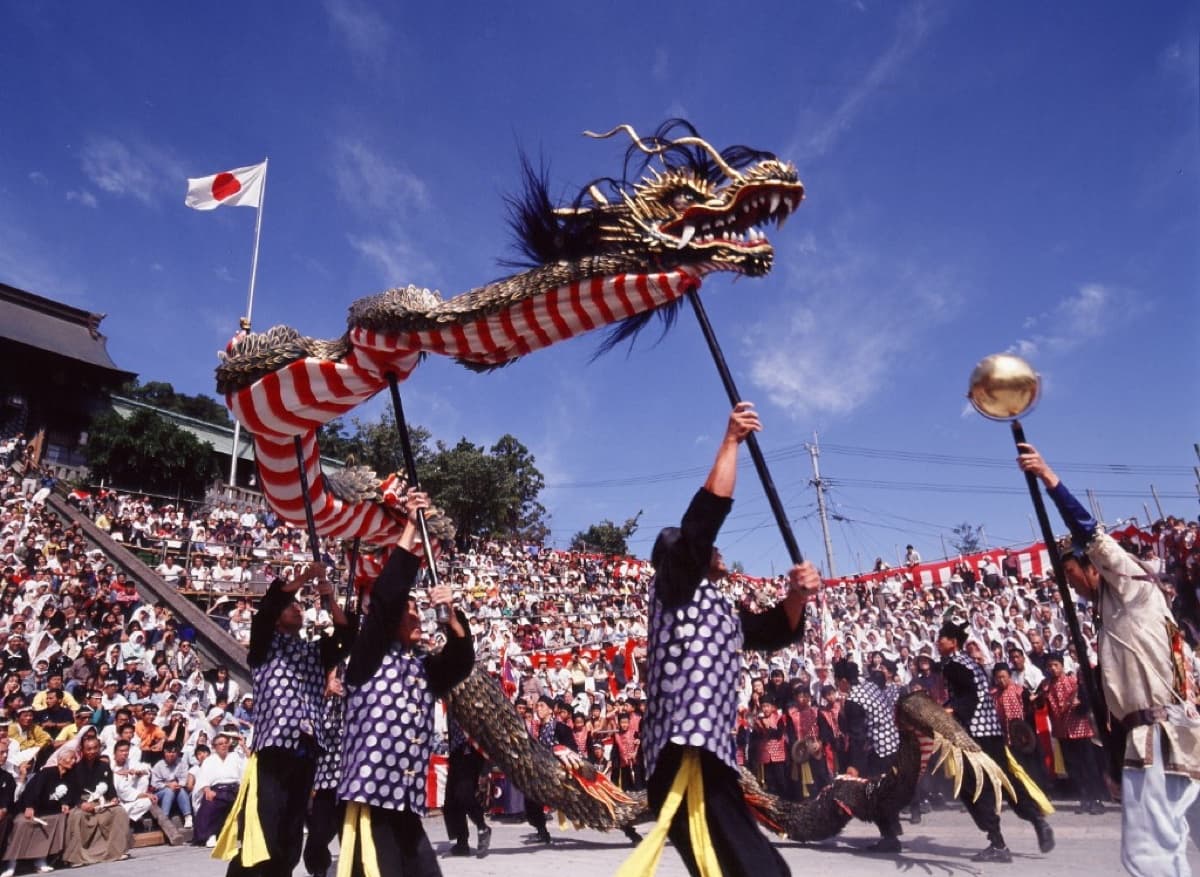
 写真提供:(一社)長崎県観光連盟
Nagasaki Kunchi 2026: How to Actually See Kyushu's Wildest Autumn Festival
October 7–9, 2026 — a Wednesday to Friday, because Kunchi never moves for the weekend. Suwa Shrine's 400-year-old festival, the dragon dance, the box seats nobody can buy, and the free street rounds that are honestly better anyway.
Nagasaki Kunchi 2026 runs October 7, 8 and 9 — a Wednesday, Thursday and Friday. The dates are fixed to the calendar, not to the weekend, and they have not moved in roughly four centuries. If you want to see it, you build the trip around those three mornings.
That is the easy part. The harder part is that almost everything written about Kunchi in English describes the ticketed grandstands at the four main stages — seats that go on sale in June through Japanese-only phone lines and sell out long before most overseas travelers have booked a flight. This guide handles both halves: what the paid seats really cost and when they go on sale, and how to have a genuinely great Kunchi with no ticket at all, following the troupes through the streets on the free niwasaki-mawari rounds. If you are shaping a wider autumn trip, our Japan in October 2026 guide sets the month in context.
🐉 Quick Answer: Nagasaki Kunchi 2026
- Dates: October 7–9, 2026 (Wed–Fri). Fixed every year — Kunchi never shifts to a weekend.
- What it is: the autumn festival of Suwa Shrine, running for about 400 years, and a designated Important Intangible Folk Cultural Property.
- Paid seats: four ticketed stages. Box seats run roughly ¥18,000–¥36,000 for a four-person box; Chuo Koen sells individual seats from about ¥4,500. Sales open June–August, mostly in Japanese.
- Free option: the niwasaki-mawari street rounds, where the same troupes perform in front of shops and homes all over the city. No ticket, no lottery, and the best thing about a self-guided Kunchi.
Nagasaki Kunchi 2026 Dates
October 7, 8 and 9, 2026. Every year, the same three dates, whatever weekday they land on. In 2026 that means a midweek festival: Wednesday, Thursday, Friday. There is no "Kunchi weekend" and there is no rain date.
The three days have names locals use constantly. October 7 is maeb — the eve, or first day. October 8 is nakabi, the middle day. October 9 is atobi, the last day. Note that October 9 is the third and final day of the festival, not "the ninth day" of anything: the name Kunchi is generally traced to ku-nichi, the ninth day of the ninth month in the old lunar calendar, which is where the festival originally sat before the calendar changed. The name stuck; the counting did not.
One practical consequence of the fixed dates: October 7 opens at 07:00 at Suwa Shrine. Not 10:00. Seven in the morning, in the dark, with the crowd already in place. Plan your first night in Nagasaki accordingly.
What Nagasaki Kunchi Actually Is
Kunchi is the annual festival of Suwa Shrine, the city's tutelary shrine, and it has been staged for roughly 400 years — the usual starting point given is 1634. The performances are collectively designated an Important Intangible Folk Cultural Property of Japan, which is the country's way of saying this is not a tourist pageant but a living civic tradition.
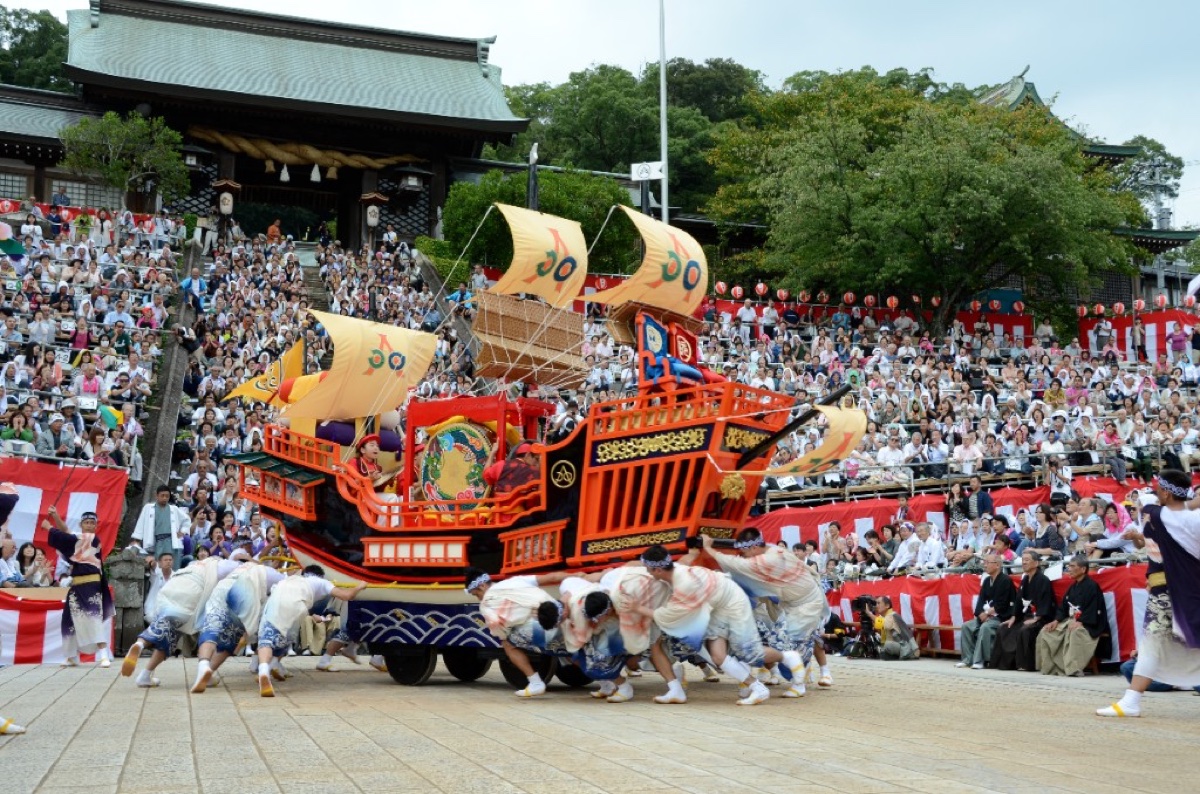
What makes it strange, in the best way, is the ingredients. For two centuries Nagasaki was Japan's only regulated window onto the outside world, trading with Chinese merchants and the Dutch at Dejima, and the festival quietly absorbed the neighbours. Over its full repertoire Kunchi includes Chinese-derived pieces such as the jaodori dragon dance — a long dragon puppet worked by a team of handlers, chasing a spinning "jewel" on a pole — alongside Dutch-flavoured set pieces like the Dutch Ship and the Dutch Comedies, and straightforward Japanese classical dance. Very few festivals in Japan look like this. None of them look like this for this reason.
💬 From our Japan travel team
Kunchi is not a fixed program that repeats every year. The city's neighbourhoods take turns: each odori-cho (dancing town) performs roughly once every seven years, and only the towns on duty appear. So the dragon dance, the Dutch Ship and the great kokkodesho palanquin are not all guaranteed in any given October — check which towns are up before you commit.
Who Performs in 2026 — and Why It Matters
Six odori-cho are on duty for 2026, and the lineup is a strong one. Local reporting on the 2026 towns lists:
- Uwamachi — Kokkodesho. A heavy decorated palanquin thrown into the air by a team of bearers and caught one-handed. It is the single most explosive thing at Kunchi, and Uwamachi has switched to it for this cycle with a newly built float.
- Chikugomachi — Jaodori (dragon dance). The signature Chinese-influenced piece, with blue and white dragons weaving after the jewel.
- Motofunamachi — Tosen Matsuri. A Chinese-ship tableau recreating the trading-port Nagasaki of the Edo period.
- Kajiyamachi — Takarabune and the Seven Lucky Gods. A treasure ship reported to weigh over five tonnes, hauled and spun by its crew.
- Aburayamachi — Kawabune. A river boat, complete with a net-caster on deck and a team of pullers spinning the hull.
- Imakagomachi — Hon-odori. Classical dance, the quiet, elegant counterweight to the boats and the dragon.
Worth being clear about, because a lot of English coverage blurs it: the Dutch Ship and Dutch Comedies are not in the 2026 lineup. They belong to towns on other years of the rotation. What 2026 gives you instead is a dragon, three heavy ships and a flying palanquin — which is not a bad trade.
The Three-Day Schedule at a Glance
Here is the shape of the festival, based on the 2026 timings published by the organisers. The important pattern to notice: the ticketed stages run in the morning (plus one evening block on October 7), and the rest of each day belongs to the streets.
🗓️ Nagasaki Kunchi, October 7–9, 2026
| Day | Venue / time | What happens | Paid or free |
|---|---|---|---|
| Oct 7 (Wed) | Suwa Shrine, 07:00 | Opening dedication on the odoriba — the six towns perform in turn | Paid (box / standing); free Nagasaka area by lottery |
| Oct 7 | Otabisho, 09:10 | Second dedication down by the harbour, food stalls alongside | Paid (box seats) |
| Oct 7 | O-kudari, 13:00 | Three portable shrines carried at speed from Suwa down to the Otabisho | Free (street) |
| Oct 7 | Suwa 16:00 / Chuo Koen 17:10 | Evening performances — the only evening stage block of the festival | Paid |
| Oct 8 (Thu) | Yasaka Shrine, 07:00 | Morning dedication at the tightest, most intimate of the four stages | Paid (box seats) |
| Oct 8 | Chuo Koen, 08:00 | Bench-seat arena in the city-centre park — the one venue sold by the single seat | Paid (individual seats) |
| Oct 8 | Around town, late morning onward | Niwasaki-mawari: troupes tour the city performing outside shops and homes | Free |
| Oct 9 (Fri) | Otabisho 07:00 / Suwa 08:20 | Final dedications — last chance to see the full-length pieces on a stage | Paid |
| Oct 9 | O-nobori, 13:00 | The finale: the portable shrines race back to Suwa and are run up the shrine's stone steps | Free (street) |
Times follow the 2026 schedule published by the festival organisers; confirm on the official site before you travel, as venue start times shift slightly year to year.
The finale deserves its own sentence. On the afternoon of October 9, the O-nobori brings the three portable shrines back from the Otabisho to Suwa, and the bearers run — up the slope, up the shrine's stone stairway, and finally up the 73 steps of the Nagasaka in one go. It is free, it is on the street, and it is the most physical thing you will see all week.
The Four Main Venues
The formal dedications happen at four odoriba — performance grounds. Each has its own seating committee, its own phone number and its own ticket rules, which is exactly as complicated as it sounds.
Suwa Shrine
The shrine itself, and the most prestigious place to watch. The dancing ground sits at the top of a long stone stairway, so the performances play out against the shrine buildings with the crowd banked above. If you only care about one stage, this is the one. Nearest tram stop: Suwa-jinja-mae.
Otabisho
The temporary shrine near the waterfront where the deities rest for the middle of the festival. Flat ground, easy access, and the densest concentration of food stalls — the venue to pair with lunch and a wander. Nearest tram stop: Ohato.
Yasaka Shrine
The smallest of the four and the most intense. The stage and the seating are close enough that the drums land in your chest rather than your ears. If you want to feel the performance rather than photograph it, book here. Nearest tram stop: Sofukuji-shita, right by Sofukuji Temple.
Chuo Koen (Central Park)
A purpose-built viewing arena in the middle of the city, with tiered bench seating and a broad, relaxed layout. Crucially, it is the only venue that sells single seats rather than four-person boxes — which makes it, by a wide margin, the most realistic ticket for an overseas traveler or a solo one. It is also the last to go on sale.
Tickets and Paid Seating: The Honest Version
Kunchi seating is not a single ticketing system. Each venue's committee runs its own sale, on its own date, largely in Japanese, and the traditional sajiki seats are sold as four-person boxes — you buy the box, not the seat. Here is what the organisers published for 2026:
🎫 2026 viewing tickets, by venue
| Venue | Price | Sale opened | How to buy |
|---|---|---|---|
| Suwa Shrine | ¥18,000–¥36,000 per four-person box; standing room around ¥1,500 (sold on the day) | June 7 in person; June 10 online / phone | Shrine office, Ticket Pia, phone |
| Yasaka Shrine | ¥26,000–¥30,000 per four-person box | June 10 online; mid-June by phone | Committee website, phone |
| Otabisho | ¥20,000–¥24,000 per box (cushioned) | Mid-July, phone only | Phone reservation |
| Chuo Koen | Individual seats from about ¥4,500 to ¥7,000 | Early August | Ticket Pia online and convenience-store terminals |
Prices and sale dates as published by the venue seating committees for 2026. They change year to year and sell out fast — confirm on the official Kunchi site before you plan around them.
Read that table and the strategy writes itself. Three of the four venues opened sales in June or mid-July, through Japanese-language phone lines and committee websites, in four-person blocks. For most overseas travelers those are effectively out of reach — not because anyone is excluding you, but because the sale is over before you knew it started.
Chuo Koen is the exception, and the plan. It goes on sale last (early August), it sells single seats, and it is listed through Ticket Pia and convenience-store terminals. If you want to sit down at Kunchi 2026 and you are reading this in summer, that is the ticket to chase — and a hotel concierge or a Japanese-speaking friend makes the difference between a booking and a browser tab. If none of that lands, keep reading. The free version is genuinely good.
Watching Kunchi for Free — What Most Travelers Should Actually Do
No ticket is not a consolation prize at Kunchi. It is a different, arguably better festival — and it is the one a self-guided traveler is best equipped to enjoy.
Niwasaki-mawari: chase the troupes through the city
After each town finishes its dedication on stage, it goes on the road. Niwasaki-mawari — literally "going round the front gardens" — is the tradition of the troupes touring the city to perform short versions of their pieces outside shops, offices and homes that support the festival, sharing the luck around. The performances are abbreviated compared with the stage dedications, but they happen at arm's length, in an ordinary street, for free.
The practical key is the niwasaki-mawari map. The organisers publish a route-and-schedule sheet for all three days from around late September, and hand it out at the Nagasaki Station tourist information centre, the bus terminals and the Kunchi information booth in the Hamanomachi arcade, as well as posting it online. Pick one up on arrival. It turns a vague hope of bumping into a dragon into a plan.
💬 How to actually do the street rounds
- Grab the map first. Nagasaki Station tourist office, day one, before anything else.
- Kamome Hiroba, the plaza in front of Nagasaki Station, is the reliable one — troupes are widely reported to appear there from around late morning on festival days, in an open space with room to see. Arrive 30 minutes early and stand at the front edge of the crowd.
- Pick a corner, not a straight. The boats and the dragon spin at intersections. A junction on the route beats a stretch of pavement every time.
- Follow the sound. Drums and the shouted call of "motte-koi!" — the crowd's demand for an encore — carry for blocks. If you hear it, walk toward it.
- Don't over-schedule. Two or three stops in a day is a full day. The troupes run late; that is the whole charm.
The free area at Suwa Shrine — with strings attached
Suwa Shrine does open a free viewing area on the Nagasaka, the great stone stairway facing the dancing ground. It is not walk-up: you need a Nagasaka seiriken, a pass allocated by advance application and lottery. The published conditions are strict, too — arrive well before the start or forfeit your place, no hats or umbrellas, no photography or filming, and you are expected to function as part of the cheering section rather than an audience. If that sounds like your kind of festival, it is a wonderful way in. If it sounds like a lot, the streets are waiting.
One thing to correct, because it circulates a lot in English: Chuo Koen is not a free viewing spot. It is a ticketed arena. The genuinely free options are the street rounds, the station plaza, the two mikoshi processions on October 7 and 9, and the lottery seats on the Nagasaka.
If you like festivals where the crowd is part of the machine, you will recognise the feeling from Kishiwada Danjiri and from the fire-and-procession pairing of Jidai Matsuri and the Kurama Fire Festival. Our Japanese festivals guide covers the wider matsuri calendar.
Getting to Nagasaki, and Around It
From Fukuoka
This is the standard approach, and it changed recently — a lot of older guidance is wrong. Since the Nishi-Kyushu Shinkansen opened, there is no longer a single limited express from Hakata to Nagasaki. Instead you take the Relay Kamome limited express from Hakata to Takeo-Onsen, then step across the same platform onto the Kamome shinkansen to Nagasaki. It is sold as one journey on one reservation, the transfer is cross-platform and timed, and the whole trip takes roughly 90 minutes.
Which makes a Fukuoka day trip technically possible and strategically silly. Kunchi's stage performances start at 07:00. Sleep in Nagasaki.
The tram is the whole transport plan
Nagasaki's electric tram network reaches every venue and costs a flat ¥150 per ride for adults (¥80 for children). A one-day pass is ¥600 (¥300 for children) — buy it in advance at a tourist information centre, a hotel front desk or a tram office, because it is not sold on board. During Kunchi you will cross the city several times a day; the pass pays for itself before lunch.
- Suwa Shrine — Suwa-jinja-mae stop
- Otabisho — Ohato stop
- Yasaka Shrine — Sofukuji-shita stop
- Chuo Koen — walkable from the Meganebashi / city-centre stops
Expect road closures and diversions on the parade routes, particularly around 13:00 on October 7 and 9 when the portable shrines are moving. Build slack into your day and plan to walk the last stretch.
A Real Self-Guided Kunchi Itinerary
To place Nagasaki within a longer trip, see our Kyushu itinerary: two nights here fit a seven-day route through Fukuoka and Kumamoto, with longer options for Unzen and Beppu.
Three nights in Nagasaki, arriving the evening of October 6. This works with or without tickets.
- Oct 6 (evening): Arrive, check in, walk to Shinchi Chinatown for dinner. Sleep early — you are getting up at 05:30.
- Oct 7: Suwa Shrine at dawn if you have a seat or a Nagasaka pass; otherwise take a position on the streets near the shrine approach. Late morning, catch the street rounds at the station plaza. 13:00, the O-kudari procession. Afternoon, the Atomic Bomb Museum and Peace Park — a deliberate change of register, and the reason many people come to Nagasaki at all.
- Oct 8: Yasaka Shrine or Chuo Koen in the morning if ticketed; otherwise use the niwasaki-mawari map and follow two troupes across town. Afternoon: Dejima, then Glover Garden. Evening: the ropeway up Mount Inasa for the night view.
- Oct 9: Morning street rounds, then hold your position for the 13:00 O-nobori finale near Suwa Shrine. Buy castella on the way to the station. Leave in the evening, or add a night and slow down.
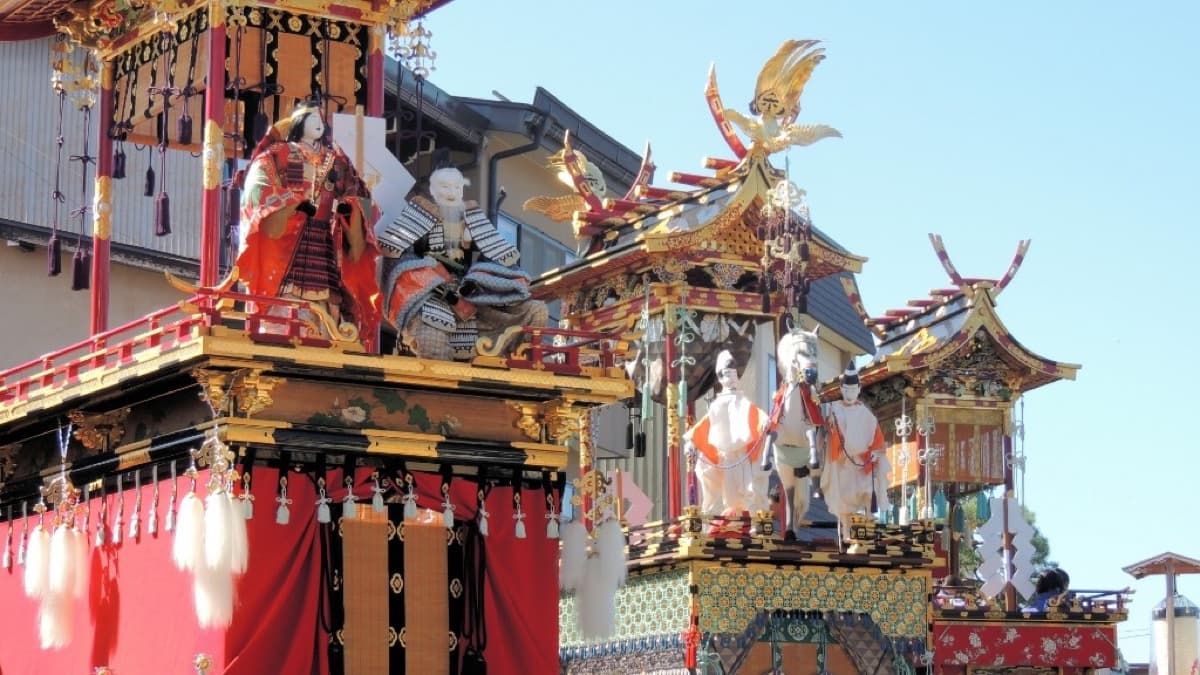
Onward from Nagasaki, the obvious continuations are Fukuoka (90 minutes) or a longer western-Japan run through autumn Japan toward Hiroshima and Kansai. If you want a second big festival in the same trip, the Takayama Autumn Festival falls on October 9–10 — which unfortunately overlaps Kunchi's last day, so pick one and plan the other for another year.
Common Mistakes to Avoid
- Assuming it moves to the weekend. It does not. October 7–9, 2026 is Wednesday to Friday. Book the leave.
- Turning up at 09:00 on October 7. The opening dedication at Suwa Shrine starts at 07:00. By nine the first venue is winding down.
- Booking a hotel late. Nagasaki is a small city with a big festival; rooms go months ahead for Kunchi week. If you are deciding in summer, book the room before you chase the ticket.
- Writing off the festival because the sajiki seats are gone. This is the big one. The street rounds are free, close-up and, for many visitors, the best part.
- Trying to see all four stages. You cannot — they run in parallel and the paid blocks overlap. Choose one stage, then spend the rest of the day in the streets.
- Packing an umbrella as your rain plan. Umbrellas and parasols are barred from the free Nagasaka viewing area, and in a packed street they make you the villain. Bring a hooded rain jacket.
Nagasaki Beyond Kunchi
Early October is a good time to be in Nagasaki independently of the festival: the month averages around 20°C, with warm afternoons and genuinely cool 07:00 starts — layer, and expect to shed them by lunch. Autumn colour arrives later in the month and into November.
If your dates cannot bend to October, the city's other headline event is the Lantern Festival in winter, built around Chinese New Year, with its own dragon and lion dances that rhyme with Kunchi's Chinese inheritance. Spring brings blossom but nothing distinctly Nagasaki. Summer is hot, humid and wet. Given the choice, come for the three days in October.
Thinking of seeing the Nagasaki Kunchi, this year or next? Get in touch through Plan My Trip on our self-guided tours site, and we’ll suggest the tours that best fit your dates and plans.
FAQ: Nagasaki Kunchi 2026
When is Nagasaki Kunchi 2026?
October 7, 8 and 9, 2026 — Wednesday, Thursday and Friday. The dates are fixed every year and never shift to a weekend. The first stage performance at Suwa Shrine begins at 07:00 on October 7.
Is Nagasaki Kunchi free to attend?
The festival itself is free. The four main stages (Suwa Shrine, Otabisho, Yasaka Shrine and Chuo Koen) are ticketed, but the niwasaki-mawari street performances, the two portable-shrine processions and the station plaza appearances all cost nothing. Suwa Shrine also opens a free area on the Nagasaka stairway, though it requires an advance lottery pass.
Can overseas visitors buy paid seats?
It is hard but not impossible. Suwa, Yasaka and Otabisho sell four-person boxes through Japanese-language phone lines and committee sites, opening in June and July — usually gone before most overseas travelers are looking. Chuo Koen is the realistic option: it sells single seats from around ¥4,500, goes on sale in early August, and is distributed via Ticket Pia and convenience-store terminals. Prices and dates change annually, so confirm on the official site.
What is the best free viewing spot?
The niwasaki-mawari street rounds, using the free route map published in late September and handed out at Nagasaki Station tourist information. Kamome Hiroba, the plaza in front of Nagasaki Station, is the most reliable single spot — troupes are widely reported to appear there from around late morning. Add the 13:00 O-nobori finale on October 9 near Suwa Shrine.
Will I see the dragon dance and the Dutch Ship in 2026?
The dragon dance, yes — Chikugomachi performs the jaodori in 2026. The Dutch Ship, no. Nagasaki's neighbourhoods rotate on a roughly seven-year cycle, and the 2026 towns bring the dragon, a Chinese ship, a river boat, a treasure ship, the kokkodesho palanquin and classical dance.
Should I base myself in Fukuoka instead?
No. The Relay Kamome plus Kamome shinkansen link Hakata and Nagasaki in about 90 minutes with a cross-platform change at Takeo-Onsen, so a day trip is possible — but the stages open at 07:00 and the finale runs at 13:00 on the last day. Two or three nights in Nagasaki is the only way to see the festival properly.
Plan Your Self-Guided Nagasaki Kunchi Trip
Kunchi rewards flexibility — no coach tour can follow a dragon down a side street. What it punishes is bad logistics: the 07:00 starts, the hotel that sold out in June, the tram day pass you could not buy on board. We build independent Japan itineraries with real timings, verified openings and fixed-date events already accounted for, whether Nagasaki is a two-night stop or the anchor of a Kyushu loop.
💬 From our Japan travel team
Transport and hotels fill up fast during festival week — book early. For Nagasaki Kunchi 2026 or if you are already thinking about 2027, get in touch and we will help you build a self-guided route that fits the dates.
Dates, venue times, ticket prices and sale dates as published by Suwa Shrine and the Nagasaki Kunchi seating committees for 2026; tram fares per Nagasaki Electric Tramway. Prices, schedules and viewing rules change year to year and seats sell out quickly — confirm on the official Nagasaki Kunchi site before booking travel. Last updated: July 16, 2026.
Related Articles
Kyushu Itinerary: 7 Days Without Driving, Plus Longer Onsen Routes
33 min read
Takayama Autumn Festival 2026: A Self-Guided Traveler's Playbook
11 min read
Jidai Matsuri 2026 and Kurama Fire Festival 2026: A Practical Guide to Kyoto's October 22 Double Bill
15 min read