
The Best Ski Resorts in Japan: 12 Ranked for 2026–27 (and Which Ones We Book)
Japan's 12 best ski resorts, ranked — Niseko, Hakuba, Rusutsu, Shiga Kogen, Furano, Nozawa Onsen and more — with 2026–27 lift prices, passes, a map, how to get there from Tokyo or Sapporo, the best picks for beginners, families and powder, and a straight list of which ones we sell.
Japan has hundreds of ski areas, and plenty of them are small local hills with two lifts and a ramen counter. They're lovely, but they're not where you spend a once-in-a-lifetime ski holiday. These are the 12 best ski resorts in Japan for a visitor who doesn't speak Japanese — ranked, with this winter's prices.
We ranked them on five things: the snow, the size and variety of the terrain, how easy they are to reach from Tokyo or Sapporo, what's around them (onsen towns, food, the snow monkeys) and how crowded they get. Every lift price below is the 2026–27 adult one-day price from the resort's own site, checked on October 3, 2026 — and almost all of them are higher than last winter.
One more thing to be upfront about. We're a Japan-based operator that sells self-guided ski trips, but four of our top 12 are resorts we don't book. You can't write an honest list of the best ski resorts in Japan without Niseko or Nozawa Onsen, so they're here, and we say clearly which ones we sell.
Quick Answer: The Best Ski Resorts in Japan
- Best overall: Niseko United, Hokkaido — the deepest reputation for powder and the easiest place to ski in English.
- Best for variety and easy access from Tokyo: Hakuba Valley, Nagano — ten resorts on one ticket under the Northern Alps.
- Best tree skiing without the crowds: Rusutsu, Hokkaido.
- Most terrain on one lift ticket: Shiga Kogen, Nagano — 18 areas and 45 lifts.
- Best for skiing plus Japanese culture: Nozawa Onsen (hot spring village) or Zao Onsen (snow monsters).
- Best time: mid-January to late February for the deepest, driest snow.
The 12 Best Ski Resorts in Japan at a Glance
Adult one-day lift tickets for 2026–27 at the window; online prices are often lower.
| # | Resort | Region | 1-day ticket | Pass | Best for |
|---|---|---|---|---|---|
| 1 | Niseko United | Hokkaido | ¥12,600 (peak ¥13,500) | Ikon | Powder, English, nightlife |
| 2 | Hakuba Valley | Nagano | ¥11,100 all 10 resorts | Epic | Variety, steeps, Alps scenery |
| 3 | Rusutsu | Hokkaido | ¥16,700 (¥13,200 online) | Epic | Tree skiing, fewer crowds |
| 4 | Shiga Kogen | Nagano | ¥9,500 (¥8,500 online) | Ikon | Most terrain on one ticket |
| 5 | Furano | Hokkaido | ¥9,000 | Ikon | Dry inland powder, long runs |
| 6 | Nozawa Onsen | Nagano | ¥7,800 | — | Skiing plus a real onsen village |
| 7 | Myoko Kogen | Niigata | ¥11,000 (four-resort pass) | Ikon (Suginohara) | Deep snow, old-school onsen towns |
| 8 | Zao Onsen | Yamagata | ¥8,000 (peak ¥9,000) | Ikon | The snow monsters |
| 9 | Kiroro | Hokkaido | see resort | — | Deep snow close to Sapporo |
| 10 | APPI Kogen | Iwate | ¥9,000 (2025–26) | Ikon | Groomed cruising, big resort hotels |
| 11 | Arai Mountain Resort | Niigata | ¥7,500 (2025–26) | Ikon | Steep, ungroomed terrain |
| 12 | Sahoro & the Asahikawa ski safari | Hokkaido | ¥9,300 / ¥5,300 | — | Empty runs, quiet powder |
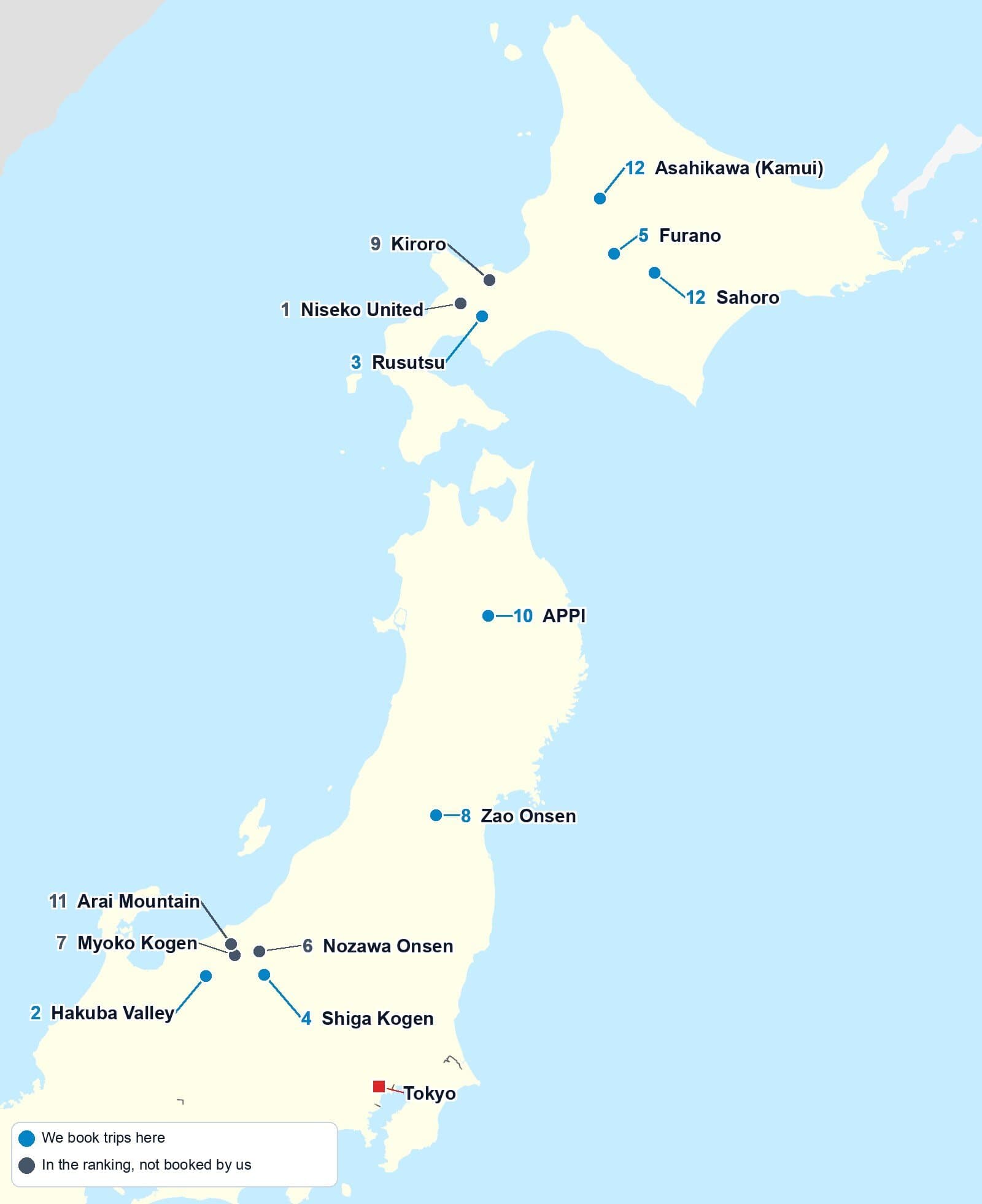
Japan Ski Resorts Map
Japan's ski resorts fall into four groups: Hokkaido, reached by flying into New Chitose Airport near Sapporo; Nagano and Niigata, reached by Shinkansen from Tokyo in one and a half to two hours; and Tohoku in the north of Honshu, also on the Shinkansen. The blue markers are where we run trips.
The Ranking: 1–5
1. Niseko United, Hokkaido
Niseko is the one everyone has heard of, and it earns it. Four resorts on Mount Niseko Annupuri — Grand Hirafu, Hanazono, Niseko Village and Annupuri — connect near the summit and share one All Mountain Pass. Ikon puts the whole area at 2,889 acres with 3,438 feet (about 1,050 m) of vertical and an average of 590 inches (about 15 m) of snow a season. The backcountry gate system, the Niseko Rules, is the reason strong skiers come: you leave the resort only through gates that ski patrol opens or closes each day.
It's also the easiest place in Japan to ski if you're worried about the language — English menus, English ski schools and a lot of seasonal staff from overseas. The downside is cost and crowds. It's the most international ski town in the country, and it's priced like it.
- Season 2026–27: November 28 to May 5 (Niseko Village closes April 4, Hanazono April 11); night skiing December 12 to March 22
- Lift ticket: ¥12,600 regular, ¥13,500 peak (December 24 to February 28), ¥8,800 early and spring
- Pass: Ikon: 7 days, Base Pass 5 (the Base Pass has blackout dates at Niseko — check Ikon)
- Getting there: Fly to New Chitose; about 2.5–3 hours by resort bus
- Best for: Powder, backcountry gates, nightlife, English
- Skip if: You want quiet, value or a traditional Japanese town
Do we book it? No. If Niseko is the reason you're going to Japan, book with an operator who specializes in it.
2. Hakuba Valley, Nagano
Hakuba Valley has ten ski resorts along the foot of the Northern Alps, from Jigatake in the south to Cortina in the north, and one valley ticket covers all ten, with free rides on the valley shuttle on the days you ski. The terrain is bigger and more alpine than almost anywhere else in Japan. Happo-one, the best known, tops out at 1,831 m with 1,071 m of vertical and still has its 1998 Olympic courses; Tsugaike has a 1,200 m-wide beginner slope; Cortina gets the valley's heaviest snow and the best tree skiing. Epic counts more than 140 trails and 103 lifts across the valley.
- Season 2026–27: Goryu opens November 21; most resorts open in early to mid-December
- Lift ticket: ¥11,100 for all 10 resorts; Happo-one ¥9,800, Tsugaike ¥9,800, Goryu with Hakuba47 ¥10,000
- Pass: Epic: 5 consecutive days, no restricted dates (physical card needed)
- Getting there: Shinkansen to Nagano (77 min on the fastest), then the Alpico bus, about 70 min
- Best for: Variety, steeps, scenery, mixed-ability groups
- Skip if: You want everything walkable from one ski-in hotel
Do we book it? Yes — Tsugaike, Misorano and Wadano, on SK005, SK105, SK205, SK009, SK002, SK102, SK003 and HK001. Our Hakuba guide covers the valley in detail.
3. Rusutsu, Hokkaido
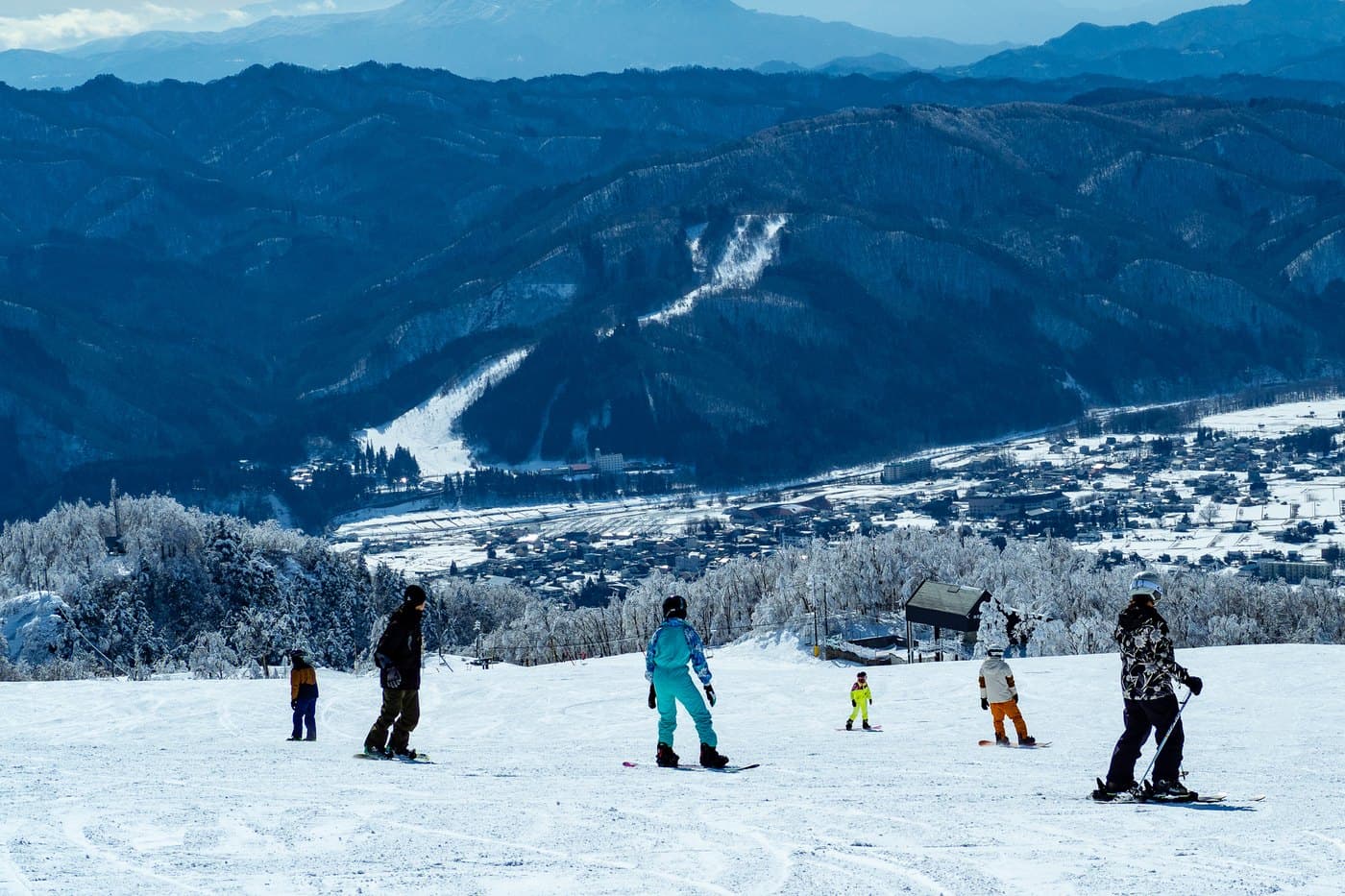
Rusutsu covers three mountains — West Mountain, East Mountain and Mount Isola — with 37 trails, four gondolas and 14 lifts (Epic's count), and its longest run, Isola Grand, is 3,500 m. It's best known for tree runs through broadleaf forest, where the powder stays soft long after the open slopes are tracked out. It's a self-contained resort rather than a town, about 40 minutes by road from Niseko, and usually far less crowded.
- Lift ticket: ¥16,700 at the window or ¥13,200 online in the regular season (December 19 to March 14) — buy online
- Night skiing: 16:00–20:00, mid-December to March 30, ¥4,000
- Pass: Epic
- Getting there: Fly to New Chitose — the closest major resort to the airport
- Best for: Tree skiing, families, Hokkaido powder without the Niseko scene
- Skip if: You want nightlife
Do we book it? Yes, at the Rusutsu Resort Hotel & Convention, on HK005, HK007, HK008, HK006 and HK001, with a chartered taxi from New Chitose Airport.
4. Shiga Kogen, Nagano
Shiga Kogen links 18 ski areas and 45 lifts and gondolas on one all-mountain ticket — the largest ski area in Japan — across a plateau that runs from 1,330 m up to 2,307 m at Yokoteyama. The altitude keeps the snow dry and the season long. Go for days of skiing across a huge range of groomed terrain, not for nightlife; the Jigokudani snow monkeys are just below the plateau for a rest day.
- Season 2026–27: December 5 to May 5 (Yokoteyama to late May)
- Lift ticket: ¥9,500 at the window, ¥8,500 online
- Pass: Ikon: 7 days, Base Pass 5, shared across all 18 areas
- Getting there: Shinkansen to Nagano, then the Nagaden express bus, 70–90 min, ¥3,000
- Best for: Intermediates, families, covering ground
- Skip if: You want a lively village
Do we book it? Yes, on SK006, SK010, SK003 and SK004. Our Shiga Kogen guide explains how the zones connect.
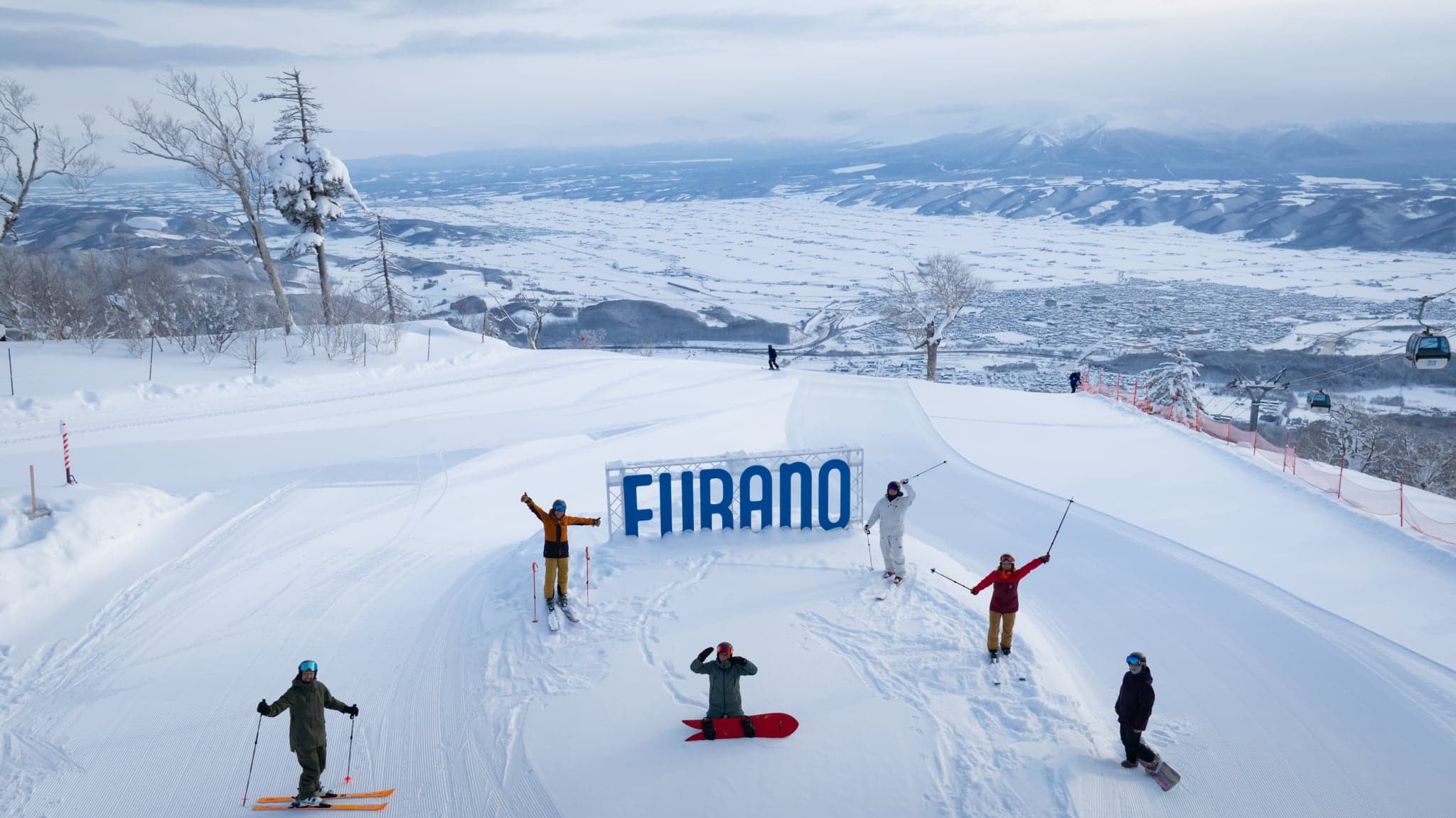
5. Furano, Hokkaido
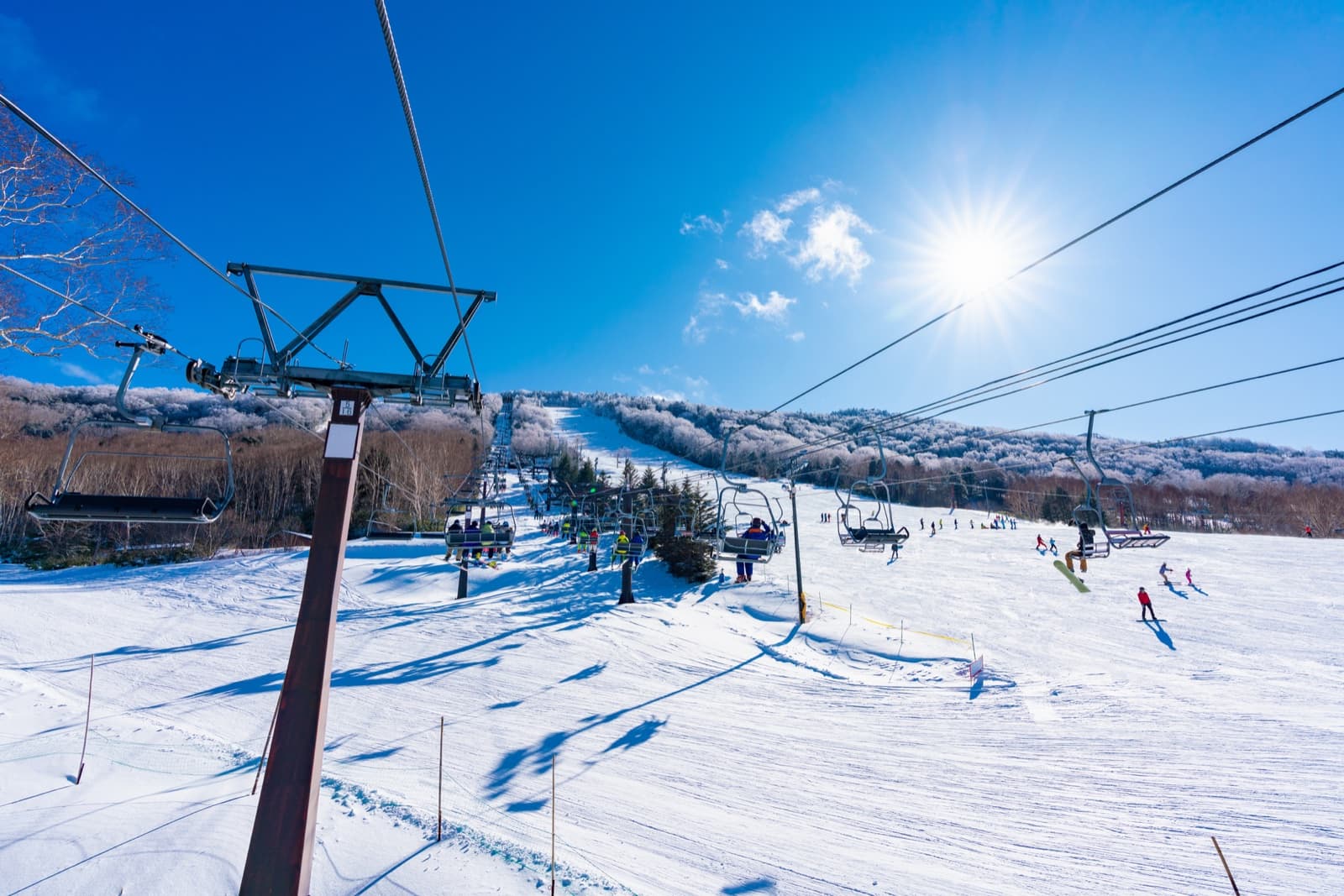
Furano sits inland in central Hokkaido, away from the coast, so the air is colder and drier and the powder tends to be lighter than at the coastal resorts. It has two zones, Furano and Kitanomine, with 28 courses, a 101-person ropeway and a gondola, and 839 m of vertical from a 1,074 m top. The runs are long and steady, with FIS World Cup courses on one side and ungroomed powder runs on the other — a great fit for intermediates who love cruising. There's a real town at the bottom.
- Season 2026–27: November 28 to May 5 (Kitanomine zone late December to March 22 only)
- Lift ticket: ¥9,000 regular, ¥7,500 early and spring — up ¥1,000 on last winter; children up to elementary school free
- Pass: Ikon: 7 days, Base Pass 5
- Getting there: Fly to New Chitose (resort bus ¥6,000, booking required) or to Asahikawa, about 1 hour 20 minutes by bus
- Best for: Dry snow, long runs, sunny days
- Skip if: You want the steepest terrain
A note on Tokachi-dake: the volcano above the Furano area has been at alert level 3 since September 12, 2026. Furano says the hotel, ski area and access roads are outside the restricted zone and operating normally.
Do we book it? Yes, on HK002, HK102, HK004, HK006 and HK007 — HK102 is the only one of our ski trips with the lift pass included.
The Ranking: 6–12
6. Nozawa Onsen, Nagano
If one place brings skiing and Japanese culture together, it's Nozawa Onsen. It's a real hot spring village, with narrow lanes, old wooden inns and 13 free public baths, and the ski area above it runs from 1,650 m down to 565 m — about 10 km top to bottom by the prefecture's count. Every January 15 the village holds the Dosojin Fire Festival.
- Season 2026–27: November 28 to May 5
- Lift ticket: ¥7,800
- Getting there: Shinkansen to Iiyama (1 hour 39 minutes at the fastest), then the 25-minute Nozawa Onsen Liner, ¥600
- Best for: Onsen culture, a first Japan ski trip
Do we book it? No.
7. Myoko Kogen, Niigata
Myoko Kogen, at the southern edge of Niigata, is a cluster of old-school resorts known for heavy snowfall: Akakura Onsen (with the area's only nightly night skiing), Akakura Kanko, Ikenotaira and Myoko Suginohara, plus tiny, powder-famous Seki Onsen. Suginohara has the big numbers — about 8.5 km from top to bottom and 1,124 m of vertical — and is on the Ikon Pass. A new Mt. MYOKO pass covers four of the resorts for ¥11,000 a day (¥10,000 if bought in October).
- Getting there: Shinkansen to Joetsumyoko (1 hour 50 minutes at the fastest), then the local line to Myoko-Kogen, about 35 minutes, ¥790
- Best for: Deep snow, onsen towns, fewer international crowds
- Note: Suginohara has dropped season passes and early-bird tickets for 2026–27
Do we book it? No.
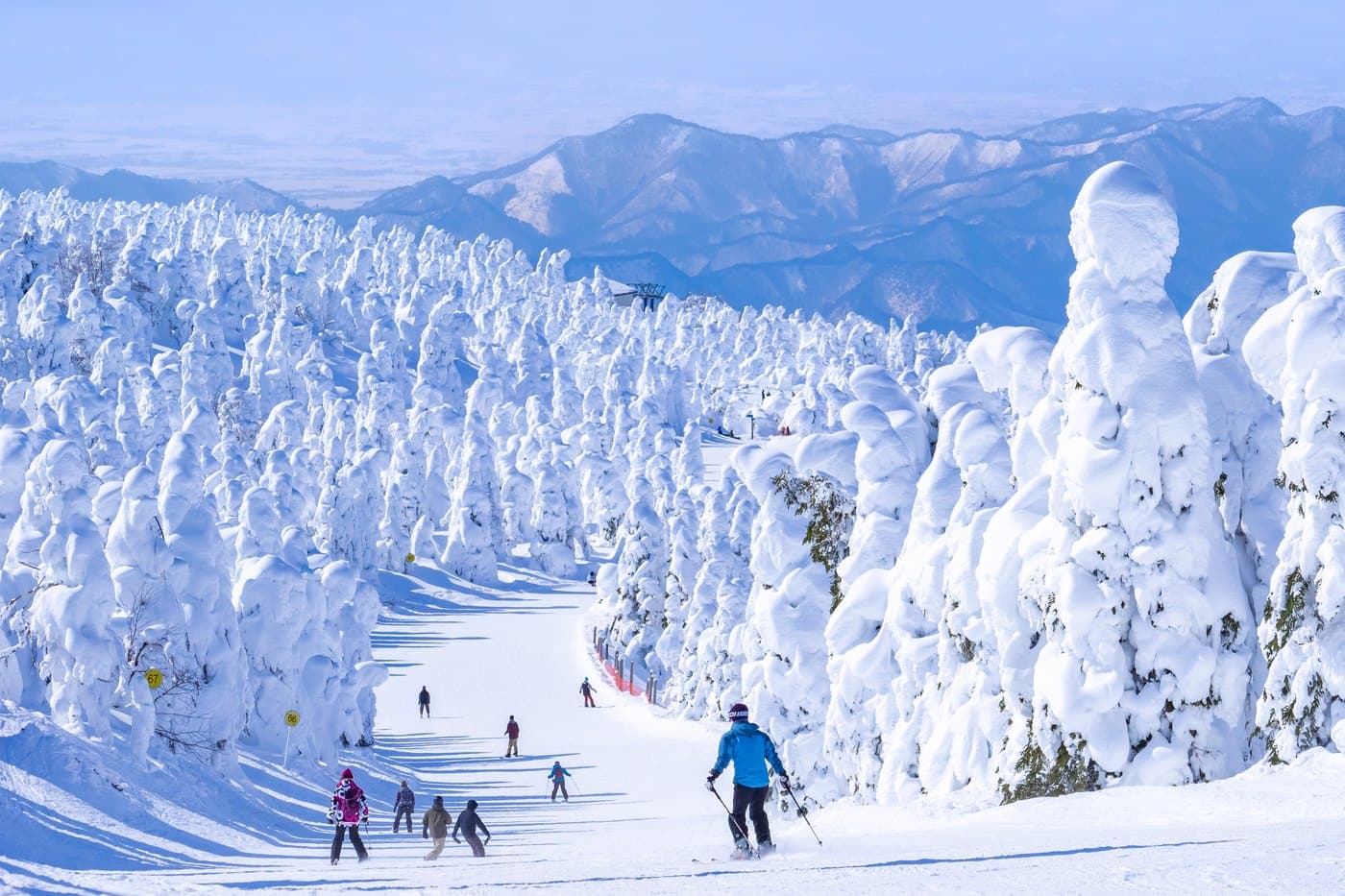
8. Zao Onsen, Yamagata
Zao Onsen is where you ski past the juhyo — the "snow monsters," fir trees coated in rime ice until they look like white figures — which are at their fullest in February. The resort has 14 slopes, 30 lifts including three ropeways, and a longest run of about 10 km from the 1,661 m top station through the monsters. At the bottom is one of Japan's oldest hot spring towns, with strongly acidic sulfur water.
- Lift ticket: ¥8,000 regular, ¥9,000 peak (December 26 to January 3, January 30 to February 28)
- Night skiing: Uwanodai slope, December 19 to February 28 plus March 6–7, 17:00–21:00
- Pass: Ikon: 7 days, Base Pass 5
- Getting there: Yamagata Shinkansen to Yamagata (about 2 hours 35 minutes), then about 40–45 minutes by bus
- Best for: The snow monsters, onsen, intermediates
Do we book it? Yes, on SK008, SK108, SK208, SK001, SK002, SK102 and SK004. See our Zao Onsen guide.
9. Kiroro, Hokkaido
Kiroro sits inland from Otaru, closer to Sapporo than Niseko is, and gets some of the deepest snow on the island. It has 24 trails, 10 lifts including a gondola, and 14 marked tree-run areas. It's a resort rather than a town, with big hotels at the base.
Do we book it? No.
10. APPI Kogen, Iwate
APPI calls itself the largest ski resort in Tohoku: 21 courses with 43 km of runs, an 8-seat gondola and a longest run of 5.5 km over 708 m of vertical. It's known for beautifully groomed cruising and big resort hotels at the base.
- Lift ticket: ¥9,000 last winter (2026–27 prices not yet out); children of elementary school age and under free
- Pass: Ikon: 7 days, Base Pass 5
- Getting there: Tohoku Shinkansen to Morioka (2 hours 10 minutes at the fastest), then a hotel-guest bus, about 70 minutes, ¥2,200
- Best for: Intermediates, families, groomers
Do we book it? Yes, at the ANA Crowne Plaza Resort Appi Kogen, on SK007 and SK001 (APPI and Zao on one trip).
11. Arai Mountain Resort, Niigata
Arai is the steep one. Its operator says about 80% of the slopes are left ungroomed and that it gets up to 18 m of snow a year, and the terrain is some of the most challenging lift-served skiing in Japan. The ski area is on the Ikon Pass; the hotel is still called Lotte Arai Resort.
- Lift ticket: ¥7,500 last winter in high season (2026–27 not yet out)
- Getting there: Shinkansen to Joetsumyoko, then a shuttle
- Best for: Advanced skiers, steep powder
Do we book it? No.
12. Sahoro and the Asahikawa Ski Safari, Hokkaido
Two quiet picks in central Hokkaido. Sahoro, east of Furano, has 21 courses and a 3 km longest run, rarely has a lift line, and pairs naturally with Furano on a two-resort trip (¥9,300 a day for 2026–27). The Asahikawa ski safari uses Hokkaido's second city as a base for three small mountains: Kamui Ski Links (26 courses, 601 m of vertical, ¥5,300 a day), Pippu, and Nayoro Piyashiri (opens December 11, ¥4,300). It's the cheapest way into Hokkaido powder and the most genuinely off the beaten path.
Do we book them? Yes — Sahoro on HK002 and HK102, the Asahikawa safari on HK003. One caveat: the bus between Asahikawa and Kamui Ski Links isn't included on HK003, so budget for it.
Interested in a tour? Click a route code above, or search for it in the top-right Search bar.
Also Worth Knowing
- Hoshino Resorts Tomamu (Hokkaido): a family resort with its own JR station about 90 minutes from New Chitose, an ice village at night and ¥9,200 day tickets online.
- Madarao (Nagano): new on the Ikon Pass for 2026–27, with more tree-run courses than any other resort in Japan by its own count; ¥9,000 with Tangram.
- Kagura (Niigata): one of the longest seasons in Japan, from November 28 to May 16; ¥8,500, or ¥11,800 with Naeba and the Dragondola.
- Sapporo Teine (Hokkaido): the 1972 Olympic slopes, about 40 minutes from central Sapporo; ¥9,800.
- Mt. T (Gunma): the closest Ikon resort to Tokyo, about an hour to Jomo-Kogen by Shinkansen, then a bus to the Tanigawadake ropeway. From January 9 to February 28 day tickets are a reservation-only ¥14,000 pass capped at 150 people; Ikon Pass holders don't need to reserve.
- Near Tokyo: Karuizawa Prince opens on October 31 and is about an hour from Tokyo; GALA Yuzawa sits on its own Shinkansen station, but its south area is closed for 2026–27 and JR hadn't announced its winter trains in early October.
The Best Ski Resorts in Japan by Type
Best for beginners
Tsugaike in Hakuba, with its huge gentle slope; Shiga Kogen, with easy runs spread across many areas; and Niseko, for the widest choice of English-language lessons. Furano and Rusutsu have wide, gentle lower slopes too. Complete beginners usually progress fastest with lessons in the morning and free skiing in the afternoon; book lessons early for peak weeks.
Best for families
Resorts where young children ski free make a big difference: for 2026–27, children of elementary school age and under ride the lifts free at Furano, Kagura and Shiga Kogen's Yakebitaiyama area (APPI and Myoko Suginohara did the same last winter). Tomamu and Rusutsu are self-contained resorts with plenty for non-skiers.
Best for powder and trees
Niseko for the gates, Rusutsu and Kiroro for tree runs, Furano for dry inland snow, Hakuba Cortina on storm days and Madarao for marked tree courses. Always ride in pairs, and hire a guide for anything beyond the resort boundary.
Best for advanced skiers
Happo-one for vertical, Arai for steep ungroomed terrain, and the Niseko gates for backcountry. Carry a transceiver, shovel and probe beyond the boundary, and take a certified local guide on your first day.
Best for skiing plus sightseeing
Nagano and Tohoku, because the Shinkansen does the work. Hakuba or Shiga Kogen fit around Tokyo, Kanazawa and Kyoto; Zao Onsen fits around Tokyo and Sendai.
Best for Ikon and Epic Pass holders
On the Ikon Pass, Japan has ten resorts for 2026–27, including Niseko, Furano, Shiga Kogen, Zao, APPI, Myoko Suginohara, Arai and Madarao. On the Epic Pass, Japan means Hakuba Valley and Rusutsu. Our Ikon Pass Japan guide has the full list.
When to Go
- Late November to mid-December: early season. Niseko, Furano, Nozawa and Kagura open on November 28; snow cover can be thin until mid-December.
- Mid-December to early January: most resorts fully open; the year-end holidays are busy and expensive.
- Mid-January to late February: peak season, with the coldest days, the most reliable powder and the best snow monsters.
- March: more sunny days, softer snow and smaller crowds.
- April to early May: spring skiing at Niseko, Furano, Shiga Kogen, Nozawa and Kagura.
Region by region, with opening dates, our Japan ski season 2026–27 guide goes deeper.
From our Japan travel team
Late December, early January and February are the busiest weeks at Japan's best-known ski resorts, and rooms in popular areas like Hakuba and Zao Onsen can be gone months ahead. Hotels and trains fill up fast, so start planning early; our self-guided ski tours handle the bookings and support you through the trip. If you already have dates in mind, just ask and we'll help you match them to the right resort.
Getting to Ski Resorts in Japan: Train First, Car Second
Shinkansen lines run straight to Nagano, Iiyama, Joetsumyoko, Yamagata and Morioka, and buses or taxis cover the last stretch. In Hokkaido, airport buses and taxi transfers from New Chitose are the norm. Only hire a car if you're confident driving on snow and ice.
One tip that's a real lifesaver: send big ski bags ahead by courier a day or two before you travel, so you aren't hauling them through Tokyo Station. For first-timers, our guide to skiing in Japan covers lift tickets, rentals, luggage and what a ski trip here costs.
From our Japan travel team
Heavy snowfall is part of the appeal, but it can also delay buses and limited express trains and occasionally close mountain roads. Every self-guided tour comes with 24/7 support from our on-the-ground operators, plus insurance, so if a storm or an emergency forces changes, you get practical help quickly. Feel free to get in touch if you'd like to know how that works on a ski route.
Turning a Resort Choice Into a Trip
- 10–11 days, Tokyo and Nagano: a night in Tokyo, a night with the snow monkeys at Yudanaka Onsen, six nights in Hakuba or Shiga Kogen, then back to Tokyo. That's the shape of SK005, SK105, SK205 and SK006.
- Two weeks, two resorts: Hakuba or Shiga Kogen plus Zao Onsen for the snow monsters, as on SK002, SK102 and SK004.
- Hokkaido only: two resorts from New Chitose — Rusutsu and Furano (HK007) or Sahoro and Furano (HK002) — with chartered taxis between them.
- Skiing plus cities: Hakuba with Kanazawa, Kyoto and Hakone (SK009), or Shiga Kogen with Takayama and Shirakawa-go (SK010). Both include ski gear rental.
Interested in a tour? Click a route code above, or search for it in the top-right Search bar.
Which of These We Actually Book
Being straight about this saves everyone time. Our self-guided winter range covers Hakuba Valley, Shiga Kogen, Zao Onsen, APPI, Rusutsu, Furano, Sahoro and Asahikawa — the mountains where we hold accommodation and can assemble a whole trip, from the airport to the last night in Tokyo.
We don't sell Niseko, Nozawa Onsen, Myoko, Kiroro or Arai. They're in this ranking because an honest comparison of the best ski resorts in Japan needs them. If one of them is the reason you're going, book with an operator who specializes in it.
Lift tickets are the line to check on any operator's quote: on all but one of our 24 winter trips they're excluded and named by resort, so you buy them at the mountain or use your Ikon or Epic Pass. The exception is the Sahoro and Furano trip sold with the pass bundled (HK102). Prices and inclusions are in our Japan ski packages guide.
Not sure which ski resort suits your group, or how to fit it around the rest of Japan? Get in touch through Plan My Trip on our self-guided tours site, and we’ll suggest the tours that best fit your dates and plans.
FAQ
What is the best ski resort in Japan?
For most international skiers, Niseko United in Hokkaido: four linked resorts, huge snowfall, gated backcountry and the most English-friendly ski town in Japan. Hakuba Valley is the best choice if you also want Tokyo and Kyoto on the same trip, and Rusutsu if you want Hokkaido powder with fewer people.
Which ski resort in Japan is best for beginners?
Tsugaike in Hakuba and Shiga Kogen have plenty of wide, gentle slopes, and Niseko has the widest choice of English-language lessons. Furano and Rusutsu are also good for a first week.
How much is a lift ticket in Japan for 2026–27?
Most big resorts charge ¥8,000–12,000 for an adult day. Niseko is ¥12,600 (¥13,500 at peak), the Hakuba Valley ticket ¥11,100, Shiga Kogen ¥9,500, Furano ¥9,000, Zao ¥8,000 and Nozawa Onsen ¥7,800. Rusutsu is ¥16,700 at the window but ¥13,200 online. Prices are up on last winter almost everywhere.
Is Hokkaido or Nagano better for skiing?
Hokkaido for the lightest, driest powder; Nagano for easy access from Tokyo by Shinkansen and for combining skiing with sightseeing. If you only have a week and want Tokyo in it, Nagano usually wins.
Which ski resorts are closest to Tokyo?
Karuizawa Prince and Mt. T are about an hour by Shinkansen; GALA Yuzawa sits on its own Shinkansen station in winter. For a proper ski holiday, Hakuba and Shiga Kogen are about three hours away.
When is the best time to ski in Japan?
Mid-January to late February for the deepest, most reliable powder. December and March trade some snow certainty for lower prices and thinner crowds.
Last updated: October 3, 2026. Lift prices, seasons and resort figures checked that day on each resort's own site (Niseko United, Hakuba Valley and its resorts, Rusutsu, Shiga Kogen, Furano, Nozawa Onsen, Myoko's resorts, Zao Onsen, Kiroro, APPI, Arai, Sahoro, Kamui Ski Links, Nayoro Piyashiri, Tomamu, Madarao, Kagura, Sapporo Teine, Mt. T, Karuizawa Prince and GALA Yuzawa); Ikon and Epic access from their own sites; train times from JR East's October 2026 timetable. APPI and Arai had not published 2026–27 prices, so last winter's are shown and labeled. Which resorts we sell is from the current catalogue.
Related Articles
Ikon Pass Japan 2026-27: All 10 Resorts, Your Days, and the Ski Trips That Reach Them
10 min read
Japan Ski Packages: Real Prices, What's Included, and Which Trip Actually Fits
16 min read
Japan Ski Season 2026-27: A Practical Niseko & Hakuba Powder Guide for Self-Guided Travelers
13 min read