
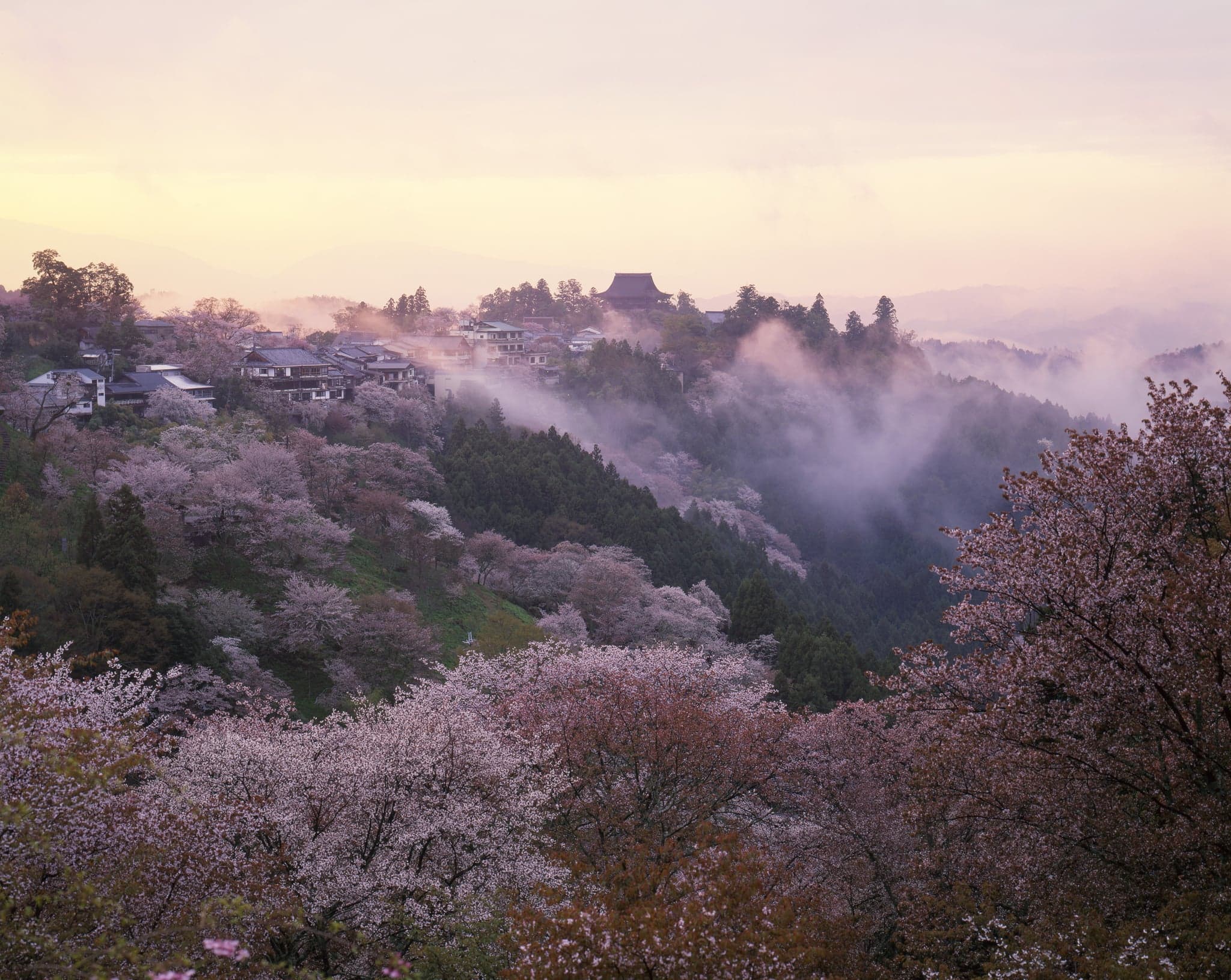
Mount Yoshino: Japan's Cherry Blossom Mountain, and How to Actually Visit It
30,000 cherry trees in four groves that bloom up the mountainside over nearly a month, a World Heritage temple with a hidden principal image, and a ropeway that does not run every day. What to know before you go, and the self-guided route that sleeps on the mountain.
Most cherry blossom spots in Japan give you a week. Mount Yoshino gives you close to a month — because its 30,000 trees are spread up a mountainside from about 200 metres to about 700 metres, and the bloom climbs from the bottom to the top.
That is the practical reason to come here rather than fight for space under the same trees as everyone else in Kyoto. The better reason is the one nobody puts in a listicle: the trees are not decoration. They were planted as religious offerings, and they have been going in for more than a thousand years.
Quick Answer: Mount Yoshino
- Where: Yoshino, Nara Prefecture. A little over 90 minutes south of Nara Park by train, and a direct run from Osaka Abenobashi on the Kintetsu Yoshino Line.
- What: around 30,000 cherry trees in about 200 varieties, across four groves called the Senbon, on a ridge inside a UNESCO World Heritage property.
- When: the mountain blooms from late March into mid-April at the bottom, and the upper groves hold on into late April — nearly a month of season if you pick your elevation.
- Getting up: a three-minute ropeway from beside Yoshino Station, which in the normal season runs Friday to Monday only. Or walk up in under 20 minutes.
- Stay the night if you can. The day-trippers leave, the town lights its trees, and the mountain becomes a different place.
Trees
~30,000
Groves
Four Senbon
Season
Late Mar–late Apr
Ridge length
About 7 km
Why There Are 30,000 Cherry Trees on One Mountain
Kinpusen-ji, the temple at the centre of the town, tells the story on its own pages. In the seventh century the ascetic En no Gyoja completed a thousand days of practice on the peak above Yoshino and had a vision of Kongo Zao Daigongen, the wrathful deity that became the principal image of Shugendo — Japan's own mountain-ascetic religion. He carved that figure into the wood of a mountain cherry, and enshrined it here.
From then on the cherry was the sacred tree of this mountain, and pilgrims planted them as offerings. That is why the slopes hold around 30,000 trees in roughly 200 varieties rather than a tidy avenue of one cultivar, and it is why the official Nara guide describes the trees here as sacred and tied to Shugendo rather than as a viewing spot.
It also changes what you are looking at. The pale, uneven wash of colour across these slopes is mostly yamazakura, the wild mountain cherry, which opens its flowers and its copper-coloured young leaves at the same time. It does not photograph like the uniform pink of a city avenue. It looks like weather moving across a forest.
The whole mountain, together with Omine, is one of the three sacred sites of the World Heritage property "Sacred Sites and Pilgrimage Routes in the Kii Mountain Range", inscribed in 2004. The other two are Kumano Sanzan and Koyasan, and they are linked to each other and to Nara and Kyoto by pilgrimage routes.
The Four Senbon: How the Bloom Climbs the Mountain
Sen means a thousand and hon means tree, so each Senbon area is, loosely, a thousand trees. The mountain runs about 7 km from Yoshino Station and the Shimo Senbon area up to Kinpu Shrine and the Oku Senbon area, climbing from roughly 200 m to roughly 700 m.
| Grove | Where it sits | What it means for your visit |
|---|---|---|
| Shimo Senbon (lower) | From Yoshino Station up to the town, around 200 m | Blooms first. The ropeway and the walk up both land here |
| Naka Senbon (middle) | The main temple town on the ridge | The heart of the mountain: Kinpusen-ji, Yoshimizu Shrine, the ryokan and the night illumination |
| Kami Senbon (upper) | Above the town, on the climb toward Kinpu Shrine | The classic view back across the valley, and the quieter half of the mountain |
| Oku Senbon (inner) | The far end, around 700 m | Blooms last — often still in flower when the bottom is already green |
This is the single most useful thing to understand about Yoshino. Everywhere else, a cherry blossom trip is a gamble on one week. Here, if you arrive and the bottom has already dropped its petals, you walk uphill. The official Nara guide puts it plainly: because the trees come into bloom progressively from the bottom to the top, visitors have almost a whole month to enjoy them.
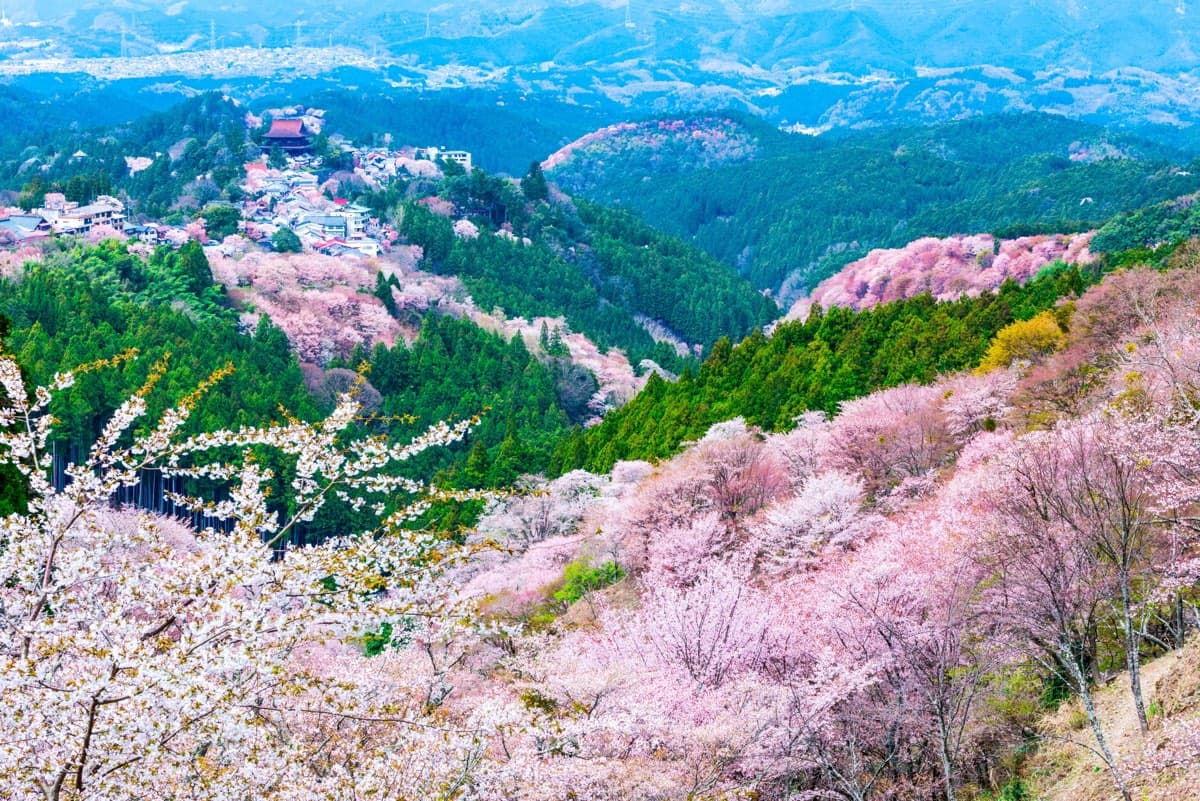
The other consequence: Kami Senbon is both the famous view and the less crowded half of the mountain. The crowds concentrate in the town.
When to Visit for the Yoshino Cherry Blossom
Nara Prefecture's own guide gives the mountain's bloom as late March to mid-April, with the upper areas running later — the top can still be in flower in late April. Early April is the safest single week for someone who only has one shot at it, because that is when the middle of the mountain, where the town and the temples are, is usually at its best.
Treat any forecast as a moving target. Japan's bloom forecasts do not start appearing until the winter, and they are revised repeatedly. Our Japan cherry blossom forecast page tracks each release and explains what the different forecast labels actually mean; the broader cherry blossom tours guide covers how to plan a whole trip around a bloom you cannot book in advance.
When the flowers peak, the trees around the town are lit at night and a good number of visitors walk the ridge in kimono. If you are only here in daylight you miss half of it — which brings us to the part most itineraries get wrong.
Getting to Yoshino Station
Yoshino is the end of the Kintetsu Yoshino Line, and the practical starting point for most visitors is Osaka Abenobashi, the Kintetsu terminal beside JR Tennoji in southern Osaka. From Nara Park it is a little over 90 minutes by train. Coming on JR instead, you can reach Yoshino-guchi from Nara, Kyoto or Osaka and change there for the 30-minute Kintetsu run to Yoshino.
The Blue Symphony, if your dates line up
Kintetsu runs a sightseeing limited express on this line called the Blue Symphony — a three-car train with a lounge car, a bar counter with an attendant, a small library of books about Nara, and wide 2+1 seating, plus salon seats for groups of three or four. It runs two round trips a day and, as a rule, not on Wednesdays.
| Service | Departure |
|---|---|
| Service 1 | Osaka Abenobashi 10:10 → Yoshino |
| Service 2 | Yoshino 12:34 → Osaka Abenobashi |
| Service 3 | Osaka Abenobashi 14:10 → Yoshino |
| Service 4 | Yoshino 16:03 → Osaka Abenobashi |
Fares are modest for what it is: the one-way base fare from Osaka Abenobashi to Yoshino is ¥1,170 for an adult and ¥590 for a child, and the Blue Symphony adds ¥730 for an adult (¥520 limited express plus ¥210 special car) or ¥370 for a child. The catch is availability — limited express tickets go on sale at 10:30 a.m. one month before the travel date, and in blossom season this train is not a seat you stroll up and buy.
Getting Up the Mountain: the Ropeway Does Not Run Every Day
This is the detail that catches people out, and it is worth reading twice before you fix a date.
The ropeway climbs from Senbonguchi, beside Yoshino Station, to Yoshinoyama at the edge of the town, in about three minutes. In the normal season the operator runs it on Fridays, Saturdays, Sundays and Mondays only, and a substitute bus covers Tuesdays, Wednesdays and Thursdays. In cherry blossom season it runs every day at roughly 15-minute intervals — and in that period round-trip tickets and group discounts are not sold.
| Item | Detail | Note |
|---|---|---|
| Normal season | Friday, Saturday, Sunday and Monday only | A substitute bus runs Tuesday, Wednesday and Thursday |
| Cherry blossom season | Every day, roughly every 15 minutes | Round-trip tickets and group discounts are not sold in this period |
| Adult fare | ¥500 one way, ¥900 round trip | The ride itself takes about three minutes |
| Child fare | ¥250 one way, ¥450 round trip | Senbonguchi at the bottom, Yoshinoyama at the top |
The reassuring part: you do not actually need it. The official Nara guide notes you can walk up to the town in less than 20 minutes. It is a steady climb rather than a hike, and on a Tuesday in November it is a more pleasant way to arrive than waiting for a bus.
Higher up, extra buses run to the upper observatories when the blossoms are out, and the ridge itself is walkable end to end if you have the day for it. Check the operator's current notices before you travel: the schedule above was read on 21 September 2026 and it changes with the season.
Kinpusen-ji, Yoshimizu Shrine, and What Is Actually Open
The Zao-do Hall
Kinpusen-ji's main hall, the Zao-do, is a National Treasure and a core asset of the World Heritage listing. The temple gives its dimensions as 34 m high and 36 m on each side, and describes it as second in size among Japan's ancient wooden buildings only to the Great Buddha Hall at Todai-ji. The present building dates from 1592. Inside is the largest zushi — the cabinet that houses a sacred image — in Japan, holding the three Kongo Zao Daigongen figures.
Those three are hidden images: normally closed to view, shown only during special openings. The temple has announced one for autumn 2026 — 24 October to 30 November 2026, 8:30 a.m. to 4:00 p.m., with admission at ¥1,600 for adults, ¥1,200 for high school and junior high school students and ¥800 for elementary school students. If your trip falls in that window, this is a stronger reason to come than the blossoms.
One thing to know before you photograph the gate
The temple's Niomon Gate, also a National Treasure and at 20.3 m the oldest structure on the site, is under a full dismantling repair with completion targeted for the 2028 fiscal year. Its two guardian statues — each around 5.3 m, made in 1338 and 1339 — have been moved to the Nara National Museum for the duration. Do not plan a photograph around the gate, and do not be surprised by scaffolding.
Yoshimizu Shrine and the "one glance, a thousand trees" view
Just off the main street, Yoshimizu Shrine has the observatory that produces the view you have probably already seen: hitome senbon, a thousand cherry trees in a single glance. Its history is the reason it is more than a viewpoint — in the 14th century Emperor Go-Daigo fled here and set up a rival imperial court, and Toyotomi Hideyoshi later held his famously enormous blossom-viewing parties on these grounds. The shrine keeps a museum of artefacts and the rooms where Go-Daigo stayed. The walk up is steep but short.
From our Japan travel team
Yoshino rewards an early start more than almost anywhere else we send people. The day-trip crowds arrive late morning and leave by mid-afternoon, so a night on the mountain buys you the quiet end of both days. If your dates fall near a special temple opening we will tell you — those are announced a few months ahead and they change what the trip is about.
Why You Should Sleep on the Mountain
Yoshino is a possible day trip and a much better overnight. Nara Prefecture's own guide says as much: a day trip is possible, but an overnight stay is advised to see everything.
The practical case is simple. The night illumination only exists after the last train down. The upper groves are a real walk from the town and you will not want to rush them. And most of the local ryokan have a hot spring bath looking out over the mountains — non-guests can usually pay a small fee to use one, but the point of a bath like that is to get into it at the end of your own day rather than on a schedule.
There is a second kind of lodging here that you will not find in most places: shukubo, temple lodgings. Our own Yoshino route stays at one — Chikurin-in in the middle of the town — and continues from there deeper into the Kii mountains. If temple stays are the part that interests you, our guide to staying overnight at Koyasan covers what a night in one is actually like, and what a ryokan is explains the more conventional alternative.
Yoshino Outside Cherry Blossom Season
The mountain is marketed on two weeks of the year and open for all of them. In autumn the same slopes turn red and gold, and the walking is better: cool air, long views, the ryokan baths, and a fraction of the visitors. Our Nara autumn leaves guide has the timing for the prefecture.
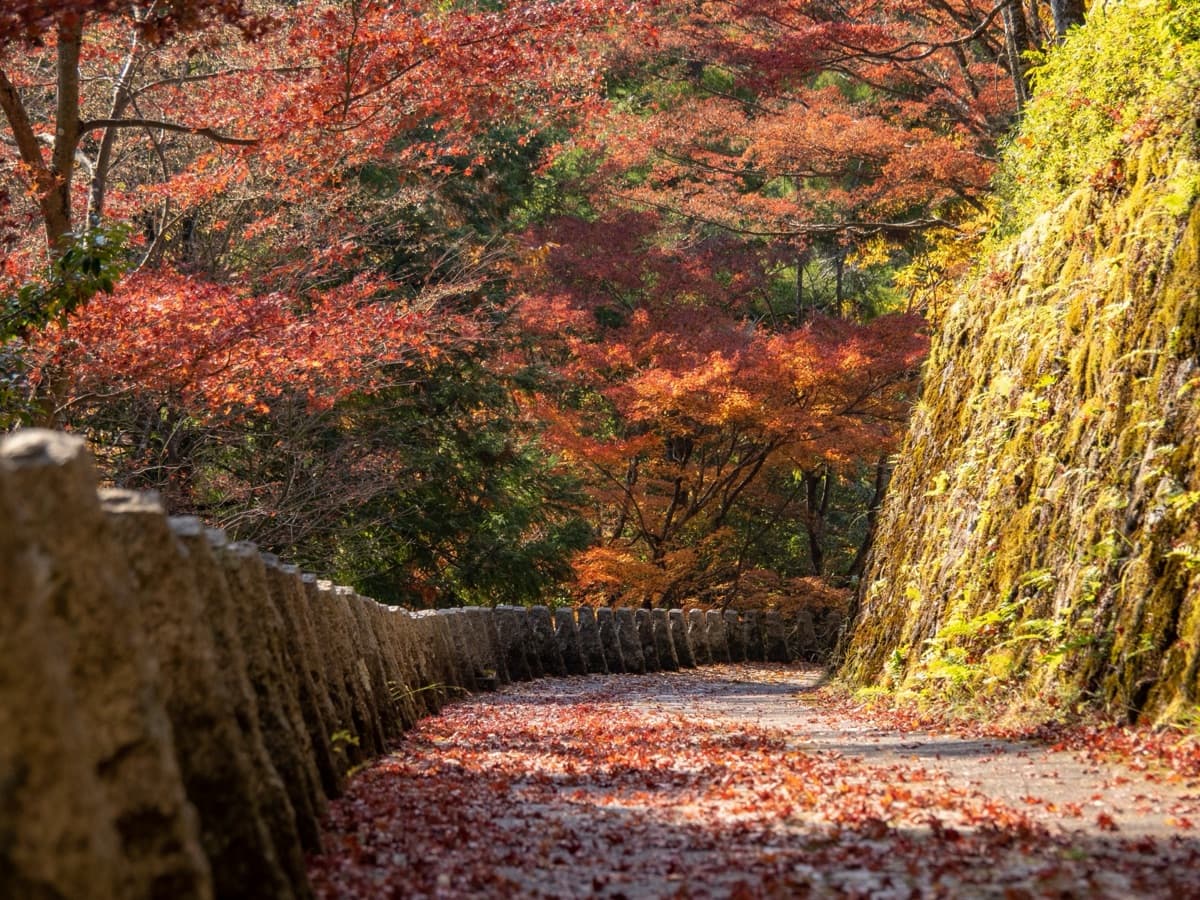
Autumn 2026 is an unusually good case for going out of season, because the Zao-do special opening runs from 24 October to 30 November. Winter is quiet and cold with occasional snow on the upper ridge; summer is green, humid and the season when the mountain feels most like what it is — a working centre of Shugendo, with practitioners on the trails rather than tour groups.
Our Self-Guided Routes to Yoshino
We are a Japan-based operator, and Yoshino is on one of our short Kansai routes rather than buried in a two-week itinerary.
Spiritual Peak Experience: Yoshino & Koyasan (KR001)
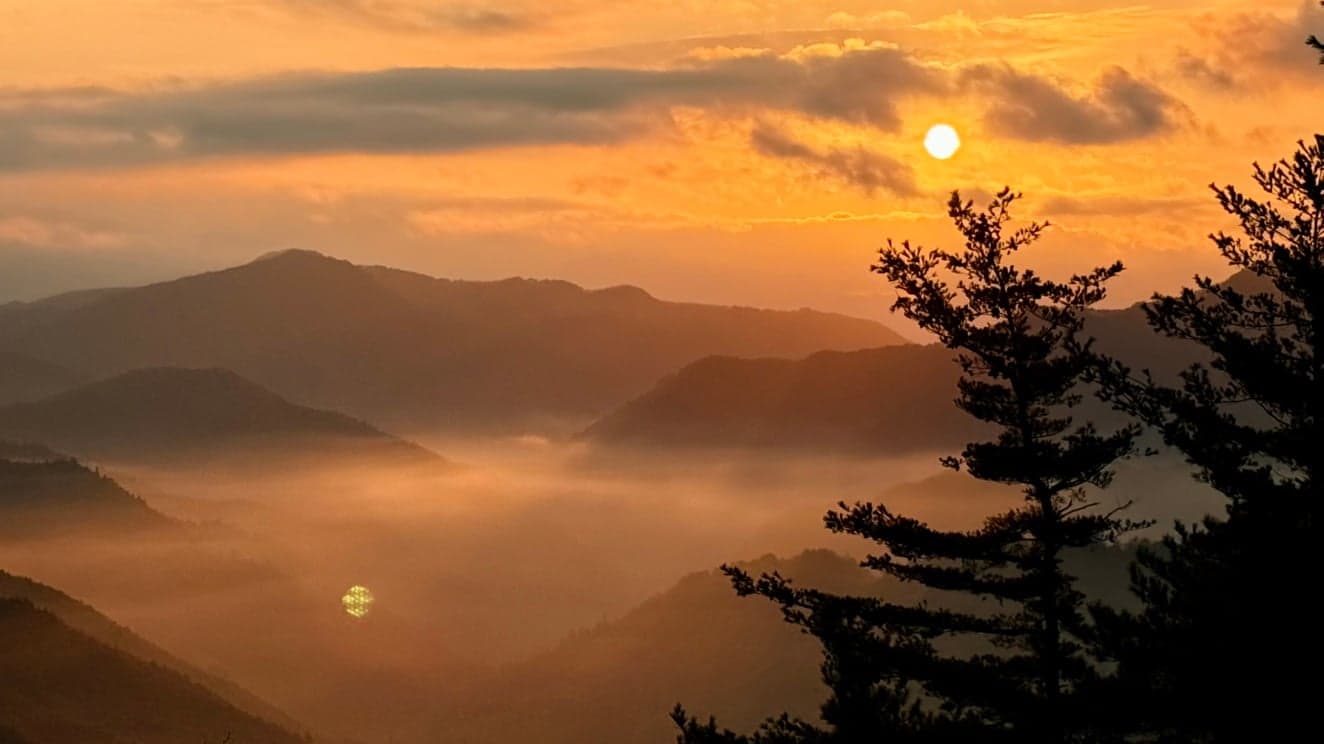
Four days, from $1,400 to $2,000 per person, and it does something no other short route we run does: it connects two of the three sacred sites of the same World Heritage property. Day 1 travels from Osaka to Yoshino aboard the Blue Symphony, with a half-day guided tour of the mountain on arrival and a night at the Chikurin-in temple lodging. Day 2 starts, if you want it, with the early morning Buddhist service at Kinpusen-ji, then moves on toward Japan's ancient beginnings around Kashihara. Day 3 sets out by private taxi before dawn to Nosegawa, where the valleys below can fill with a sea of clouds at sunrise, and ends at a temple lodging on Koyasan. Day 4 is the temple morning service and the quieter corners of Koyasan.
Included: limited express trains between cities, three nights' accommodation with one hotel and two temple lodgings, three breakfasts and two dinners, the half-day Yoshino tour, the private taxi transfer, a transport IC card loaded with ¥7,000, travel insurance and 24/7 support from our team while you are in Japan. Departures run from spring through autumn, so this is not only a blossom-season route.
If you want the blossoms but not the mountain
Our other short spring route, Hidden Cherry Blossom & Ancient Temple of Nara (KR003), is four days from $900 to $1,500 with three nights in Osaka, and it goes somewhere else entirely: Takami-no-Sato, the weeping cherry garden in the Nara mountains, and Hasedera Temple, with transport and entrance fees for that day included. Departures are set for 8–17 April 2027. It is the cheapest way into a Japanese cherry blossom trip that we sell, and it avoids the busiest ground completely.
From our Japan travel team
Tell us your dates and we will tell you honestly which of the two fits. If you are travelling in the first half of April and you want the mountain, the Yoshino route needs booking early — the train, the temple lodging and the mountain's own capacity all tighten at the same time. Outside blossom season the same route is easier to get and, in our view, no less worth doing.
Five Mistakes People Make at Yoshino
- Treating it as a half-day stop. The ridge is about 7 km end to end. A couple of hours gets you the town and nothing above it.
- Assuming the ropeway is running. Outside blossom season it operates Friday to Monday. Check, or plan to walk the 20 minutes up.
- Booking the exact forecast peak. The forecast is for one elevation. Here you adjust by walking uphill — which only works if you have a whole day on the mountain.
- Leaving before dark in blossom season. The illuminated trees and the near-empty streets after the last day-trippers go are the best hours of the visit.
- Expecting a city hanami park. These are wild mountain cherries on a working religious mountain. Steep lanes, few barriers, and shrines that are not viewing platforms.
FAQ: Mount Yoshino
When is the best time to see the cherry blossoms at Mount Yoshino?
Nara Prefecture gives the mountain's bloom as late March to mid-April, with the upper groves running later and sometimes still in flower in late April. Early April is the safest single week, because the middle of the mountain — the town, the temples and the main viewpoints — is usually at its best then. Because the four Senbon groves bloom in sequence from the bottom of the mountain to the top, the season across the whole mountain lasts nearly a month.
How many cherry trees are there on Mount Yoshino?
Around 30,000, in roughly 200 varieties, across the four Senbon areas. They are mostly wild mountain cherry, and they were planted over centuries as religious offerings rather than as a viewing avenue.
How do I get to Mount Yoshino from Osaka or Nara?
Yoshino is the end of the Kintetsu Yoshino Line. Most visitors travel from Osaka Abenobashi, next to JR Tennoji. From Nara Park it is a little over 90 minutes by train, and on JR you can reach Yoshino-guchi from Nara, Kyoto or Osaka and change there for the 30-minute run to Yoshino. Kintetsu's Blue Symphony sightseeing train runs the same line twice a day in each direction, generally not on Wednesdays.
Does the Yoshino ropeway run every day?
No. In the normal season the operator runs it on Fridays, Saturdays, Sundays and Mondays only, with a substitute bus on Tuesdays, Wednesdays and Thursdays. During cherry blossom season it runs daily at roughly 15-minute intervals, and round-trip tickets and group discounts are not sold in that period. An adult single is ¥500 and a return ¥900; the ride takes about three minutes. You can also walk up to the town in under 20 minutes.
Is Mount Yoshino worth visiting outside cherry blossom season?
Yes, and it is a great deal easier to book. Autumn brings red and gold across the same slopes, cool walking weather and hot spring baths with mountain views, with a fraction of the crowds. In 2026 there is a further reason: Kinpusen-ji is holding a special opening of its normally hidden principal images from 24 October to 30 November.
Can I see the Zao Gongen statues at Kinpusen-ji?
Only during a special opening. The three Kongo Zao Daigongen images are hidden images kept inside Japan's largest zushi in the Zao-do, a National Treasure. The announced autumn 2026 opening runs 24 October to 30 November, 8:30 a.m. to 4:00 p.m., at ¥1,600 for adults, ¥1,200 for high school and junior high students and ¥800 for elementary students. Note also that the temple's Niomon Gate is under a full repair targeted for completion in fiscal 2028, and its two guardian statues are on deposit at the Nara National Museum meanwhile.
Should I stay overnight on Mount Yoshino or visit as a day trip?
Stay if you can. The official Nara guide advises an overnight to see everything, and the two best parts of a Yoshino visit — the night illumination in blossom season and the quiet upper groves — both sit outside day-trip hours. The mountain has ryokan with hot spring baths and temple lodgings; our Yoshino route stays at a temple lodging in the middle of the town.
Is Mount Yoshino a UNESCO World Heritage Site?
Yes. Yoshino and Omine is one of the three sacred sites of "Sacred Sites and Pilgrimage Routes in the Kii Mountain Range", inscribed in 2004. The other two are Kumano Sanzan and Koyasan, linked by pilgrimage routes to Nara and Kyoto. Kinpusen-ji's Zao-do and Niomon Gate are core assets of the listing.
Transport schedules, fares and temple opening dates in this guide were checked against the operators' and temple's official pages on 21 September 2026. Mountain schedules change with the season — confirm your own dates before you travel.
Sleep on the Mountain, Not Beside the Station
Our four-day Yoshino and Koyasan route travels by sightseeing train, stays in temple lodgings on both sacred mountains, and includes the guided half-day in Yoshino and the pre-dawn transfer for the sea of clouds — with our team in Japan on call throughout.
Related Articles
Japan Cherry Blossom Forecast 2027: The Practical Planning Guide for Self-Guided Travelers
14 min read
Japan Cherry Blossom Tours 2027: Peak Dates, Real Prices and Self-Guided Routes From $900
19 min read
Koyasan Temple Stay: What a Night in a Shukubo Is Really Like, and What It Costs
16 min read