Koyasan Temple Stay: What a Night in a Shukubo Is Really Like, and What It Costs
Sleeping inside a working Buddhist temple on Mount Koya: the morning service, the vegetarian dinner, the trains from Osaka, what a room costs — and the temple with the mountain's only hot spring, where our routes stay.
A koyasan temple stay is not a hotel with incense. It is a night inside a working Buddhist temple on a mountain top: a tatami room with a futon, a vegetarian dinner brought to your room on lacquer trays, a communal bath, and a chanted morning service you can walk into before breakfast. Around fifty temples on Mount Koya take overnight guests, and the experience is one of the few in Japan that has barely changed in a thousand years.
This guide covers what a night in a shukubo actually involves, what it costs, how to get up the mountain from Osaka, whether a day trip is enough, and the temple our own routes book — the one with the only natural hot spring on Koyasan.
🛕 Quick Answer: A Night on Mount Koya
Stay one night. A shukubo includes a tatami room, shojin ryori dinner and breakfast, and the morning service — typically ¥10,000–¥40,000 per person depending on the temple and the room. From Osaka it is about 80 minutes on the Nankai limited express, then a five-minute cable car and a ten-minute bus.
🕕 Morning service
Usually 06:00–07:00, free for guests, no booking
🍚 Meals
Vegetarian, often vegan; dinner and breakfast included
🚡 Getting up
Nankai from Namba, then cable car — not JR
💴 Cash
Many temples and shops take cash only
What a Koyasan Temple Stay Actually Is
The Japanese word is shukubo — lodging at a temple. It began as accommodation for pilgrims, and on Koyasan it still runs on temple time rather than hotel time.
A standard room is a private Japanese-style room with tatami, sliding paper doors and a futon laid out for the night. Bathrooms and the bath are usually shared, though several temples now have rooms with their own facilities. Dinner and breakfast are included and vegetarian. In the morning, guests are welcome at the service in the main hall — chanting led by the head monk, incense, and at some temples a goma fire ritual after the morning ceremony.
It is quiet, plain and early. That is the point: you are a guest in a working monastery, not a customer in a hotel — and the hospitality, from the monks who carry in your trays to the one who sits with you at the morning service, is part of what people remember.
Rooms: what "private" means here
Most temples offer private rooms with a shared bathroom down the corridor and a communal bath — a serene Japanese style room with a garden view, and not much else. A few have upgraded rooms with their own facilities. Nothing is locked, nobody checks your ID, and the whole building tends to be asleep by ten.
Where Koyasan Is, and Why It Exists
Koyasan sits in a mountain basin in Wakayama Prefecture, south of Osaka. It is the headquarters of Shingon Buddhism, founded in the ninth century by the monk Kukai — known posthumously as Kobo Daishi, who founded Koyasan as a training ground far from the capital, and it forms part of the UNESCO World Heritage listing "Sacred Sites and Pilgrimage Routes in the Kii Mountain Range".
There are around 117 temples in the town today, and roughly half of them — about fifty — take overnight guests through the Koyasan Shukubo Association or directly. Monks live and train here, bells mark the hours, and the cedar forest keeps the air cold well into summer.
The Temple Our Routes Book: Fukuchi-in
Most guides list temples they have never stayed in. Ours book one: Koyasan Onsen Fukuchi-in, a temple founded around 800 years ago, a few minutes' walk from Kongobuji in the middle of town.
Two things make it unusual among shukubo. First, it has the only natural hot spring on Koyasan — after a cold day walking the cemetery, a temple stay with an onsen bath is a different proposition entirely. Second, its three gardens were designed by Mirei Shigemori, the twentieth century's most influential garden designer, whose bold stone arrangements are regarded as modern masterpieces.
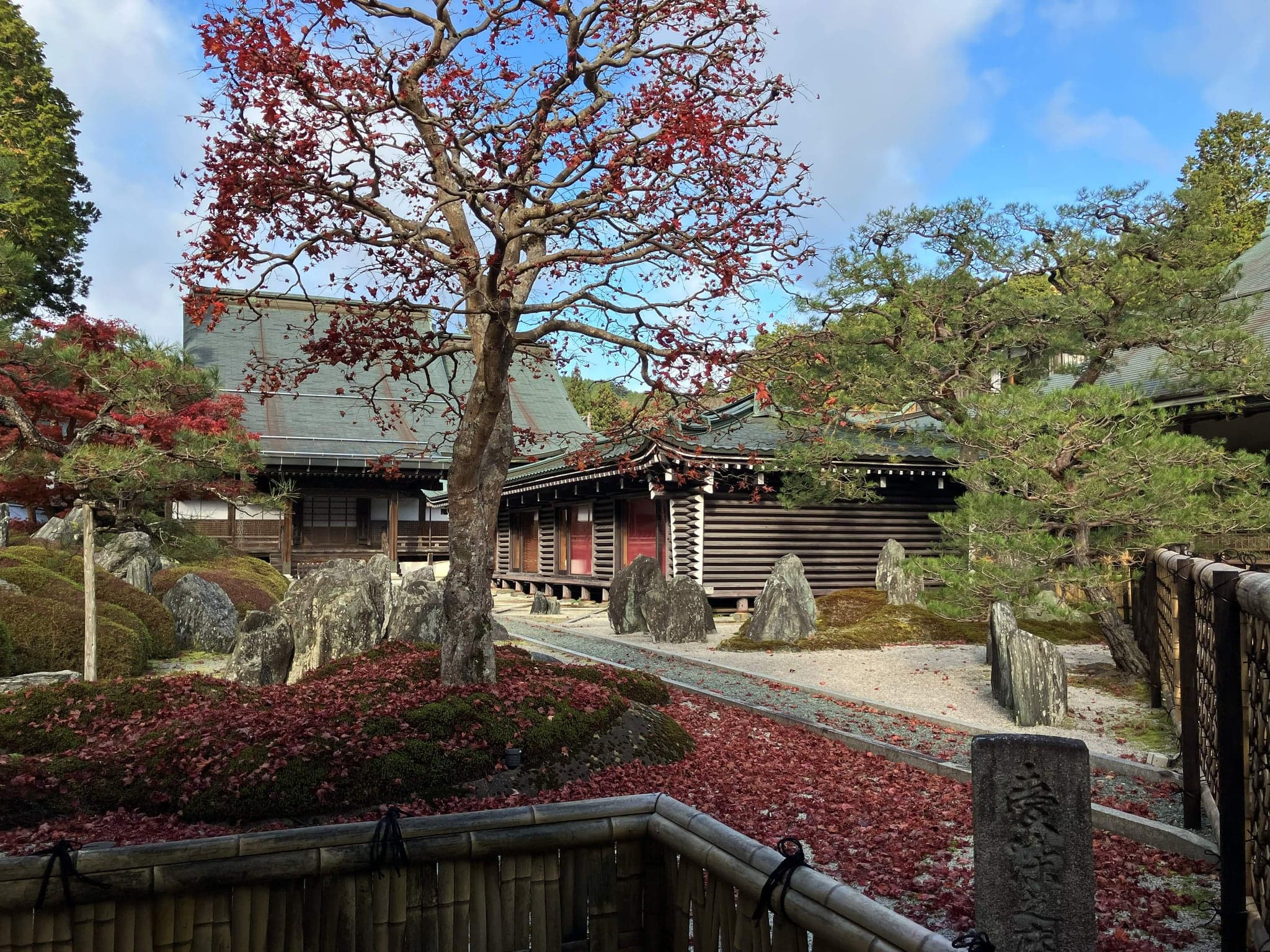
The morning service is held daily at 06:00 and anyone may attend. Dinner is shojin ryori built around local produce — Koya-dofu, the freeze-dried tofu invented on this mountain, sesame tofu, mountain vegetables and pickles.
A Night in a Shukubo, Hour by Hour
Schedules vary by temple, but the shape of the evening is consistent across Koyasan:
- Around 14:00–15:00 — check in. You are shown to a tatami room; slippers off at the threshold, tea on the low table.
- Late afternoon — bathe. The communal bath usually opens in the afternoon and closes around 21:00 or 22:00. At Fukuchi-in this is the hot spring.
- Around 17:30–18:00 — dinner. Served in your room or a dining hall. Arrive late and you may miss it entirely, so plan the trains to land in the early afternoon.
- Evening — the town goes quiet. Most temples have a gate curfew around 21:00. The Okunoin path, however, is open all night and lit by stone lanterns.
- 06:00–07:00 — morning service. Chanting in the main hall, guests welcome, free, and the one part of Koyasan's temple lodging that no hotel can copy. Some temples add a goma fire ritual; ask when you book if that matters to you.
- Then breakfast, and check-out around 10:00. Breakfast is another vegetarian tray: rice, miso soup, pickles and a simmered dish or two.
Take socks — the halls are cold underfoot — and a small towel for the shared bathroom and bath. Many temples are cash-only, and there are few ATMs on the mountain.
The evening: night tour, meditation, sutra copying
Between dinner and the curfew there is more to do than you would expect. Local guides run a night tour of Okunoin — around 90 minutes among the lanterns, with the history of Kobo Daishi and the stories behind the older tombs — and it is the single most popular thing guests book on the mountain, so reserve it before you arrive. Many temples also offer an afternoon meditation session: ajikan meditation, the Shingon practice of sitting with the syllable A, usually explained step by step by a monk, plus sutra copying for anyone who would rather use a brush than sit still. Ask whether your temple runs them, and whether they are free for guests staying overnight.
From our Japan travel team
Rooms on Mount Koya fill up early, especially in the autumn foliage weeks from mid-October to mid-November and around the cherry blossoms in April. The temple and the Nankai trains are booked on separate systems, so it is easy to end up with a train ticket for a night the temple cannot take you. Our self-guided tours book both together, along with the rest of the route. Feel free to get in touch with your dates and we'll check what is open.
Shojin Ryori: The Food
For many guests the meals are the memory. Shojin ryori is Buddhist vegetarian cuisine — no meat, no fish, and traditionally no onion or garlic. In practice most of it is vegan.
Expect sesame tofu with a dab of wasabi, tempura of edible wild plants, simmered dishes built on seasonal vegetables, pickles, miso soup and rice, all arriving on lacquer trays and arranged by season. These are vegetarian meals in the strict sense — no dashi from fish, no meat stock. Koya-dofu, the freeze-dried tofu that takes its name from this mountain, turns up in some form at nearly every meal. If you have allergies — soy and sesame especially — tell the temple when you book, because the menu is built on both.
Okunoin: Japan's Largest Cemetery
The approach to Okunoin runs about two kilometers from the Ichinohashi bridge to the mausoleum of Kobo Daishi, who is held by believers not to have died but to be in eternal meditation. More than 200,000 monuments line the path under cedars several hundred years old, and the beautiful surroundings do as much of the work as the monuments themselves, including the graves of Oda Nobunaga, Toyotomi Hideyoshi, Tokugawa Ieyasu and the forty-seven ronin.
Walking the approach is free, and you can participate in as much or as little as you like. Walk it twice if you can. In daylight you can read the monuments; after dark, lit only by stone lanterns, it is the single most atmospheric hour on the mountain. The path is open at night, and local operators run guided night walks — book those ahead, since they fill in peak weeks.
The Rest of the Town
- Danjo Garan — the ritual heart of Koyasan, a few minutes from the Senjuinbashi crossroads. The vermilion Konpon Daito pagoda stands about 48 meters tall, with a three-dimensional mandala inside (entry ¥500). Walking the precinct itself is free.
- Kongobuji — the head temple of Shingon Buddhism, founded by Kobo Daishi in 816, with painted sliding screens and Banryutei, the largest rock garden in Japan.
- Daimon Gate — the great western entrance, rebuilt in 1705 and standing 25.1 meters high, with a guardian statue on each side. It is the natural end of a walk through the town centre.
All three are walkable, and the local bus loop connects them if the weather turns.
Getting to Koyasan From Osaka
This is where people come unstuck: Koyasan is not on the JR network. You travel on the Nankai Koya Line from Namba or Shin-Imamiya to Gokurakubashi Station at the foot of the mountain, take the cable car up, then a bus into the town centre. It is a long day if you start it in Tokyo, so most visitors come up from Osaka or Kyoto.
🚃 From Osaka Namba (adult, one way)
| Leg | Time | Fare | Notes |
|---|---|---|---|
| Nankai Limited Express Koya (direct) | About 80 minutes | ¥1,880 e-ticket / ¥2,030 paper | Reserved seats, roughly two trains a day |
| Nankai express or rapid express | About 100 minutes | ¥930 | Every 20–30 minutes; most need a change at Hashimoto |
| Cable car, Gokurakubashi → Koyasan Station | About 5 minutes | ¥500 | The only way up from the valley |
| Bus, Koyasan Station → Senjuinbashi | About 10 minutes | ¥460 | Walking that road is not permitted |
💡 The Koyasan World Heritage Ticket bundles the return train, two days of unlimited buses on the mountain and discount coupons: from Namba it is ¥4,210 as a paper ticket or ¥3,980 digital, and ¥5,200 / ¥4,910 with a one-way limited express seat (2026 prices).
One quirk worth knowing: you cannot walk from the cable car station into town. The connecting road is closed to pedestrians, so take the bus or a taxi.
Day Trip or Overnight?
Is a koyasan temple stay worth it if you are short on time? A day trip from Osaka is possible — you can visit Danjo Garan, Kongobuji, Daimon Gate and Okunoin in daylight and be back for dinner. But the morning service, the shojin ryori, the temple bath and the lantern-lit cemetery after dark are the things that make Koyasan different from every other temple town in Japan, and all of them need the night.
If you only have a day, go. If you can spare a night, the night is the trip.
When to Visit
Koyasan is 800 meters up, so it runs colder than Osaka all year. Spring brings cherry blossoms in April; the rainy season in June suits the moss and the cedars; summer is a genuine escape from the heat of the cities. Autumn, from mid-October to mid-November, is peak foliage and the busiest season for the shukubo — book two months out at least. Winter is cold, snowy and very quiet, and some temples shift their morning schedule, so confirm when you book.
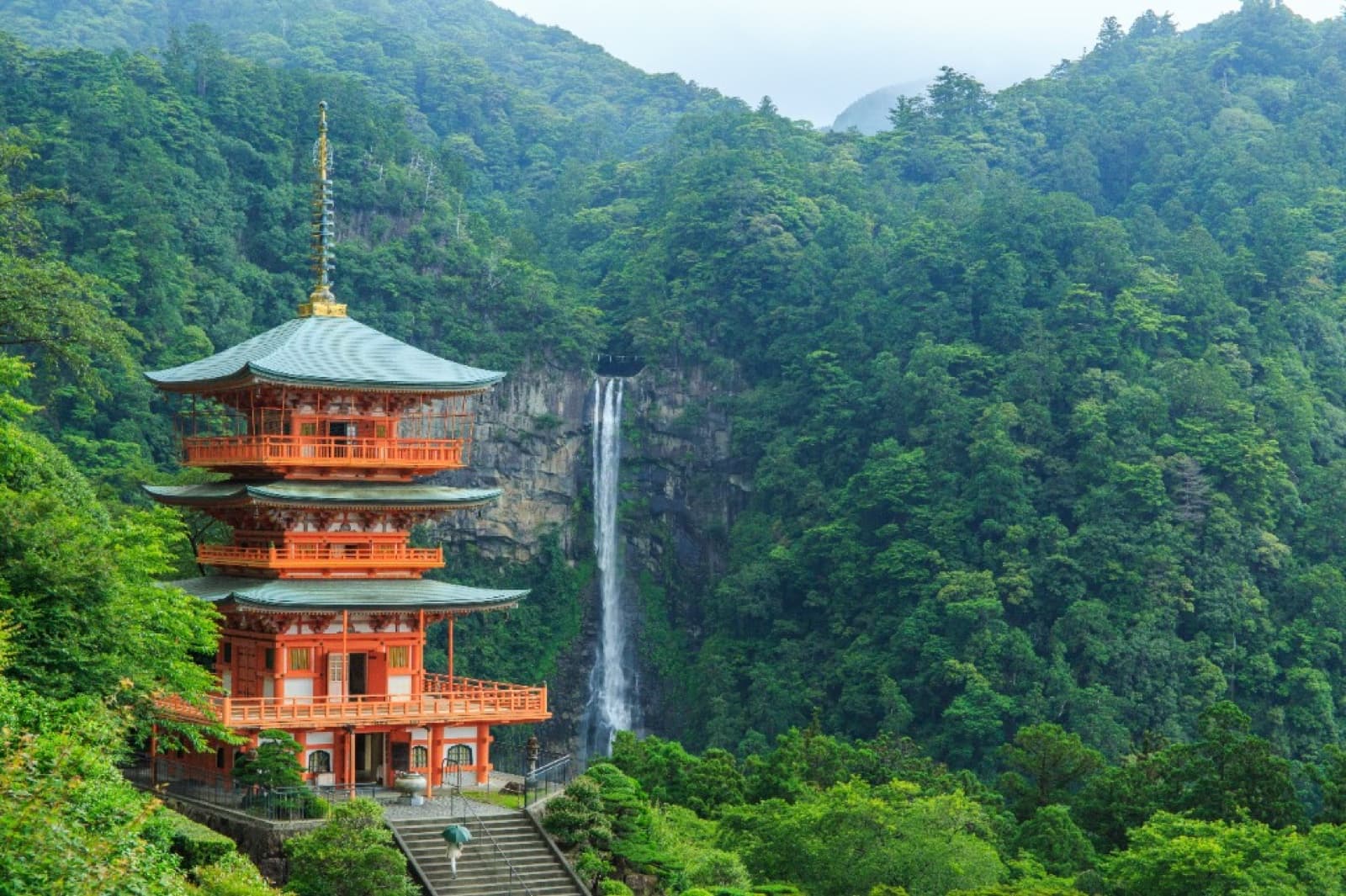
If you are pairing Koyasan with the Kii Peninsula, our Kumano Kodo guide covers the pilgrimage routes that start from this mountain.
Choosing between the other temples
If our dates do not suit you, the Koyasan Shukubo Association books most of the mountain's temple lodging centrally, and many temples take direct reservations. Ekoin temple is the best known among foreign guests and the easiest to book in English. The differences between other temples are mostly in the morning: some hold a goma prayer — the fire ceremony, where a monk feeds cedar sticks into a rising flame — while others keep to sutra chanting for their morning prayers. If the fire ritual is what you came for, confirm that the temple holds one before you book, because not every morning ritual includes it. A family is welcome at most temples, though the early bedtime and shared bath suit older children better than toddlers.
Our Self-Guided Routes With a Koyasan Temple Stay
Every route below books Fukuchi-in along with the trains, the other hotels and your luggage transfers. Most give you two nights on the mountain, which is what turns a temple stay from a stopover into the centre of the trip.
🗺️ Routes with a night at Fukuchi-in (per person)
| Route | Length | The Koyasan nights | Price range |
|---|---|---|---|
| Koyasan: Sacred Sites and Quiet Beauty (KM003) | 12 days | Two nights at Fukuchi-in, with Kyoto, Nara, Kinosaki and Osaka | $3,500–$5,200 |
| From Urban Energy to the Soul of Koyasan (KM004) | 12 days | Two nights at Fukuchi-in, plus a night in Kinosaki Onsen | $3,300–$4,700 |
| Koyasan: Sacred Sites and Quiet Beauty – Deluxe (KM103) | 12 days | The same route with upgraded hotels and three dinners | $4,000–$4,900 |
| SOLO Koyasan: Sacred Sites and Quiet Beauty (SL003) | 12 days | The solo version, two nights on the mountain | $3,700–$5,400 |
| Walking Japan's Coastal & Sacred Trails (NT003) | 13 days | One night at Fukuchi-in after the Kumano Kodo and Ise | $4,500–$6,100 |
| Spiritual Peak Experience: Yoshino & Koyasan (KR001) | 4 days | A short Kansai add-on: Yoshino, then a night on Koyasan | $1,400–$2,000 |
💡 Prices are per person from the current catalog and vary by departure date. KM001, KM002, KM101, KM102, NT001, NT002, NT006 and NT007 also include a night at Fukuchi-in as part of longer journeys.
From our Japan travel team
A temple stay only happens at a handful of places in Japan, and Koyasan is the one that does it best — the morning service and the shojin ryori are part of the room, not an optional extra. Our self-guided routes give you two nights up there, so you get the cemetery at night and again in the morning light. If you'd like Koyasan built into a Kansai trip, just ask and we'll help you slot it into your route.
FAQ: Koyasan Temple Stay
Do you have to be Buddhist to stay at a shukubo?
No. Temple lodgings welcome guests of any faith or none, and nothing is compulsory — you can skip the morning service and sleep in, though most guests find it the best part of the stay.
How much does a Koyasan temple stay cost?
Typically ¥10,000–¥40,000 per person per night with dinner and breakfast, depending on the temple and the room. On our routes the Koyasan nights are inside the tour price, which runs from $1,400 for the four-day Yoshino and Koyasan trip to $5,400 for the twelve-day solo route.
What is the food like?
Shojin ryori: Buddhist vegetarian cuisine, usually vegan, built on tofu, mountain vegetables, pickles and rice. Koya-dofu, the freeze-dried tofu invented on this mountain, appears at most meals. Tell the temple about allergies when you book.
How do I get to Koyasan from Osaka?
Not by JR. Take the Nankai Koya Line from Namba — about 80 minutes on the limited express (¥1,880 as an e-ticket) or 100 minutes on the express with a change at Hashimoto (¥930) — then the five-minute cable car (¥500) and a ten-minute bus into town (¥460). Walking that last road is not permitted.
Is the morning service free?
Yes, for overnight guests. Fukuchi-in holds it daily at 06:00 and it is open to anyone. Some temples follow it with a goma fire ritual; not every temple does, so check if that is what you came for.
Is one night enough?
One night gets you the dinner, the morning service and the cemetery after dark. Two nights let you walk Okunoin in both daylight and lantern light and still see Danjo Garan, Kongobuji and Daimon without rushing — which is why most of our routes book two.
Are there private bathrooms and baths?
Traditionally no: rooms are tatami with shared facilities and a communal bath. Some temples now offer upgraded rooms with their own bathroom. Fukuchi-in's draw is different — it has the only natural hot spring on Koyasan.
Can I do Koyasan as a day trip from Osaka or Kyoto?
Yes, and you will see the main halls and Okunoin in daylight. You will miss the meals, the morning service and the night walk. If the temple stay is the reason for the detour, stay the night.
Which of your tours include a Koyasan temple stay?
KM003, KM004, KM103 and SL003 stay two nights at Fukuchi-in; KR001, NT003, KM001, KM002, KM101, KM102, NT001, NT002, NT006 and NT007 include one night as part of a longer route.
Want a Temple Stay in Your Japan Trip?
Tell us your dates and what else you want to see, and we'll tell you which routes have Koyasan nights open, what they cost, and whether one night or two fits the rest of your plan. We book the temple and the trains together, send your luggage ahead so you climb the mountain with a day bag, and support you around the clock while you travel.
Last updated: September 16, 2026. Temple details are from Fukuchi-in and the Koyasan Shukubo Association; train, cable car and bus times and fares are as published by Nankai, and the Koyasan World Heritage Ticket prices are the 2026 fares from Namba. Tour prices are per person from our current catalog and vary by departure date.