
Kyushu Itinerary: 7 Days Without Driving, Plus Longer Onsen Routes
A realistic week through Fukuoka, Nagasaki and Kumamoto, with longer journeys to Takachiho, Beppu and southern Kyushu.
Last updated: October 13, 2026. Prices and seasonal operations checked against the linked sources.
Getting around Kyushu without a car is easier than most trip reports suggest. Fukuoka, Nagasaki, Kumamoto and Kagoshima all sit on fast rail lines. The places that don't, such as Takachiho, the upper Aso grasslands and the far end of the Satsuma Peninsula, are where a prebooked chartered taxi works better than a rental car you'd have to park, refuel and return.
So here's the short answer. A good seven-day Kyushu itinerary uses three bases connected by rail: Fukuoka for two nights, Nagasaki for two and Kumamoto for two, then you travel onward on day 7. It leaves Takachiho, Beppu and Kagoshima for a longer trip. Our nine-day routes add either the Takachiho–Beppu crossing or a southern route through Kagoshima and Ibusuki; the slower onsen journeys take twelve or thirteen days.
The seven-day plan below is an independent planning example. Our bookable Kyushu self-guided tours run nine, twelve and thirteen days. All five are compared side by side further down, along with what each one includes and what it doesn't.
Quick Answer: Which Kyushu Itinerary to Start With
Seven days, booked yourself, no driving: Fukuoka (2 nights) → Nagasaki (2) → Kumamoto (2) → leave on day 7. You only take trains. Going to Nagasaki, you change once, across the platform at Takeo-Onsen. Going on to Kumamoto, you change twice, at Takeo-Onsen and Shin-Tosu.
Nine days, with mountains and hot springs: start with Hidden Kyushu: Nature, Onsen & Culture Adventure (KY001). It covers the same three cities, then adds a night in Takachiho and two in Beppu. The catalog lists:
- Shinkansen and limited express tickets for the main intercity legs
- chartered sightseeing taxis on days 6 and 7
- the Gunkanjima Landing & Tour Cruise
- eight nights with breakfast
- three dinners in Takachiho and Beppu
The published range for KY001 is US$2,900–4,000 per person, based on two people sharing a room. Your departure date, room arrangement and availability determine the final quote. The KY001 price sheet (PDF) shows the spread.
Why start with KY001? It fills the gap the seven-day plan leaves. Takachiho and the road across to Beppu are the hardest legs to do without a car, and that's where its taxi days fall.
Kyushu Rail Update, Checked October 13, 2026
Transport status as of October 13, 2026 (Japan time)
- Kyushu Shinkansen (Hakata–Kumamoto–Kagoshima-Chuo): the whole line has been running again since September 18, 2026, but on a changed timetable. When service restarted, JR Kyushu changed train times and ran trains more slowly on a stretch near Shin-Yatsushiro, south of Kumamoto. Old timetables and saved screenshots may no longer be right.
- Kagoshima Main Line (the regular line, not the Shinkansen): the Uto–Yatsushiro section reopened on October 10, 2026, and the line went back to its full normal timetable that day.
- These are two separate lines. A normal timetable on the Kagoshima Main Line doesn't mean every Kyushu service is back to normal. Check JR Kyushu (or its English site) the day before any train transfer.
Both changes follow the July 2026 earthquake in Kumamoto Prefecture. The main north–south rail route is open, but plan connections using the current timetable. Check the service notices when booking and again on the travel day, particularly before a flight connection.
Is Kyushu Worth Visiting Without a Car?
Yes. For a first trip, going without a car is probably the better choice. Kyushu is the southernmost main island of Japan's big four, and its rail network has a clear backbone:
- Kyushu Shinkansen: runs north–south from Hakata to Kagoshima-Chuo.
- Nishi-Kyushu Shinkansen plus the Relay Kamome limited express: links Hakata and Nagasaki.
- JR Hohi Line: crosses the middle of the island from Kumamoto, through the Aso caldera, toward Oita.
Most of the famous places sit along those three lines.
What makes Kyushu worth visiting is how much fits into a small area:
- hot springs in almost every prefecture, from Beppu's steaming vents to Ibusuki's sand baths
- two active volcanoes you can actually see, Aso and Sakurajima
- Nagasaki, whose history runs from Portuguese traders to the atomic bomb
- food worth planning a trip around, Hakata ramen above all
There is a real catch, though. Rural Kyushu runs on infrequent buses, and Takachiho has no working train station at all. On the southern Satsuma Peninsula, Miyazaki's east coast and the high Aso roads, public transport exists on paper, but in practice it uses up half your day. The routes in this guide are built around that gap.
Kyushu Road Trip or Rail? Where a Rental Car Actually Helps
To be fair to drivers, a Kyushu road trip has real appeal. The Nichinan coast south of Miyazaki is a classic driving route. The roads around the Aso caldera rim are gorgeous. A rental car also makes Kirishima's scattered hot springs an easy afternoon.
But look at what driving involves:
- Paperwork: check the license documents required for your nationality before booking a rental vehicle.
- Driving on the left: traffic in Japan keeps left.
- City parking: it's tight and paid in Fukuoka, Nagasaki and Kumamoto. Nagasaki's steep hillside streets are a bad place to get used to a new car.
- Speed between cities: the train is simply faster. Hakata to Kumamoto takes well under an hour on the fastest Shinkansen, which beats the expressway.
The routes combine rail and prebooked chartered taxis in different proportions. KY001, KY003 and KY005 use trains for major city legs, while KY002 and KY004 lean more on chartered taxis. The comparison table shows the transport included in each. If you want the coast drive anyway, add it as a separate part of the trip so it doesn't shape everything else.
The 7-Day Kyushu Itinerary Without Driving
This is the do-it-yourself sample: six nights, three bases, no car and no 5 a.m. alarms. Staying two nights in each place means you pack up three times instead of six, and each base gets at least one full day.
| Day | Overnight | How you get there | Main focus |
|---|---|---|---|
| 1 | Fukuoka | Fukuoka Airport → Hakata by subway | Hakata ramen, yatai |
| 2 | Fukuoka | Nishitetsu train to Dazaifu and back | Dazaifu Tenmangu, Kushida Shrine, Tochoji Temple |
| 3 | Nagasaki | Relay Kamome to Takeo-Onsen, then Kamome Shinkansen | Glover Garden, harbor |
| 4 | Nagasaki | City tram | Peace Park, Atomic Bomb Museum, Sanno Shrine |
| 5 | Kumamoto | Kamome → Takeo-Onsen → Relay Kamome → Shin-Tosu → Kyushu Shinkansen | Kumamoto Castle |
| 6 | Kumamoto | Optional JR Hohi Line to Aso | Aso grasslands, or a slow city day |
| 7 | — | Shinkansen north, or a bus to the airport | Onward departure |
You'll book all of this yourself: hotels, Shinkansen and limited express seats, any Gunkanjima cruise, and local transport. None of it is hard, but the order matters. Book rooms first, then trains.
Day 1: Land in Fukuoka, Then Hakata Ramen and Yatai
Fukuoka Airport is unusually close to the city. From the domestic terminal, the subway reaches Hakata Station in about five minutes. International arrivals can use the free terminal shuttle to reach that subway, or a bus or taxi directly into the city. Stay near Hakata Station for the easiest departure on day 3, or in Tenjin if nightlife and shopping matter more to you.
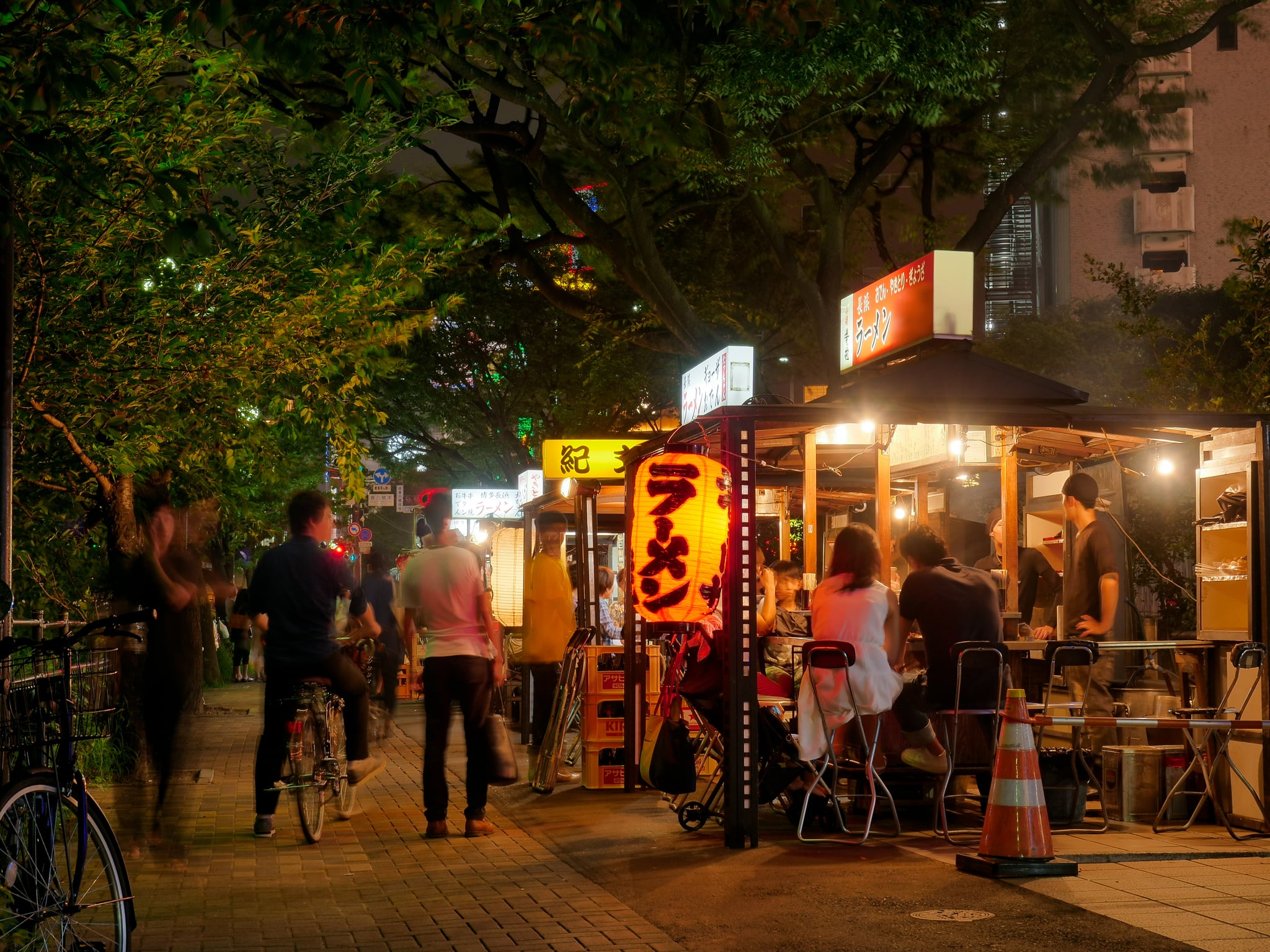
The evening is for eating. Hakata ramen is the local style: cloudy pork-bone (tonkotsu) broth and thin, straight noodles. When your bowl runs low, you order a kaedama, which is a refill of noodles, so drink the broth slowly. Canal City Hakata, between Hakata and Tenjin, has a whole floor of ramen shops if you want to compare styles in one place.
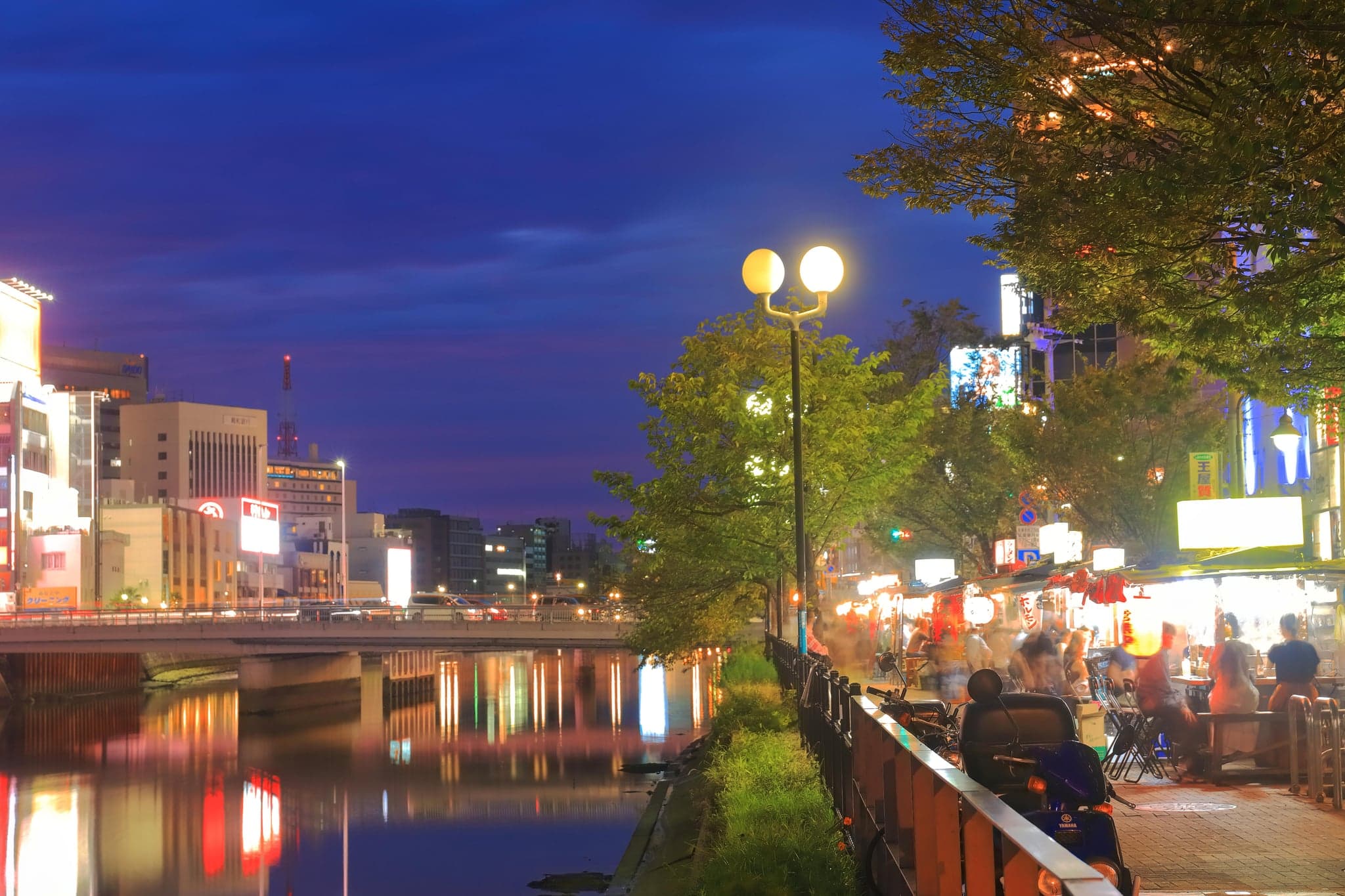
Then go to the yatai. Fukuoka is one of the last big Japanese cities where open-air food stalls set up on the street every evening, mostly around Nakasu, Tenjin and Nagahama. Yatai food stalls only seat a handful of people, so the etiquette is simple. Order a drink and a dish or two, chat, and give up your seat when people are waiting. It's street food with a roof and a host, and it's the most Fukuoka thing you can do on your first night.
Day 2: Dazaifu Tenmangu Shrine and Old Hakata
Start in Hakata's older streets. Kushida Shrine is Hakata's guardian shrine and home of the Hakata Gion Yamakasa festival, held July 1–15 each year. A towering decorated float stays on display at the shrine for most of the year, except June. Close by, Tochoji Temple holds what is described as Japan's largest seated wooden Buddha, almost 11 meters tall.
After lunch, head to Dazaifu Tenmangu Shrine. It honors Sugawara no Michizane, a scholar and statesman worshipped as a god of learning. Nishitetsu trains from Tenjin reach Dazaifu in about half an hour, though some services need a change at Futsukaichi. Check Dazaifu Tenmangu’s current visitor notices for access to the main hall and any work affecting the approach. Leave time for the street leading up to the shrine and a warm umegae-mochi, the local grilled rice cake.
Two practical notes:
- Nishitetsu isn't a JR line, so a JR rail pass won't cover it. A transport IC card will.
- For more Fukuoka ideas, see our Fukuoka guide. We won't repeat that list here.
Day 3: Hakata to Nagasaki via Takeo-Onsen
From Hakata Station, take the Relay Kamome limited express. It stops at Shin-Tosu and Saga on the way to Takeo-Onsen. There, the Nishi-Kyushu Shinkansen Kamome waits on the other side of the same platform for the run into Nagasaki. Allow about an hour and a half in total. The connection is timed and usually only a few minutes long.
If your bags are light, Takeo Onsen is worth a stop. It's a hot spring town with more than 1,300 years of bathing history and a vermilion gate designed by Tatsuno Kingo, the architect of Tokyo Station. Otherwise, go straight on to Nagasaki.
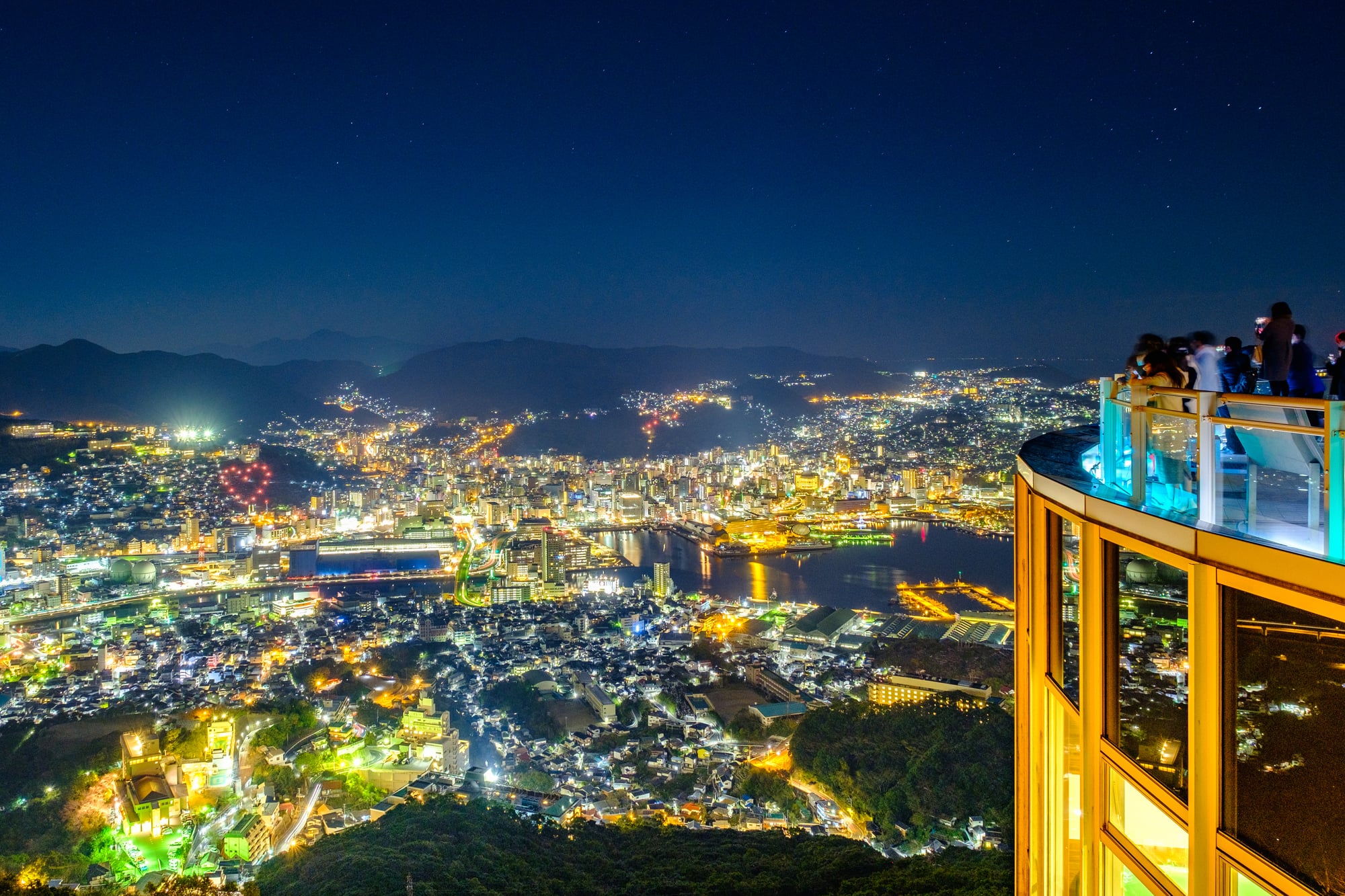
Spend the afternoon at Glover Garden, a hillside group of 19th-century Western-style houses above the harbor. The former Glover House is part of the UNESCO-listed Sites of Japan's Meiji Industrial Revolution, as is Gunkanjima. After dark, take the ropeway up Mount Inasa for an amazing view over the harbor.
About Gunkanjima: if you want the island landing cruise, book it directly with an operator for the afternoon of day 3 or the morning of day 4. That way you have a backup if the first sailing can't land. Boats leave from Nagasaki Port, and they only land when wind and waves are within the operator's safety limits. On rougher days a boat may circle the island without landing, or not sail at all.
Day 4: Peace Park, the Atomic Bomb Museum and Sanno Shrine
Give the morning to the Urakami district, a tram ride north of the center. At 11:02 a.m. on August 9, 1945, an atomic bomb exploded about 500 meters above this neighborhood. The Nagasaki Atomic Bomb Museum tells that story through objects, photographs and survivor testimony. Don't rush it, and don't book a tight lunch straight afterward.
From the museum, walk to the hypocenter area and then up to Nagasaki Peace Park. Seibo Kitamura's Peace Statue sits at its north end. One raised hand points to the threat of nuclear weapons, and the outstretched hand stands for peace.
Urakami Cathedral was devastated by the atomic bombing. It was later rebuilt, and pieces of the original wall still stand near the hypocenter.
Sanno Shrine is another stop to consider after the museum and Peace Park. Its one-legged torii gate lost one pillar in the blast and still stands on the other. The shrine's two camphor trees were stripped bare in 1945, survived and grew back. Of all the places in this itinerary, this is one of the quietest and most affecting.
Keep the afternoon light: Dejima, the rebuilt Dutch trading post, then Chinatown for dinner. If you'd rather walk the peace sites with someone who can explain them, a local guide can be arranged as an option, even on a self-guided trip.
Day 5: Nagasaki to Kumamoto via Shin-Tosu
Take the Kamome Shinkansen to Takeo-Onsen, cross the platform to the Relay Kamome, ride it to Shin-Tosu, then change to the Kyushu Shinkansen south to Kumamoto. With two changes, allow most of the morning. Check that day's Kyushu Shinkansen times on JR Kyushu, because the line is still on its changed timetable.
In the afternoon, visit Kumamoto Castle. Check the castle’s official visitor notices for the current route through the grounds, opening hours and any areas affected by repair work. Sakuranobaba Josaien, at the foot of the castle, is good for a late lunch. Suizenji Jojuen, a landscaped garden with a small Fuji-shaped mound, is a calm next stop by tram.
Day 6: Kumamoto Castle, or a Mount Aso Day Trip
You have two options:
- Stay in town: finish what you missed at Kumamoto Castle, browse the covered shopping arcades, and try basashi (horse sashimi, a Kumamoto specialty) if you're game.
- Day trip to Mount Aso: JR Hohi Line trains go from Kumamoto to Aso Station. From there, a taxi is the easiest way to reach the caldera viewpoints. Read the Aso section below before you commit, because the crater area is currently restricted.
Day 7: Onward Departure
Most people take the Kyushu Shinkansen back to Hakata for Fukuoka Airport, which takes well under an hour on the fastest trains. Some Sakura and Mizuho trains run straight through to Shin-Osaka if you're continuing into Honshu. Aso Kumamoto Airport is reached by airport bus from the city.
Why This Plan Leaves Out Takachiho and Beppu
Getting to Takachiho means a substantial road transfer from Kumamoto. Going from there to Beppu is another travel day, with sightseeing along the way. Beppu alone is reachable from Hakata in about two hours by Sonic limited express, but adding an overnight stay means changing the three-city plan above. If those places matter to you, give them the time they need, and the nine-day routes below do exactly that.
Aso Kuju National Park: Seeing an Active Volcano Without a Car
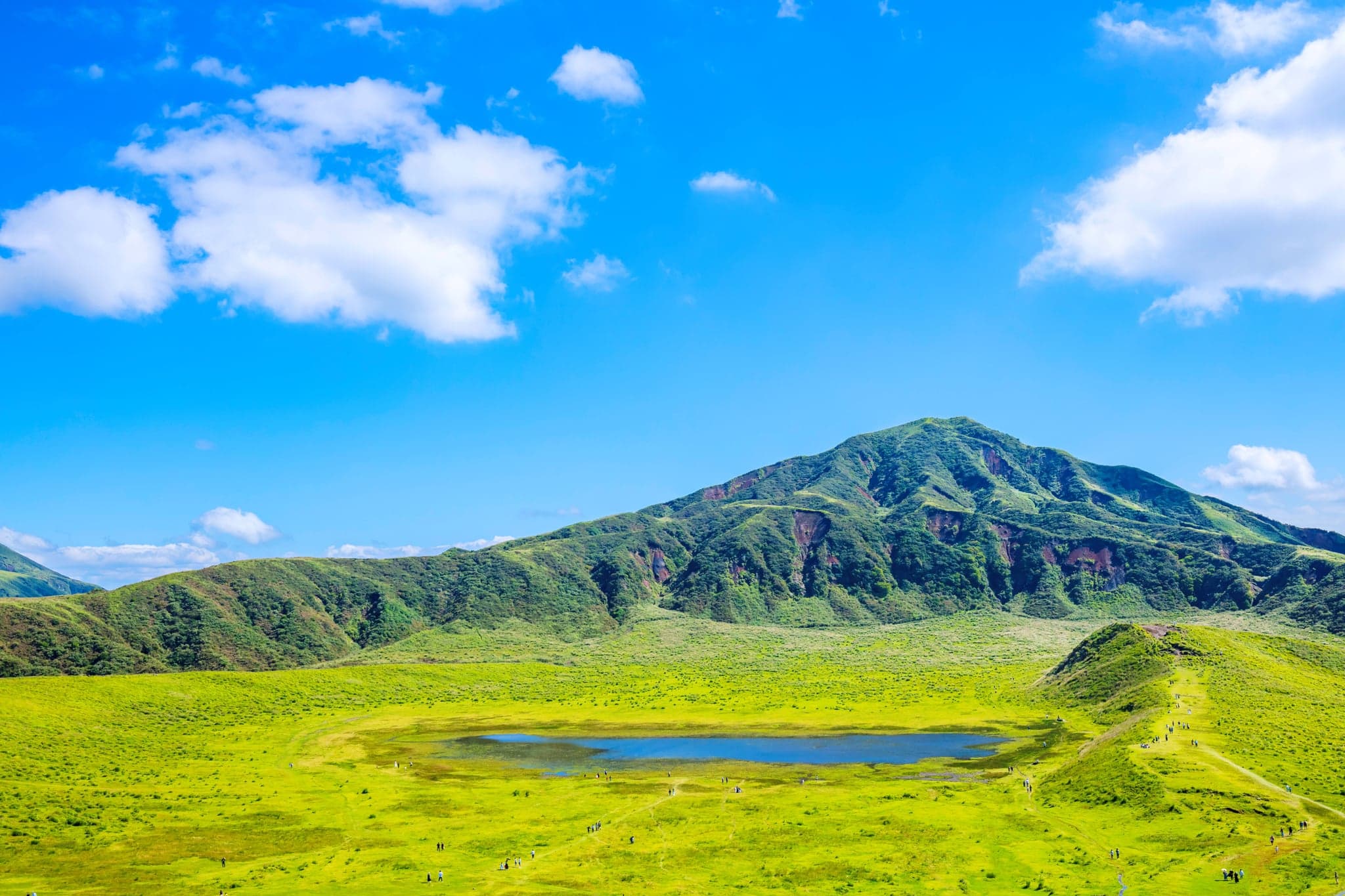
Aso Kuju National Park was among Japan's first national parks, designated in 1934. It stretches across Kumamoto and Oita Prefecture. At its center is the Aso caldera, roughly 25 km north to south and 18 km east to west, big enough to hold towns, farms and a railway line. The central cones rise inside it. Nakadake (Mount Naka) is the active one people usually mean when they say "Mount Aso."
Aso status checked October 13, 2026: JMA’s October 9 report continues volcanic alert level 2, with restrictions within roughly 1 km of Nakadake’s crater. Plan around the wider caldera, and check the local crater access notice and road conditions before setting off. Being outside the crater restriction does not itself confirm that a road or attraction is open.
So for now, plan an Aso visit around the caldera rather than the crater rim. That's still a very good day:
- Daikanbo: a lookout on the northern rim with an amazing view across the caldera floor to the central peaks.
- Kusasenri: a broad grassy crater meadow where horses graze.
- Aso Volcano Museum: next to Kusasenri.
- Aso Shrine: in the town of Ichinomiya, within reach of Miyaji Station on the Hohi Line.
Across the border in Oita, the Kuju mountains have proper hiking trails. They're better suited to people with a full day and real boots than a quick stop. The Japan National Parks page for Aso-Kuju gives good background.
Without a car, take the train from Kumamoto to Aso Station, then a taxi for the rim-and-grassland loop. Local buses up the mountain run on limited schedules. On our tours, KY001 and KY003 spend a night in Kumamoto, then go to Takachiho on a chartered sightseeing taxi day. That drive passes the southern side of the Aso area, so ask us what the taxi plan for that day covers.
The 9-Day Kyushu Trip With Takachiho and Beppu
This is the route most people really want when they search for a Kyushu itinerary, even if they first typed "7 days." Here is how KY001 lays it out:
- Days 1–2, Fukuoka: the same ground as the DIY plan above.
- Days 3–4, Nagasaki: the Gunkanjima Landing & Tour Cruise is included. The tour sends your luggage ahead from Fukuoka to Kumamoto, so your main suitcase skips Nagasaki. Pack two nights' worth in a day bag.
- Day 5, Kumamoto: you meet your suitcase again here. The castle is a short ride from the station.
- Day 6, Takachiho: a chartered sightseeing taxi day, with an overnight stay in the gorge town.
- Day 7, Beppu: another chartered sightseeing taxi day, taking you out of the mountains.
- Day 8, Beppu: a free day for baths, the "hells" or a side trip.
- Day 9: the tour ends in Beppu. Plan and budget for your onward train or airport transfer separately.
Sightseeing stops describe the planned route; admissions and activities are extra unless explicitly included, such as the Gunkanjima cruise. The tour includes three dinners in Takachiho and Beppu, eight breakfasts, and a Japanese-style room for the Beppu stay. Rail tickets for the main intercity legs are included. Local services outside the itinerary are extra. The tour also comes with a transport IC card loaded with JPY3,000 for those smaller rides. Day 9 ends in Beppu, so tell us when you enquire which onward leg you need, whether that's Oita Airport, a train back toward Fukuoka or something else.
Takachiho Gorge and Amanoiwato Shrine
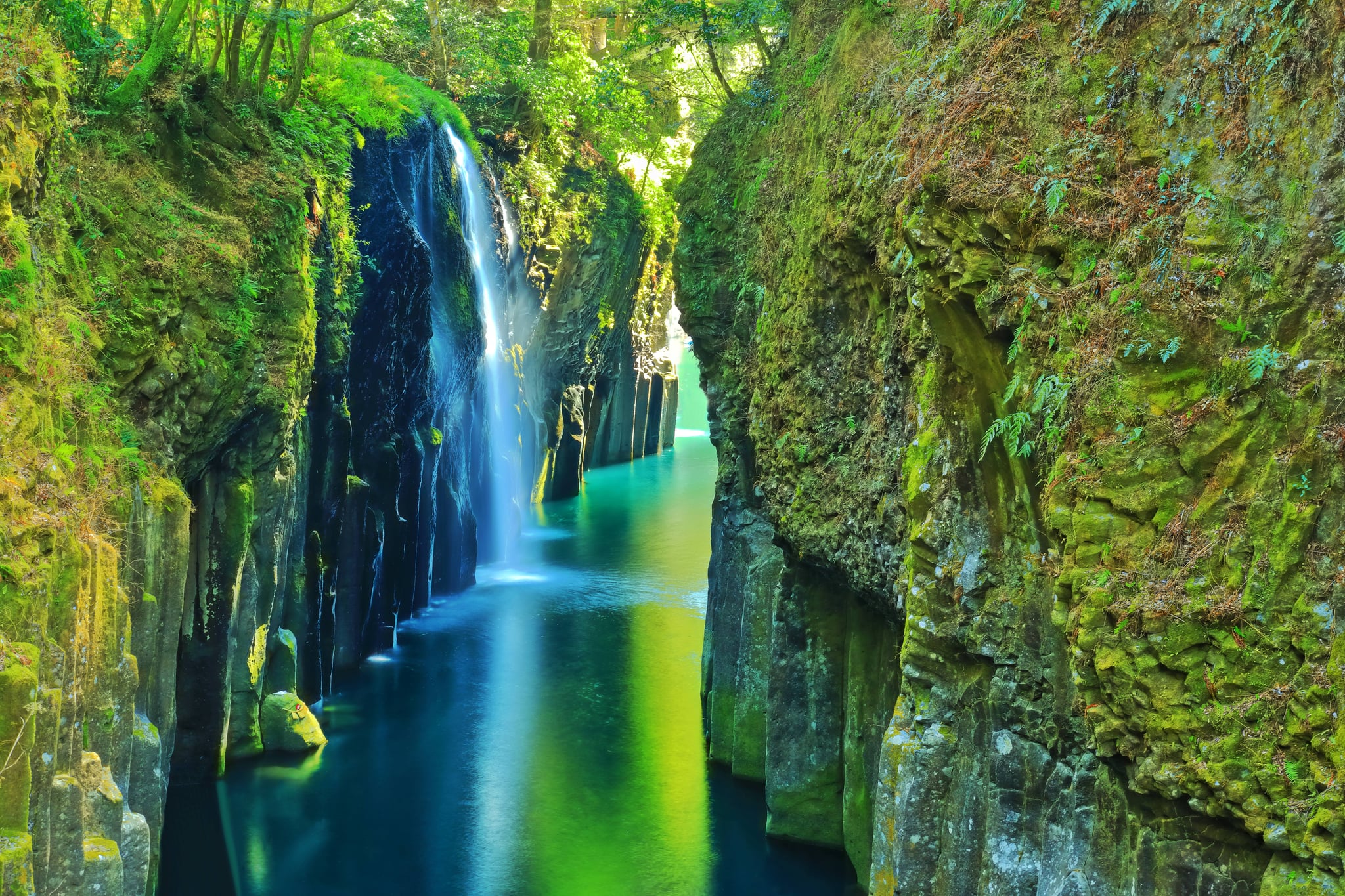
Takachiho Gorge is the reason people put up with the mountain road. The Gokase River has cut a narrow channel through rock walls formed from ancient pyroclastic flows from Aso. The cliffs rise roughly 80–100 meters, and the columnar rock looks almost carved. Manai Falls, about 17 meters high, drops into the green water at the heart of the gorge.
You can see it in two ways:
- On foot: the tourism association describes a walking path of about 1 km, with a viewpoint over the waterfall. Allow time for the steps and photo stops, and check any path closures before visiting.
- By rowboat: this is the classic close-up view of the falls. Boats are booked online. The official booking page takes advance online reservations from two weeks before the date until 9 a.m. two days before. Phone reservations are not accepted. Check the daily operating notice and any same-day ticket availability for your date instead of relying on a walk-up place.
The boat is not included in any of our five Kyushu packages. If it matters to you, set a reminder for the day booking opens. If no slot comes up, the walking path still gets you most of the way, and on an overcast morning the stunning gorge looks moody and atmospheric rather than disappointing.
Amanoiwato Shrine is a short taxi ride east. This Shinto shrine is tied to one of Japan's founding myths. In it, the sun goddess Amaterasu hides in a cave and plunges the world into darkness until the other gods coax her out. A riverside path leads to Amano Yasugawara, the cave where the gods are said to have met. Visitors leave thousands of small stacked stones there.
Takachiho is also known for kagura, a sacred dance. Ask at your accommodation whether a performance is on that evening. With one night here, plan the evening performance around dinner at your inn and confirm how much time the following day’s taxi schedule allows at the gorge and shrine.
Kamishikimi Kumanoimasu Shrine: A Bit Hidden, and Worth Asking About
Kamishikimi Kumanoimasu Shrine sits in Takamori, on the Kumamoto side of the Aso–Takachiho road. It's a bit hidden. A mossy stone stairway lined with about a hundred lanterns climbs through cedar forest, and the surrounding nature does most of the work. It's a beautiful shrine, linked in many visitors' minds with the anime film Hotarubi no Mori e. The steps are steep, uneven and slippery after rain, so wear real shoes.
It isn't a named stop on any of our catalog itineraries. Because it lies close to the route between Aso and Takachiho, though, ask whether it fits into your taxi day.
Beppu: Two Nights in a Hot Spring Town
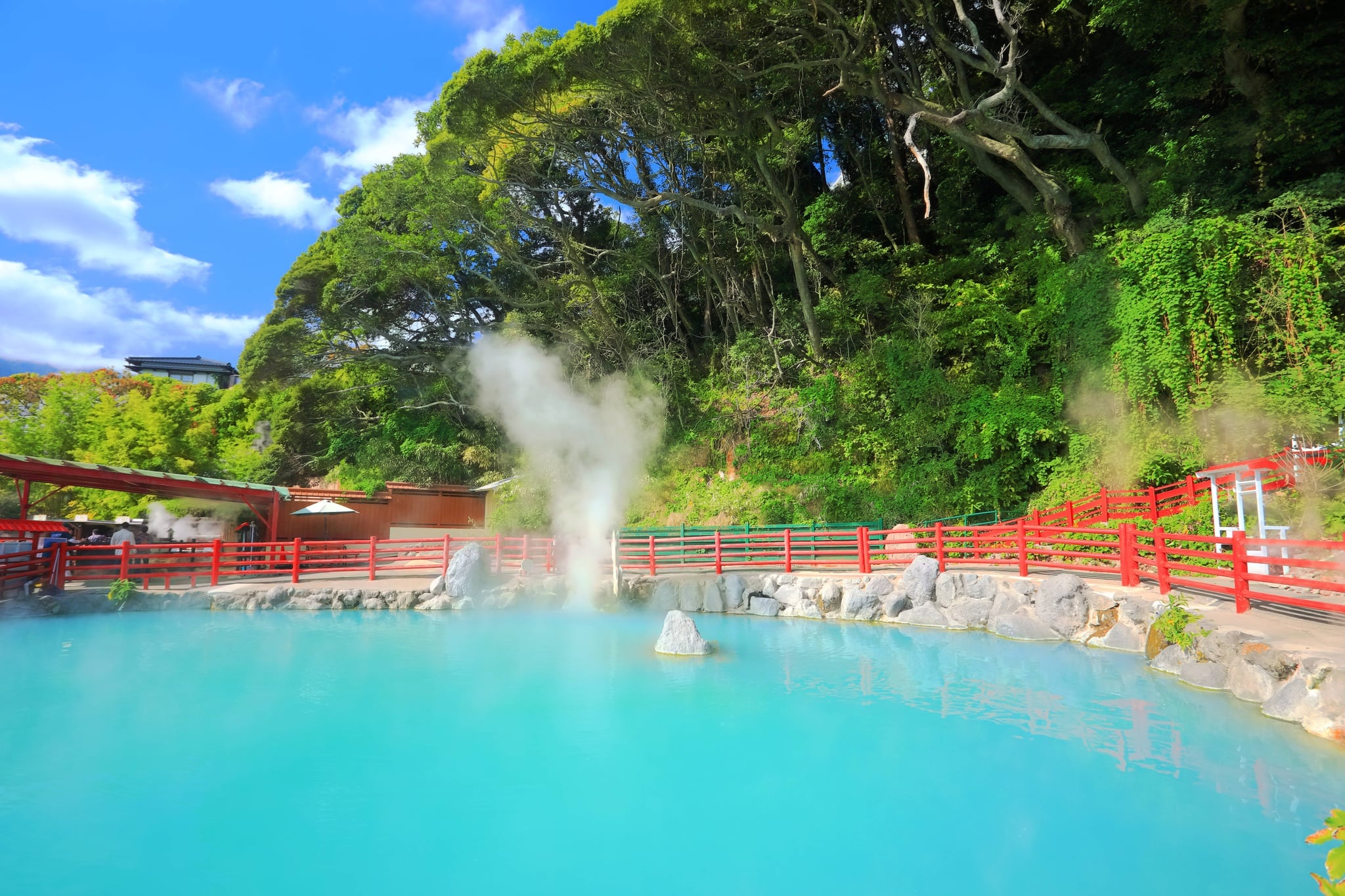
Beppu, in Oita Prefecture, is the hot spring town people picture when they think of Kyushu onsen:
- The hells (Jigoku Meguri): seven pools of boiling mud, cobalt-blue water and steam. They're for looking at, not bathing in.
- Jigoku-mushi: food steamed over the vents.
- Takegawara Onsen: a historic wooden bathhouse with bathing and sand-bath options; check the current hours and how to join before visiting.
Two nights is the right amount. One night gets you a bath and dinner. Two give you a whole slow day.
If you're new to bathing etiquette, read our onsen guide first. It covers washing, towels and tattoos, so we won't repeat that here.
On the free day, Yufuin is another option. Check the bus timetable or the rail connections via Oita before setting off; this side trip is not included in the tour. Yufuin Floral Village, a Cotswolds-style lane of small shops and animal cafés, is a short walk from Yufuin Station. Lake Kinrin is nearby. Neither is essential, but on a sunny day the town is lovely.
Going South: Kagoshima, Ibusuki and Kirishima-Kinkowan National Park
Kyushu Discovery: Volcanoes, Onsen & Scenic Wonders (KY003) swaps Nagasaki for southern Kyushu. It's also nine days and eight nights:
- Fukuoka (Hakata) 2 nights
- Kagoshima 1
- Ibusuki 1
- Kumamoto 1
- Takachiho 1
- Beppu 2
The catalog lists:
- Shinkansen and limited express tickets for the main intercity legs
- a transport IC card with JPY4,000 (the only Kyushu route with the higher amount)
- the Ibusuki no Tamatebako sightseeing train from Ibusuki to Kagoshima-Chuo
- chartered sightseeing taxis on days 4, 6 and 7
- eight nights with breakfast
- four dinners in Ibusuki, Takachiho and Beppu
- luggage delivery from Fukuoka to Kumamoto
There's no Gunkanjima cruise and no Nagasaki. That's the trade-off. Indicative catalog range: US$3,500–5,700, with date, room occupancy and availability affecting the price (KY003 price sheet).
Because your suitcase goes from Fukuoka straight to Kumamoto, you'll cover Kagoshima and Ibusuki with a smaller bag. That's two nights, so pack accordingly.
Kagoshima City faces Sakurajima, an active volcano, across the bay. The Sakurajima ferry leaves from a ferry terminal near the port. Check the current ferry timetable: the city ended 24-hour operation in October 2025, so older all-night sailing advice no longer applies. Climb to the Shiroyama Park observation deck for the classic view. Shiroyama is a hill about 107 meters high in the middle of town and was the last battleground of the Satsuma Rebellion. The view of the volcano across the water is amazing at sunset. Ash falls on some days, so a compact umbrella is useful.
Ibusuki sits near the tip of the Satsuma Peninsula. It's known for its hot sand bath. You put on a yukata, lie on the beach and are buried in sand heated by hot spring water rising beneath the shore. Follow the facility staff’s guidance on how to use the sand bath and how long to stay. In both Ibusuki and Beppu, KY003 puts you in a Japanese-style room. The Ibusuki no Tamatebako back to Kagoshima-Chuo is a reserved-seat sightseeing train of about 50 minutes. Its theme is the Urashima Taro folk tale, and it has seats facing the bay (JR Kyushu's train page).
The southern scenery connects with Kirishima-Kinkowan National Park, one of Japan’s original national parks designated in 1934. It has three areas:
- the Kirishima mountains
- Sakurajima and the inner bay
- the Ibusuki–Sata area, with Lake Ikeda, Mount Kaimon and Cape Nagasakibana
Day 4's chartered taxi falls on the Ibusuki day, and that southern Satsuma Peninsula landscape is exactly the kind of ground where someone without a car would otherwise struggle. Kirishima's own hiking trails aren't on this route, and volcanic access there changes from time to time. See the Japan National Parks overview for the bigger picture.
Staying West: Pottery Towns, Huis Ten Bosch and Yutoku Inari Shrine
Kyushu Pottery Towns & All of Nagasaki (KY002) skips the mountains entirely. It's nine days and eight nights:
- Fukuoka 2 nights
- Ureshino 1
- Huis Ten Bosch 2
- Nagasaki 3
It's the gentlest route of the five. Two hotel moves are short, and the second half is a long, unhurried stay in Nagasaki.
The inclusions are different from KY001 and KY003, so read them carefully:
- chartered sightseeing taxis on days 3 and 4 (the Ureshino and Huis Ten Bosch days)
- a non-reserved rapid train ticket from Huis Ten Bosch to Nagasaki
- the Gunkanjima Landing & Tour Cruise
- a transport IC card with JPY3,000
- eight nights with breakfast
- one dinner at the hotel in Ureshino
- luggage delivery from Ureshino to Nagasaki
The catalog doesn't list Shinkansen or limited express tickets for this tour. Ask us to walk you through each transfer before you book. Indicative catalog range: US$2,800–4,400 (KY002 price sheet), with date, room occupancy and availability affecting the price.
Ureshino is a riverside hot spring town known for its baths and local green tea. If arranging a separate rail visit, allow a bus or taxi transfer from Ureshino-Onsen Station to the hot spring town. Try onsen yudofu, tofu simmered in the spring water, if you see it on a menu. The pottery and porcelain country of Saga and Nagasaki is close by, with Arita the best-known name. The tour page has the details of each day.
Huis Ten Bosch in Sasebo is a resort built as a re-creation of the Netherlands, with canals, windmills and European architecture. Two nights give you a full day and evenings for the park. Park admission is not listed as included in KY002, so confirm the ticket you need before visiting.
Close to Ureshino, in the town of Kashima, is Yutoku Inari Shrine. It's often counted among Japan's three great Inari shrines. Its main hall stands high on wooden stilts against the hillside, and there's a paid elevator if the stairs are too much. It isn't in KY002's included list, and the local bus or taxi there is extra. Still, if you've seen Fushimi Inari in Kyoto and want a different kind of Inari shrine, it's a good half-day.
Slower Onsen Routes: 12 and 13 Days
The two premium routes cost more, but they cover more ground, include more dinners and, most of all, give you more nights in onsen towns. Both have an indicative catalog range of US$6,600–8,900. Departure date, room occupancy and availability all affect the final price.
Thirteen Days: Nagasaki, Unzen, Yanagawa, Hita and Beppu
Premium Kyushu: Serenity, Onsen & Coastal Heritage (KY004) runs thirteen days and twelve nights:
- Fukuoka 2 nights
- Nagasaki 3
- Unzen 2
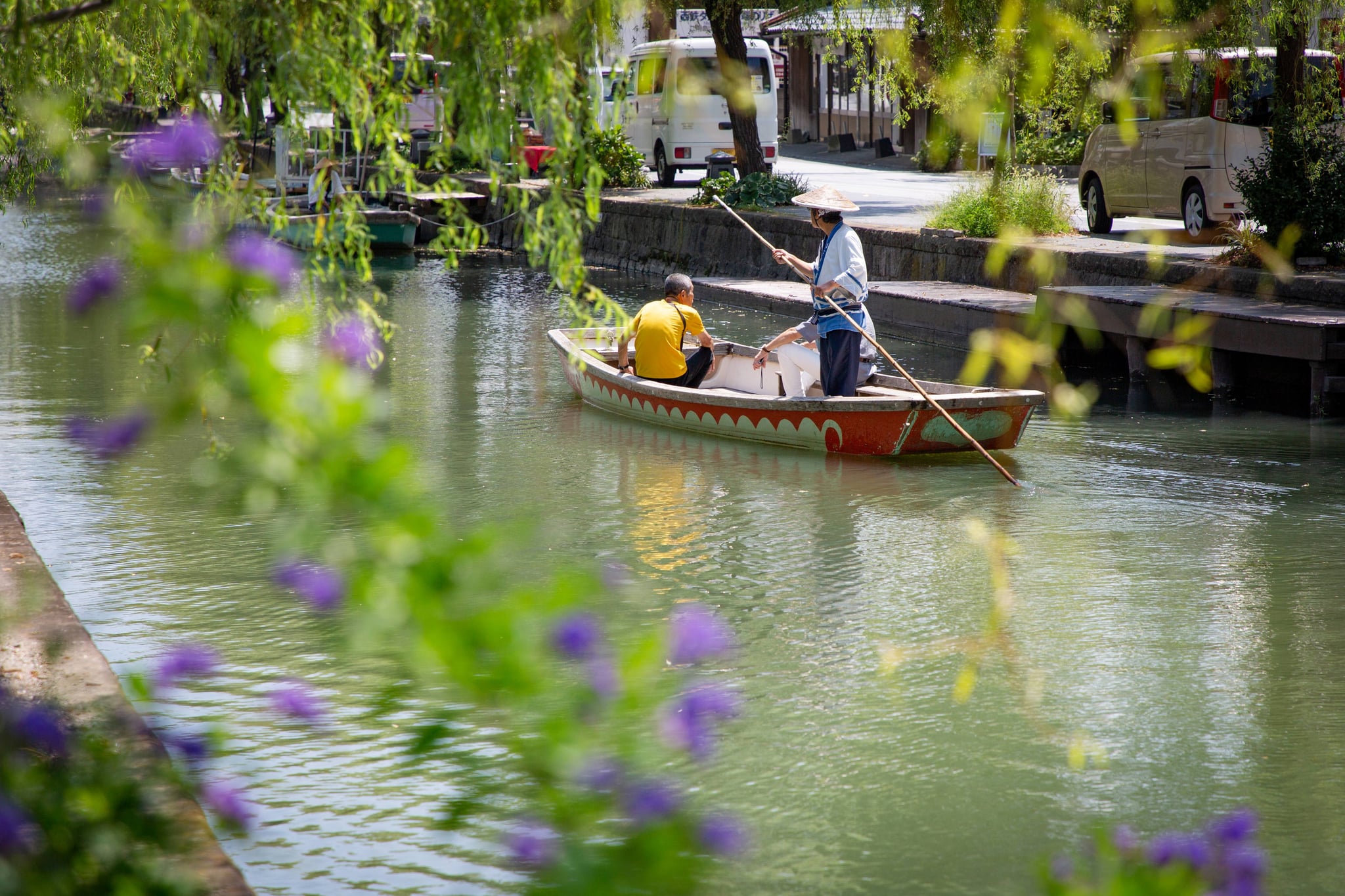
- Yanagawa 2
- Hita 1
- Beppu 2
The catalog lists:
- chartered sightseeing taxis on days 3, 6, 8, 10 and 11
- the Gunkanjima Landing & Tour Cruise
- a transport IC card with JPY3,000
- twelve nights with breakfast
- seven hotel dinners: two in Unzen, two in Yanagawa, one in Hita and two in Beppu
- luggage delivery from Unzen to Hita
As with KY002, Shinkansen and limited express tickets aren't on the list, because this route relies on its taxi days. Here's the KY004 price sheet.
On Day 8, KY004 crosses from Shimabara to Kumamoto by ferry, with taxis on either side. Ask us to confirm the ferry fare in your quote, as it is not explicit in the published inclusions.
The stops each have their own character:
- Unzen, on the Shimabara Peninsula, has its own steaming "hells," a field of roughly 30 sulfurous pools.
- Yanagawa is a canal town south of Fukuoka. The classic thing to do there is an hour-long punt ride of about 4 km through the old waterways.
- Hita has Mameda-machi, a preserved merchant district of wooden houses. The Hita room is a Japanese-style room with a private open-air bath.
Because luggage goes from Unzen to Hita, you'll cover the two Yanagawa nights with a smaller bag.
Twelve Days: Yanagawa to Kagoshima, Takachiho, Beppu and Hita
Kyushu Premium Experience: Nature, Heritage & Onsen (KY005) begins in Yanagawa and finishes in Fukuoka. It starts in Yanagawa, with a taxi from Fukuoka Airport on day 1, and continues:
- Yanagawa 2 nights
- Ibusuki 1
- Kagoshima 2
- Takachiho 1
- Beppu 2
- Hita 1
- Fukuoka 2
That's twelve days and eleven nights. The catalog lists:
- Shinkansen and limited express tickets for the main intercity legs
- the Ibusuki no Tamatebako from Kagoshima-Chuo to Ibusuki
- chartered sightseeing taxis on days 3, 4, 6, 7, 9 and 10
- a transport IC card with JPY3,000
- eleven nights with breakfast
- seven dinners: two in Yanagawa, one in Ibusuki, one in Takachiho, two in Beppu and one in Hita
- luggage delivery in two stages, Yanagawa to Kagoshima and Kagoshima to Beppu
The rooms in Yanagawa and Ibusuki are Japanese-style with two beds. Hita again has a Japanese-style room with a private open-air bath. Ending with two nights in Fukuoka is a smart design choice, because your last nights fall next to the airport. Here's the KY005 price sheet.
Compare All Five Kyushu Tours
| Code | Tour | Length | Overnights | Intercity transport listed | Chartered taxi days | Included dinners | Gunkanjima | Luggage delivery | Indicative USD range |
|---|---|---|---|---|---|---|---|---|---|
| KY001 | Hidden Kyushu: Nature, Onsen & Culture Adventure | 9 days / 8 nights | Fukuoka 2, Nagasaki 2, Kumamoto 1, Takachiho 1, Beppu 2 | Shinkansen and limited express for major intercity legs | Days 6, 7 | 3 (Takachiho, Beppu) | Yes | Fukuoka → Kumamoto | $2,900–4,000 |
| KY002 | Kyushu Pottery Towns & All of Nagasaki | 9 days / 8 nights | Fukuoka 2, Ureshino 1, Huis Ten Bosch 2, Nagasaki 3 | Rapid train, Huis Ten Bosch → Nagasaki (non-reserved) | Days 3, 4 | 1 (Ureshino) | Yes | Ureshino → Nagasaki | $2,800–4,400 |
| KY003 | Kyushu Discovery: Volcanoes, Onsen & Scenic Wonders | 9 days / 8 nights | Hakata 2, Kagoshima 1, Ibusuki 1, Kumamoto 1, Takachiho 1, Beppu 2 | Shinkansen and limited express; Ibusuki no Tamatebako (Ibusuki → Kagoshima-Chuo) | Days 4, 6, 7 | 4 (Ibusuki, Takachiho, Beppu) | No | Fukuoka → Kumamoto | $3,500–5,700 |
| KY004 | Premium Kyushu: Serenity, Onsen & Coastal Heritage | 13 days / 12 nights | Fukuoka 2, Nagasaki 3, Unzen 2, Yanagawa 2, Hita 1, Beppu 2 | No Shinkansen or limited express listed | Days 3, 6, 8, 10, 11 | 7 (Unzen, Yanagawa, Hita, Beppu) | Yes | Unzen → Hita | $6,600–8,900 |
| KY005 | Kyushu Premium Experience: Nature, Heritage & Onsen | 12 days / 11 nights | Yanagawa 2, Ibusuki 1, Kagoshima 2, Takachiho 1, Beppu 2, Hita 1, Fukuoka 2 | Shinkansen and limited express; airport taxi to Yanagawa on day 1; Ibusuki no Tamatebako (Kagoshima-Chuo → Ibusuki) | Days 3, 4, 6, 7, 9, 10 | 7 (Yanagawa, Ibusuki, Takachiho, Beppu, Hita) | No | Yanagawa → Kagoshima; Kagoshima → Beppu | $6,600–8,900 |
Interested in a tour? Click a route code above, or search for it in the top-right Search bar.
All USD ranges are per person, based on double occupancy, as stated in the linked pricing PDFs. Your departure date, room arrangement and availability determine the final quote. Accommodation tax and unlisted transport, admissions and meals are extra.
Here's a quick way to choose:
- [KY001](https://selfguidejapan.com/tours/KY001): the best all-rounder.
- [KY003](https://selfguidejapan.com/tours/KY003): if Sakurajima and the sand baths appeal more than Nagasaki.
- [KY002](https://selfguidejapan.com/tours/KY002): for a slower western loop without mountains.
- [KY004](https://selfguidejapan.com/tours/KY004) or [KY005](https://selfguidejapan.com/tours/KY005): when the onsen nights matter as much as the sights.
Choose a starting route
Hidden Kyushu: Nature, Onsen & Culture Adventure
Two nights in Fukuoka, two in Nagasaki, one in Kumamoto, one in Takachiho and two in Beppu. Includes the specified trains and sightseeing taxis on Days 6 and 7.
Share your dates and party size, and we’ll check availability and send a quote for your trip.
What's Included, and What You'll Still Pay For
All five Kyushu routes include:
- 24/7 customer support during your stay in Japan
- travel insurance
- breakfast with every night's accommodation
- a transport IC card: JPY3,000 on KY001, KY002, KY004 and KY005, and JPY4,000 on KY003
The other inclusions vary by route:
- [KY001](https://selfguidejapan.com/tours/KY001): Shinkansen and limited express for major intercity travel, the Gunkanjima cruise, taxis on days 6–7, three dinners (Takachiho and Beppu) and luggage delivery from Fukuoka to Kumamoto.
- [KY002](https://selfguidejapan.com/tours/KY002): the rapid train from Huis Ten Bosch to Nagasaki, the Gunkanjima cruise, taxis on days 3–4, one dinner (Ureshino) and luggage delivery from Ureshino to Nagasaki.
- [KY003](https://selfguidejapan.com/tours/KY003): Shinkansen and limited express, the Ibusuki no Tamatebako, taxis on days 4, 6 and 7, four dinners and luggage delivery from Fukuoka to Kumamoto.
- [KY004](https://selfguidejapan.com/tours/KY004): the Gunkanjima cruise, taxis on days 3, 6, 8, 10 and 11, seven dinners and luggage delivery from Unzen to Hita.
- [KY005](https://selfguidejapan.com/tours/KY005): Shinkansen and limited express, the airport taxi to Yanagawa, the Ibusuki no Tamatebako, taxis on days 3, 4, 6, 7, 9 and 10, seven dinners and two luggage transfers.
Not included on any of the five:
- international flights
- local trains and buses not in the itinerary
- early check-in and late check-out fees
- hotel incidentals
- meals and drinks beyond those listed
- entrance fees for sights not detailed in the itinerary
- personal expenses
- visas
- accommodation tax
These are self-guided trips, so no guide travels with you. If you'd like a local guide for a particular day, such as Nagasaki's peace sites or Takachiho, one can be arranged as an option. At the airport, you receive your trip documents, tickets for the legs listed as included and a loaded IC card. None of these tours includes a rail pass.
Miyazaki's East Coast: Aoshima Shrine, Udo Shrine and a Blue Torii Gate
To be upfront: none of these five tours stays overnight on the Miyazaki coast. Takachiho is in Miyazaki Prefecture, but it's up in the mountains, a long way from the sea. Still, the east coast is full of interesting sites, and it's fair to tell you what's there.
- Aoshima Shrine: just south of Miyazaki City, on a small island reached by a footbridge. Around the island, rows of ridged rock called the "Devil's Washboard" fan out into the blue sea. On a clear day it's beautiful.
- Udo Shrine: further south on the Nichinan coast, built into a cave in a sea cliff. Visitors throw small clay "lucky balls" (undama) at a turtle-shaped rock below. Hit the target and you're said to get good luck.
- Sun Messe Nichinan: only a short drive from Udo Shrine. Its seven moai statues are replicas made with the permission of Easter Island's elders.
- Cape Toi: at the southern tip of the prefecture, known for its free-roaming Misaki horses, a native Japanese breed protected as a national natural monument.
- Minato Shrine: in Nobeoka, near where the Gokase River (the same river that cut Takachiho Gorge) and the Kitagawa reach the sea. It has a rare blue torii gate.
This coast is honestly the strongest argument for a Kyushu road trip. The Nichinan road is a scenic route, and trains and buses along it are sparse enough that a rental car makes sense. If it's on your list, plan it as its own part of the trip. Fly into or out of Miyazaki, drive the coast, and fit it before or after one of the rail-based routes above.
Transfers, Luggage and the Rail Pass Question
Rail Pass vs Included Tickets
JR Kyushu sells the JR Kyushu Rail Pass for overseas visitors traveling on temporary visitor status. The All Kyushu version offers 3, 5 or 7 consecutive days, Northern Kyushu 3 or 5, and Southern Kyushu 3. The area and duration must match the journeys you plan. Check the official coverage against your exact route and the current price before you buy.
- On the seven-day DIY plan: compare single tickets for Days 3, 5 and 7 with the Northern Kyushu pass. A five-day pass activated on Day 3 covers that travel window; a three-day pass would not cover the Day 7 return. Standard adult prices are ¥15,000 for three days and ¥17,000 for five; JR Kyushu’s own online-booking prices differ. Nishitetsu, city subways, buses and the Sanyo Shinkansen between Hakata and Kokura are not covered.
- On KY001, KY003 and KY005: Shinkansen and limited express tickets for the main intercity legs are already included, so a pass would mostly pay for what you already have.
- On KY002 and KY004: transfers lean on chartered taxis and, for KY002, the included rapid train. Ask us how each leg works before buying anything extra.
IC cards work on most city trains and many buses in Kyushu, but not every local operator accepts them. Keep some cash for rural buses and small shrines.
Luggage Between Hotels
Japanese trains are easy with a carry-on and awkward with two large suitcases. For a suitcase with total dimensions over 160 cm and up to 250 cm, reserve a seat with an oversized-baggage area on the Kyushu and Nishi Kyushu Shinkansen. Larger suitcases cannot be carried onboard; check JR’s rules for sports equipment and other exceptions. The cross-platform change at Takeo-Onsen is quick but manageable. The double change on the Nagasaki–Kumamoto day is where heavy bags really hurt.
On the DIY plan, consider sending your big case ahead by courier from your Fukuoka hotel. Hotel front desks can usually arrange it. Allow for the time it takes to arrive, and carry a day bag. On our tours, each route already includes luggage delivery for specific legs, as listed above. In practice that means a small overnight bag for the stops in between:
- Nagasaki on KY001
- Kagoshima and Ibusuki on KY003
- Huis Ten Bosch on KY002
- Yanagawa on KY004
- Ibusuki and Takachiho on KY005
Planning Tools Worth Bookmarking
- JR Kyushu (English): timetables, service notices and rail passes.
- Aso volcano restriction information: the official crater status, updated whenever the alert level changes.
- Takachiho Gorge rowboat booking: run by the local tourism association.
- Visit Kyushu: the regional tourism site, good for spotting places to visit beyond this guide.
- Our Kyushu typhoon season guide: how to plan around late-summer and autumn storms.
When to Go: Kyushu Seasons Compared
| Season | Why go | Watch out for |
|---|---|---|
| Spring (March–May) | Cherry blossoms usually around late March to early April in Fukuoka; mild walking weather | Busy weekends; Golden Week (late April–early May) |
| Rainy season (about early June to mid/late July) | Lush green gorges and moss shrines | Heavy downpours can disrupt trains and close mountain roads |
| Summer months (July–August) | Hakata Gion Yamakasa (July 1–15); long days | Heat and humidity; Takachiho and Beppu are still worth it, just slower |
| Late summer to autumn | — | Typhoon season; see our typhoon guide |
| Autumn (October–November) | Clearer skies, autumn colors in the gorges, Aso's silver grass | Takachiho boats sell out on busy dates |
| Winter (December–February) | The best onsen weather; plum blossoms at Dazaifu from around February | Cold, and sometimes snow and ice, on Aso and Kuju roads |
If you're asking when to visit Kyushu for a first trip, autumn and spring are the easy answers. Winter is underrated if hot springs are the main point: Beppu in January, with steam rising from every drain, is hard to beat. In the rainy season, build some slack into the plan. Don't schedule Takachiho on the last possible day.
Common Mistakes on a First Kyushu Trip
Trying to see everything in a week. Nagasaki, Takachiho, Beppu and Kagoshima are each worth a stay. Pick two or three areas, or take nine days or more.
Treating "the Shinkansen is back" as "everything is normal." The Kyushu Shinkansen and the Kagoshima Main Line came back on different dates and different terms. Check each line before each travel day.
Assuming you can see into Aso's crater. As of mid-October 2026, you can't. Plan around the caldera rim and grasslands instead.
Leaving the Takachiho boat until you arrive. Advance online booking opens two weeks out and closes at 9 a.m. two days before. Check the operating notice for your date; same-day tickets are not guaranteed.
Dragging big suitcases through the Nagasaki rail changes. Send them ahead, or pack light.
Booking Gunkanjima for your last hour in Nagasaki. Landings depend on the sea. Give yourself a second chance.
Not mentioning your bathing preferences. If you'd rather not use shared baths, or you have tattoos, say so early. Routes with a private open-air bath room, such as Hita on KY004 and KY005, may suit you better.
How to Turn This Into a Real Booking
If you're booking it all yourself, use the seven-day table as your skeleton. Book hotels first, then Shinkansen seats once they go on sale, then any timed activities such as Gunkanjima and the Takachiho boat. Check JR Kyushu the night before every transfer.
If one of our routes fits, it helps to send these details when you get in touch:
- your travel dates, or a range if you're flexible
- party size and ages
- how many nights you have in Kyushu, and whether it's part of a longer Japan trip
- your arrival and departure airports
- onsen preferences: shared baths, private bath, Japanese-style room or beds
- anything you can't miss, such as Gunkanjima, Takachiho or Sakurajima
- any mobility limits, since shrine steps and gorge paths are real climbs
We'll tell you plainly which of the five routes fits. If none of them does, we'll say that too.
Planning a week in Kyushu, or a longer journey through its onsen towns? Get in touch through Plan My Trip on our self-guided tours site, and we’ll suggest the tours that best fit your dates and plans.
Frequently Asked Questions
Can you do a 7-day Kyushu itinerary without a car?
Yes, if you keep it to Fukuoka, Nagasaki and Kumamoto. The main city legs are by rail; an optional Aso outing needs a bus or taxi beyond Aso Station. Our nine-day tours either extend toward Takachiho and Beppu or take a southern route through Kagoshima and Ibusuki. The seven-day plan is an independent travel example.
Do you sell a 7-day Kyushu tour?
Should I buy a JR Kyushu Rail Pass if I book one of your tours?
Is Mount Aso open, and can I still see Takachiho Gorge?
As checked on October 13, 2026, JMA continues Aso at volcanic alert level 2, with restrictions around Nakadake’s crater. Plan for the wider caldera and check road and attraction access for your travel day. Takachiho has separate walking-path and boat operating notices; check those and book a boat in advance if it matters to your trip.
Which Kyushu tour is best for onsen lovers?
KY004 and KY005 give you the most onsen-town nights and seven included dinners each. Both include a Hita room with a private open-air bath. KY003 adds Ibusuki's sand baths and Japanese-style rooms in Ibusuki and Beppu. KY001 offers two Beppu nights in a Japanese-style room, at a lower indicative price range.
Related Articles
Things to Do in Fukuoka: Yatai Nights, Hakata Ramen, Dazaifu and the Gateway to Kyushu
13 min read
Kyushu Typhoon Season 2026: A Practical Planning Guide for Self-Guided Travelers
12 min read
Grand Sumo November 2026: Your Complete Guide to the Kyushu Basho in Fukuoka
13 min read