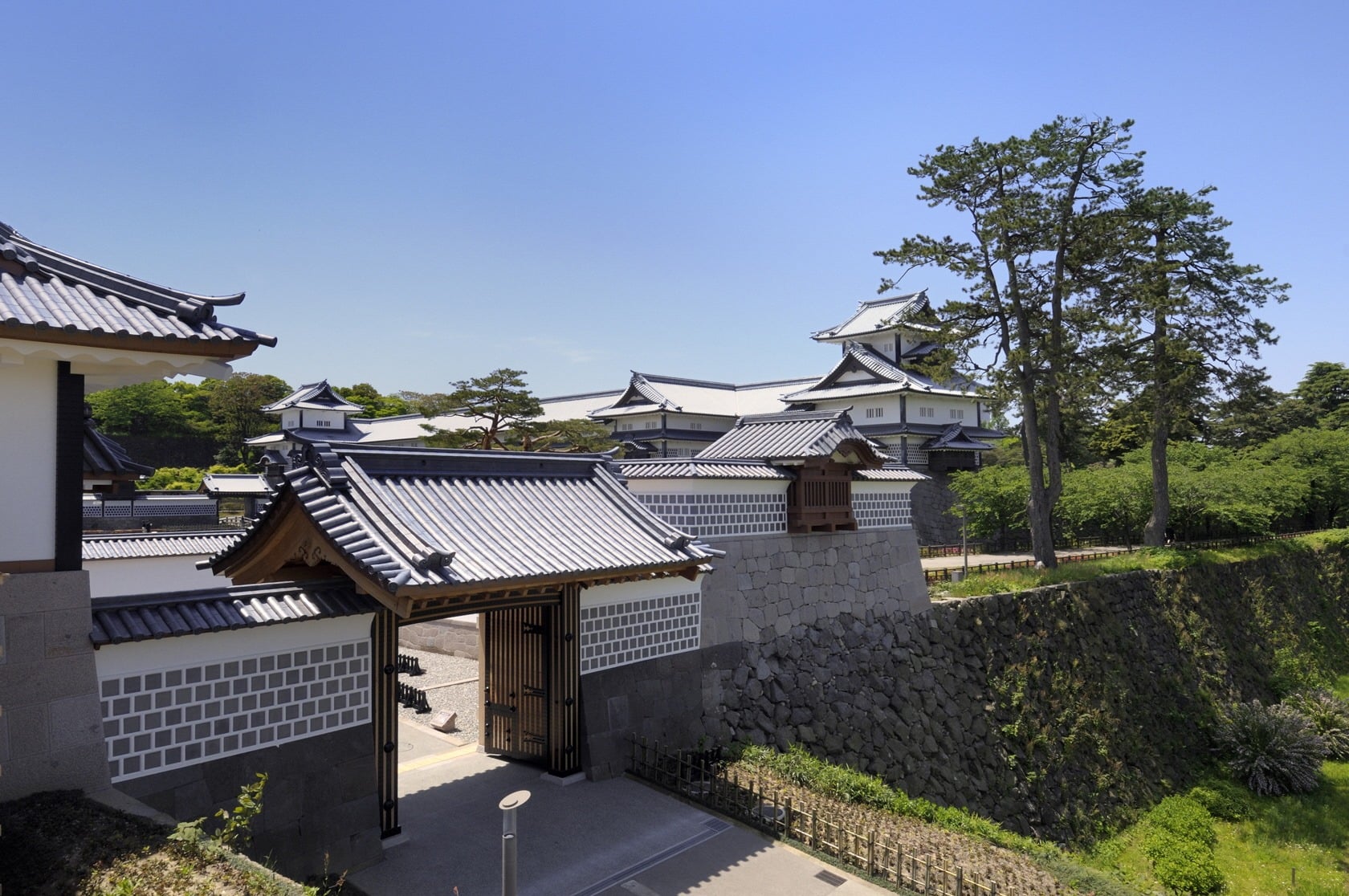
 Winniepix, CC BY 2.0
Kenrokuen Garden in Winter for Early Entry and the Snow Ropes
The rope-supported pines are there even before the first snowfall. Choose your gate according to whether you want the quiet early hour or a longer visit.
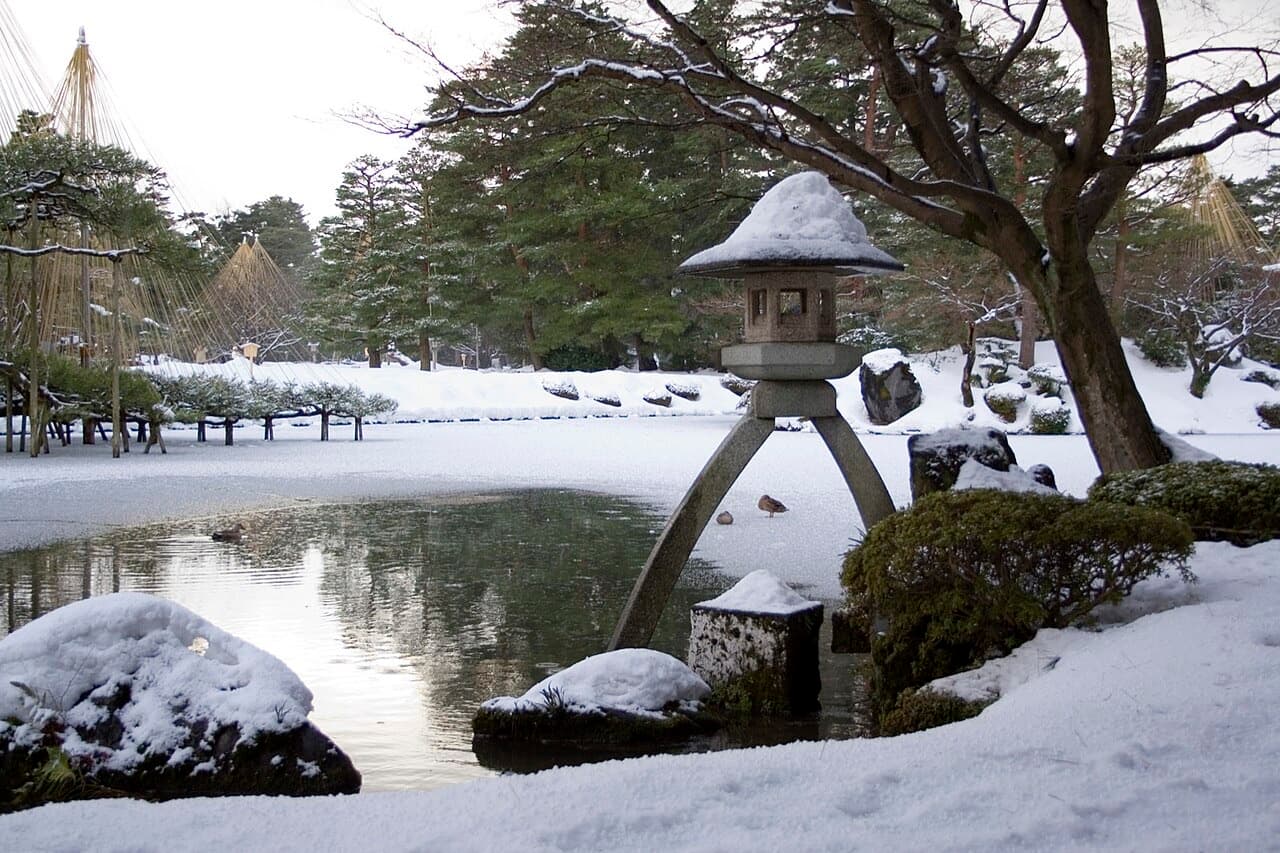
Kenrokuen Garden sits next to Kanazawa Castle in Kanazawa City, the capital of Ishikawa Prefecture. In winter, your first decision is which gate to walk to. For the free early visit in November through February, only Renchi-mon and Zuishinzaka open, at 06:00. You must leave by 07:45. If you want to take your time over the pond and the rope-supported pines, normal admission begins at 08:00. You can choose a later breakfast or an extra hour in the garden before you even leave your hotel. Ishikawa Prefecture’s opening hours and gates.
Choose your time and entrance
| Visit | Winter hours | Admission |
|---|---|---|
| Early visit, November through February | 06:00–07:45, Renchi-mon or Zuishinzaka only | Free, with exit required before regular entry |
| Regular daytime visit, October 16 through the end of February | 08:00–17:00, last entry 16:30 | ¥320 adult, ¥100 for ages 6–17 |
| February 2027 winter light-up | 18:00–21:00 on listed evenings, last admission 20:45 | Free |
Katsurazaka on the castle side is a convenient starting point during regular hours, especially if you want to visit Kanazawa Castle Park afterward. For an early visit, pick one of the two opening gates the evening before and check the walk from your hotel. Some paths slope, and an icy route can take longer than the map suggests. For wheelchair access, consult the garden office about a suitable entrance for your date.
From JR Kanazawa Station to Kenrokuen Garden
From Kanazawa Station, the city lists the Kanazawa Loop Bus to the Kenrokuen Garden and Kanazawa Castle Park stop. From the stop to the castle side of the garden takes about three minutes on foot. The natural entrance from this direction is useful for a daytime visit, but do not count on daytime bus service getting you to an early gate at 06:00. Check the first departure on your date or walk from a nearby hotel. Official directions.
At the daytime ticket desk, last admission in winter is 16:30. The gates close at 17:00, so a late train leaves less walking time than the closing hour suggests. Current prefectural visitor information.
At the daytime ticket desk, adults pay ¥320 and children aged 6–17 pay ¥100. A party of two adults and a ten-year-old therefore pays ¥740. The prefecture lists free admission from age 65 with proof of age. Carry your passport if you plan to claim the exemption. The Japanese visitor page lists approved cards and electronic payment methods. Carrying small amounts of cash also gives you an option at the gate. Ishikawa’s admission and payment details.
How far to go before breakfast
The prefecture maps a standard walking course of about 1.3 kilometres and allows around ninety minutes for it. The early window gives you 105 minutes from first entry to the required exit, including your walk back to a gate. With ice on the paths, a photographer in the group or a slower walker, see two or three places around the pond and come back in daylight for the rest. If you reach Kanazawa Station later that morning, leave the entire garden circuit for the regular hours. You can enjoy the scenic views without counting the minutes to the early exit. Official garden walking map.
Give Kenrokuen a full Kanazawa sightseeing day
Hidden Japan: Yudanaka, Kanazawa & Takayama
The Golden Route: Tokyo Start, Osaka Finish
Ready to Book. Pay Within 7 Days to Confirm.
Black Friday Sale20% comes off these prices when you book online by November 30. The discount is already in the total shown on the tour page.See sale tours
Kenrokuen Garden’s yukitsuri beside Kasumigaike Pond
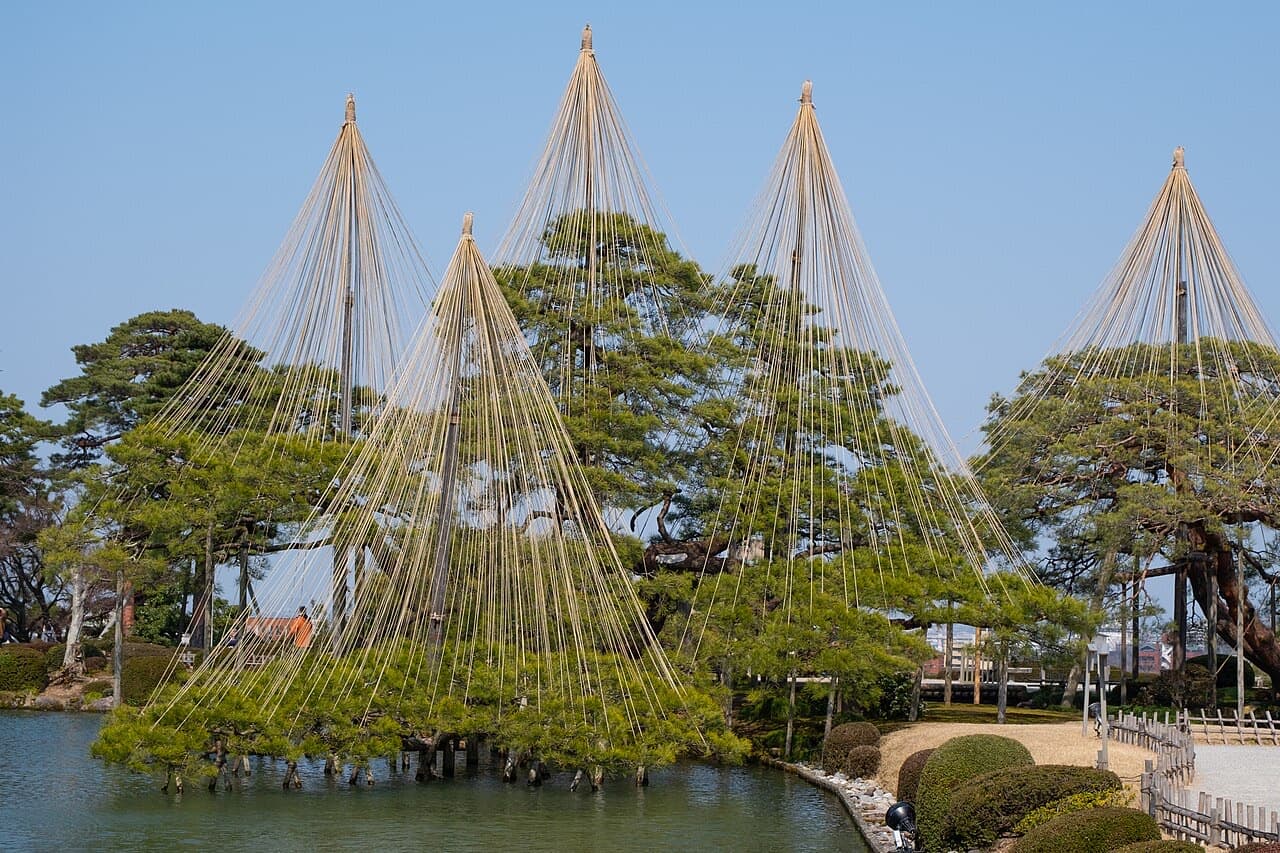
Start by Kasumigaike Pond and look for the tall central poles with ropes descending in a fan. Yukitsuri translates roughly as “snow hanging.” When the pine trees are bare of snow, you can follow the line from the top of a pole down to a single branch. Photographs of snow-covered pine trees often hide the knot that does the work. These are yukitsuri. The conical array of ropes supports individual tree branches against the weight of the wet snow that falls on this part of the Sea of Japan coast. Look at the trees from the opposite bank for the pattern of the ropes, then move closer to see where the individual lines meet the branches.
The gardeners start with Karasaki Pine on November 1. Installation continues into mid-December, and the supports can usually be seen until mid-March. A mild day is still a good time to see how the system works. Take the pond path toward the two-legged Kotoji stone lantern, then leave by the castle side if the group is warm enough for another walk. Kanazawa’s yukitsuri installation guide and official garden guide.
A short Kenrokuen Garden walk around Kasumigaike Pond
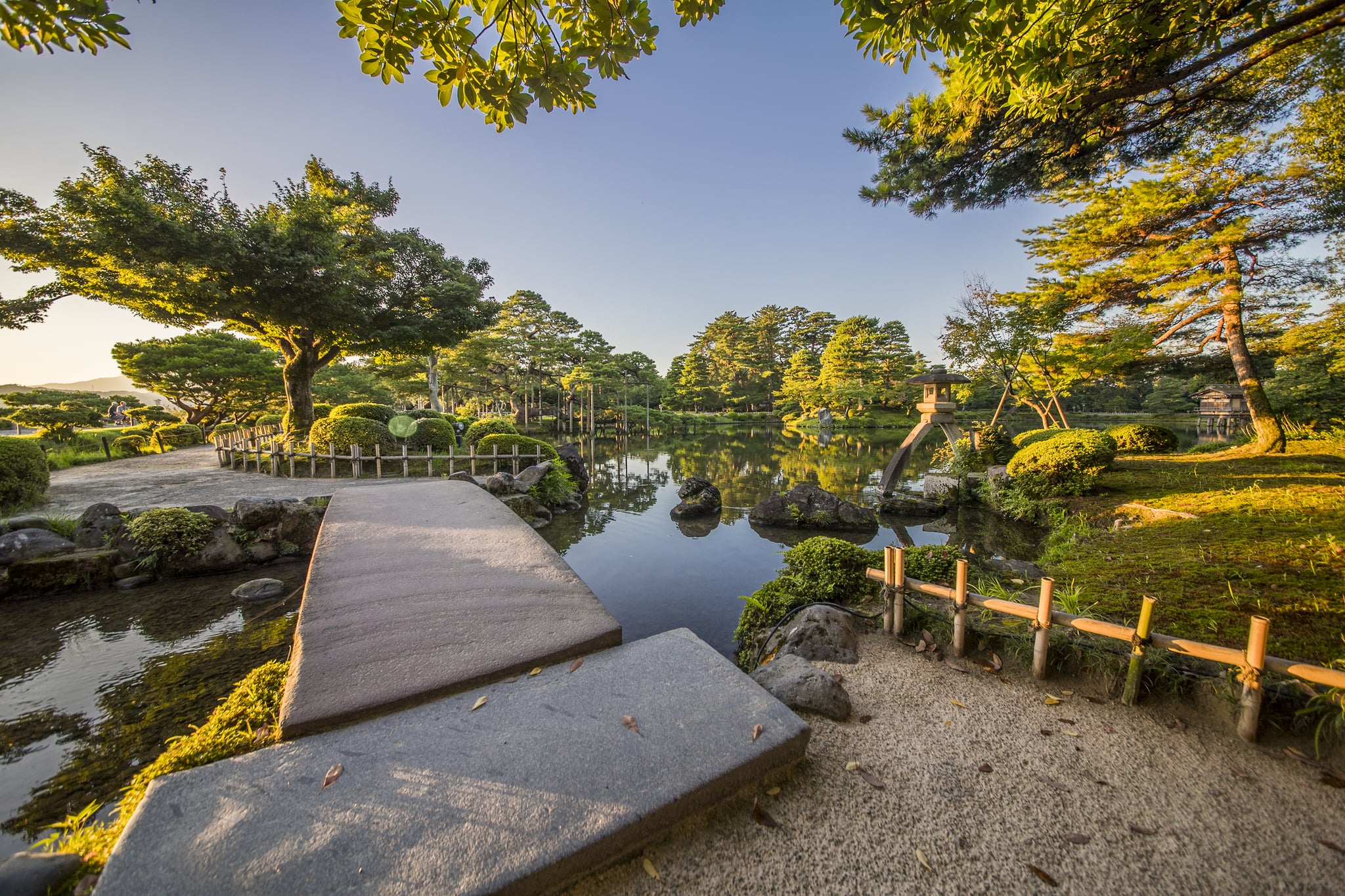
From the Kotoji stone lantern, walk along the edge of Kasumigaike far enough to see the pines from the side. The supports stand out clearly against the sky. Karasaki Pine is a good place to stop and follow one rope down to its branch. The island in the pond is Horai Island. On the way back, look again at the stone lantern from the bridge. Against the water you can make out how its two legs differ in length. Across a short stretch of path you get three different views, which makes this a satisfying route for someone who cannot cover the full garden.
How to see the six attributes in one of Japan's three great gardens
Generations of the Maeda clan developed Kenrokuen Garden near Kanazawa Castle. The Maeda family used meandering paths to reveal a succession of views as guests walked. Visitors to Ishikawa Prefecture often hear it described as one of Japan's Three Great Gardens, alongside Korakuen in Okayama and Kairakuen in Mito. Kenrokuen means a garden of six attributes. The name describes an ideal landscape, with qualities a visitor can discover on foot. They are easier to understand beside the water than on a signboard. The prefecture’s account of Kenrokuen Garden.
The six qualities come in pairs. A garden can feel spacious in one place and secluded in the next. An old pine can look entirely natural even though people have shaped and supported its branches for generations. And water normally sits at the lowest point of a landscape, while a panorama usually calls for height. The garden brings the watercourses and views together on its hillside. Look for the first pair as you leave Kasumigaike Pond. Open water gives you a long view to the far bank, while a few steps back among the trees can reveal a small, secluded corner. On the paths below the pond, you can see how water moves between different parts of the garden. The prefecture’s guide to the garden’s six qualities.
The waterway between the garden and Kanazawa Castle
When you walk from the water features in the garden toward Kanazawa Castle, you are following part of the route of the Tatsumi Waterway. Built in 1632, it carried water from the upper Saigawa River through Kanazawa City. Underground conduits took it from Kenrokuen to the castle across the moat. For travellers interested in the Kaga domain, the castle park’s diagrams explain how water reached higher ground on the other side. Ishikawa Prefecture’s illustrated history of the Tatsumi Waterway.
Tea houses and indoor stops near Kenrokuen Garden
Shigure-tei is a tea house inside the garden, with its own hours. The prefecture lists 09:00–16:30, last admission 16:00, and a December 29–January 3 closure. It will still be closed when early visitors have to leave. If tea is part of your plan, use the paid daytime opening and allow for this earlier finish. On a slippery day, keep the garden walk short. The Ishikawa Prefectural Museum of Traditional Arts and Crafts is shown on the official walking map near the garden. The 21st Century Museum of Contemporary Art is another option beyond the Mayumizaka side. Check the individual museum calendar for your visiting day. Tea house information.
Walk the garden after arriving from Osaka
Alpine Japan: Kanazawa, Takayama & Traditional Towns
Discover West Japan: Osaka Round trip
Ready to Book. Pay Within 7 Days to Confirm.
Black Friday Sale20% comes off these prices when you book online by November 30. The discount is already in the total shown on the tour page.See sale tours
Kenrokuen Garden’s eight February light-up evenings
Kanazawa lists February 6–10, 13, 20 and 27, 2027 for the winter illumination. The garden closes at 17:00 before the evening session opens at 18:00. Last entry is 20:45 and closing is 21:00. A daytime visit on another February date still gets you the regular garden and the yukitsuri. If the lights are high on your list, choose the overnight by the published dates. Official winter illumination calendar.
Pick a daylight or after-dark visit for your party
A family that wants to look closely at the ropes may prefer daytime. It is easier to follow the attachment points on individual branches, read the map and change direction before a steeper path. During the free evening session, the lit trees make a strong outline against the dark and the pond reflects the lights when the water is still. If you plan to take photographs, allow for other visitors using the same narrow pond-side viewpoints.
For a guest staying two nights, the easiest combination is a daylight garden visit on the full day and a separate evening walk if the date lines up. An overnight on February 12, for example, does not give you the February 13 light-up if you leave that morning. Match the event to the night you actually sleep in Kanazawa.
Kenrokuen Garden and Kanazawa Castle Park in half a day
Early garden, castle grounds and lunch at Omicho Market
On a December morning, the 06:00 opening is well before sunrise. For a visit in the growing daylight, aim for about 06:45 and allow an hour for the pond, Karasaki Pine and the lantern before you must leave at 07:45. On December 1, the National Astronomical Observatory lists sunrise in Kanazawa at 06:46. Snow and cloud affect what you actually see from the paths. December daylight in Kanazawa.
Leave the paid garden area and walk toward the castle side. The regular winter hours for Kanazawa Castle Park start at 08:00. The grounds and the interiors have different hours. If you mainly want the stone walls and white turrets, you can take an exterior walk and continue toward Omicho rather than waiting at a closed building. Individual market stalls keep their own hours. A late breakfast or lunch gives you time to linger over the displays and still get back to the hotel for luggage. Garden and castle park admission details.
Daytime garden, tea and a shorter indoor stop
Arrive around 08:30 through Katsurazaka. Follow the upper pond path to the lantern and Karasaki Pine. After 09:00 the tea house is an option on its operating days. When the paths are dry, use the prefecture’s standard circuit and finish on the castle side. If ice is building up, see the garden from the upper paths, leave early and choose somewhere indoors. A ticket to Kenrokuen only covers admission to the garden during its own hours. Check the hours and fee for the castle buildings or the next museum separately.
For a party that includes a wheelchair user, ask the garden office about the least steep entrance and a route that suits the conditions that morning. Ishikawa Prefecture lists wheelchair loans at the Kodatsuno gate and several other entrances. After heavy snow, ask which paths have been cleared that morning. A flat-looking line on a printed map gives you little warning about a short icy descent. Splitting up for the lower pond section and agreeing on a meeting point can work better than trying to complete the whole standard walk together.
Spring cherry blossoms and the winter rope supports
If you have seen Kenrokuen Garden in spring, return to the same pond in winter and the shape of the pine branches becomes much easier to read. In spring, cherry blossoms draw visitors toward the cherry trees and the Flower Viewing Bridge. In winter, the rope supports make a better starting point, and short daylight is a reason to walk the main sights before lunch. Someone travelling for cherry blossoms should use the spring opening hours. The early gates and February evening dates here describe the winter visit. Kenrokuen’s official seasonal guide.
Fit Kenrokuen Garden around your Kanazawa train
On Hidden Japan you sleep in Kanazawa on nights 5 and 6. Day 6 suggests Kenrokuen and the castle, which gives you a whole morning locally. Continue across Ishikawa Bridge for the castle grounds, or leave time for lunch near Omicho Market. The Kanazawa winter guide has choices for the rest of the day if rain or sleet sets in.
For a shorter trip, Alpine Japan reaches Kanazawa from Osaka on day 2 and moves on to Shirakawa-go the following day. After reaching Kanazawa Station, leave your bags and use the arrival afternoon for a self-planned garden walk. You can check dates and prices on both itineraries and pay for regular garden admission separately. When comparing the two routes, write down the time you will actually be in town. On the longer route, a local night before the garden day opens the possibility of entering at dawn. On the Osaka arrival itinerary, using the afternoon protects you against a late start and leaves your next morning free for the transfer. On either route, choose a regular paid visit if it gives your group enough time to look around.
The Kanazawa city guide shows which districts fit around either route.
Interested in a tour? Click a route code above, or search for it in the top-right Search bar.
Explore Hidden Japan: Yudanaka, Kanazawa & Takayama
Hidden Japan: Yudanaka, Kanazawa & Takayama
The Golden Route: Tokyo Start, Osaka Finish
Ready to Book. Pay Within 7 Days to Confirm.
Black Friday Sale20% comes off these prices when you book online by November 30. The discount is already in the total shown on the tour page.See sale tours
Hidden Japan: Yudanaka, Kanazawa & Takayama
Sleep in Kanazawa before day 6, when the itinerary suggests Kenrokuen and the castle. You can reach the garden early from your hotel.
Black Friday Sale20% comes off these prices when you book online by November 30. The discount is already in the total shown on the tour page.See sale tours
Check dates & prices — GR510These are multi-day Japan trips. Choose your departure date and room on the tour page to check the current price and availability. Optional day tours cost extra.
Before you book
- Pick a paid daytime visit or the November–February early window. Only Renchi-mon and Zuishinzaka open for early admission.
- If you go early, leave by 07:45. Buy a ticket when the garden reopens at 08:00 if you want more time.
- Walk to Karasaki Pine and the pond, allowing extra time for slopes, ice or a change in the weather.
- For a February light-up, match your overnight to one of the published evenings and check the last admission before heading back.
Send your dates and walking preferences if you would like help fitting the garden into a Kanazawa stay. Get in touch through Plan My Trip on our self-guided tours site, and we’ll suggest the tours that best fit your dates and plans.
Questions about your visit
Which gates open for free winter admission?
Renchi-mon and Zuishinzaka open at 06:00 from November through February. You must leave by 07:45, fifteen minutes before regular admission starts. Daytime visitors can enter again at 08:00.
Can I see the snow ropes if it has not snowed?
Yes. Gardeners begin installing yukitsuri at Karasaki Pine on November 1 and continue until around mid-December. The ropes help support branches under wet snow and can usually be seen into mid-March.
Which evenings are listed for the February 2027 illumination?
Kanazawa lists February 6–10, 13, 20 and 27. Evening entry is free from 18:00, last entry is 20:45, and the garden closes at 21:00. The published hours apply on those dates.
Prices and operating dates checked .
Hero photo by Winniepix, licensed under CC BY 2.0. Photograph resized and cropped for display.
Explore Alpine Japan: Kanazawa, Takayama & Traditional Towns
Alpine Japan: Kanazawa, Takayama & Traditional Towns
Discover West Japan: Osaka Round trip
Ready to Book. Pay Within 7 Days to Confirm.
Black Friday Sale20% comes off these prices when you book online by November 30. The discount is already in the total shown on the tour page.See sale tours