
Gion Matsuri 2026: The Self-Guided Traveler's Guide to Kyoto's Greatest Festival
July 1–31, 2026, with the Yamaboko Junko parades on July 17 and 24 and the Yoiyama nights before each. Fixed dates, where to stand, the floats, and how to build Kyoto's month-long festival into a trip.
If you're plotting a Japan trip for July, this is the festival to build your dates around. Gion Matsuri runs July 1–31 every year — 2026 is over, and with a few exceptions the schedule is fixed, so you can already lock flights and hotels for July 2027. The best-known highlights are the Yamaboko Junko parades on July 17 and July 24, plus the Yoiyama evening festivities in the days before each. For the month around the festival — weather, Tenjin Matsuri, fireworks — see Japan in July 2027.
If you only have one window, aim for July 14–17 to catch the Saki Matsuri build-up and first parade. Prefer to dodge the worst crowds? The Ato Matsuri half (July 21–24) is calmer and arguably better for photographers. This guide is for independent travelers — what to do on each key date, where to stand, where to eat, common mistakes, and how to slot it into a wider Japan trip.
🏮 Quick Answer: Gion Matsuri 2026
- Dates: July 1–31, 2026 (fixed every year) in central Kyoto, tied to Yasaka Shrine.
- Parades (Yamaboko Junko): Fri July 17 (Saki Matsuri, 23 floats) and Fri July 24 (Ato Matsuri, calmer).
- Yoiyama nights: July 14–16 and July 21–23 — lantern-lit floats, food stalls, yukata.
- Cost: free to watch; paid reserved seats on Oike-dori near Kyoto City Hall.
What Is Gion Matsuri, Really?
It's not a one-night street party — it's a month-long festival cycle tied to Yasaka Shrine, spreading through central Kyoto all July. The roots are ancient: in 869, during a plague blamed on vengeful spirits, Emperor Seiwa ordered prayers to Susanoo-no-Mikoto and 66 halberds (one per province) were erected at Shinsen-en. That purification ritual became annual, and over 1,150 years later it's still here.
Gion Matsuri is one of Japan's three great festivals, alongside Osaka's Tenjin Matsuri and Tokyo's Kanda Matsuri — the longest-running and most visually iconic of the three. In 2009 it was designated a UNESCO Intangible Cultural Heritage.
Gion Matsuri 2026 Dates and Schedule
The schedule is fixed regardless of weekday. In 2026, both parades fall on a Friday (July 17 and 24) — handy for bookending with a Kyoto weekend.
🗓️ Key dates you need to remember
| Date | Event |
|---|---|
| July 1–5 | Opening ceremonies in each yamaboko neighborhood |
| July 10 | Mikoshi cleansing ritual at Shijo Bridge |
| July 14–16 | Saki Matsuri Yoiyama (first night festival) |
| July 17 (Fri) | Saki Matsuri Yamaboko Junko (first parade) + Shinkosai mikoshi |
| July 21–23 | Ato Matsuri Yoiyama |
| July 24 (Fri) | Ato Matsuri Junko (second parade) + Hanagasa procession + return mikoshi |
| July 31 | Eki Shrine summer purification ritual closes the month |
The Floats: Hoko and Yama
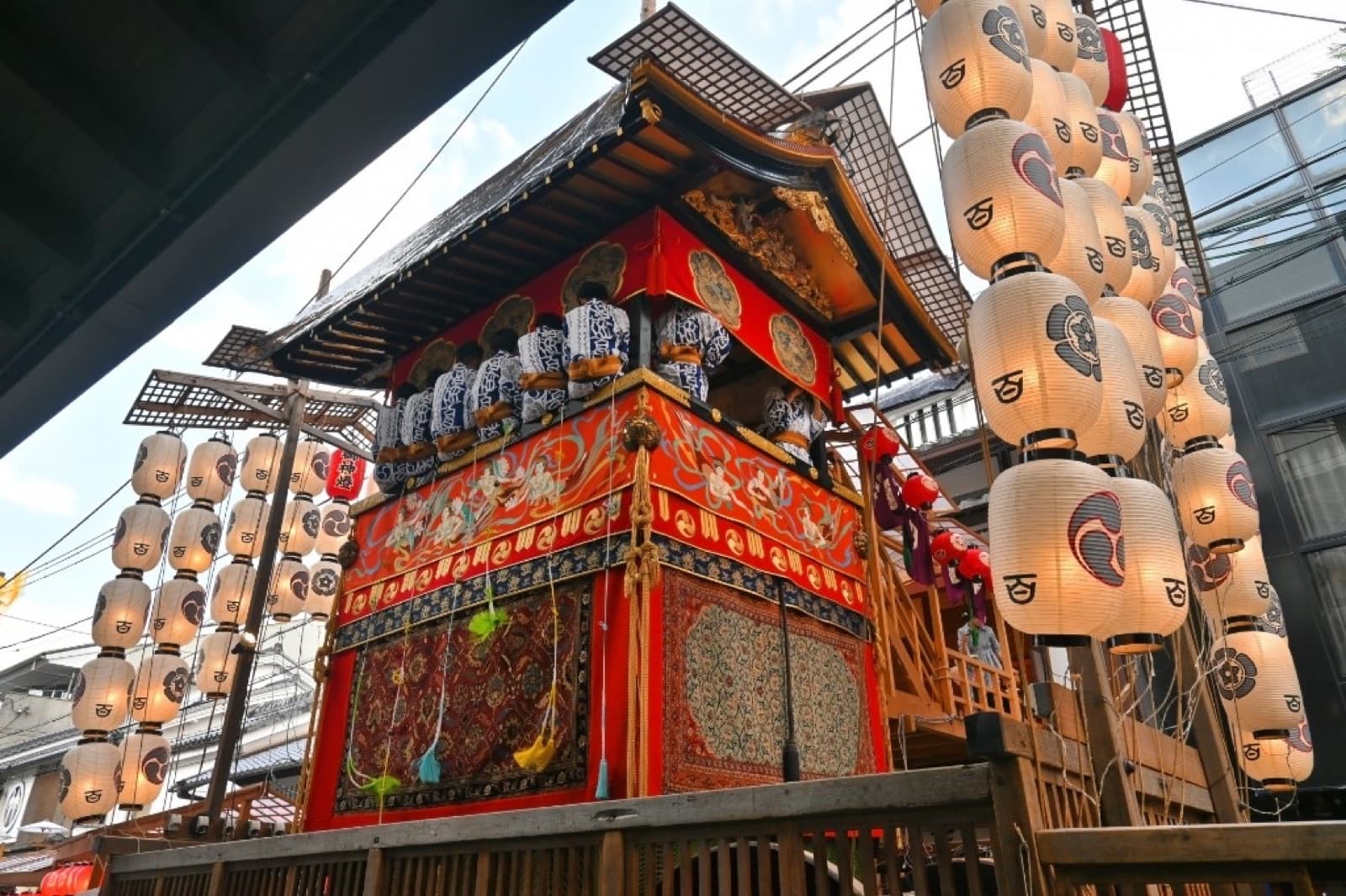
The yamaboko floats are the festival's visual signature. Hoko are the giants — multi-story wheeled structures up to 25 meters tall and 12 tons, pulled by rope teams. Yama are the smaller cousins, carried on platforms and often displaying life-sized figures from myth and history. Remarkably, the floats are built from scratch each year using rope lashing instead of nails — a technique called nawagumi — assembled right in the street in the days before each parade.
Of the 33 main Yamaboko floats, 29 are Important Tangible Cultural Properties, adorned with carpets and tapestries (some incorporating imported Gobelin and Nishijin weaves) — earning them the nickname "moving museums."
The Two Parades: Saki (Jul 17) & Ato (Jul 24)
| Saki Matsuri (Jul 17) | Ato Matsuri (Jul 24) | |
|---|---|---|
| Floats | 23 yamaboko (the big one) | ~10–11 (a third, calmer) |
| Start | 9:00 AM, Shijo × Karasuma | 9:30 AM, route reversed |
| Route | Shijo → Kawaramachi → Oike (ends ~1 PM) | Oike → Kawaramachi → Shijo |
| Also | Shinkosai mikoshi (6 PM) | Hanagasa procession (10 AM) + return mikoshi |
The moment everyone films is the tsuji-mawashi corner turn: because the wheels can't pivot, crews lay bamboo under them and pour water on the road so the several-ton float slides sideways. The most dramatic turns happen at the Shijo-Kawaramachi intersection — one of the best free viewing spots, so get there properly early (30–60 minutes before the 9:00 start). For a guaranteed seat, paid reserved seating is set up on Oike-dori in front of Kyoto City Hall (prices and booking dates via the Kyoto City Tourism Association).
Most tourists clear out after lunch and miss the spiritual half. Don't: on the evenings (6 PM) of July 17 and 24, portable shrines (mikoshi) are carried between Yasaka Shrine and the Otabisho through lantern-lit streets by chanting men in white robes. On the 24th, the Hanagasa procession adds ten umbrella floats and around 1,000 people — including geiko and maiko — from 10:00.
Yoiyama: The Night Festival
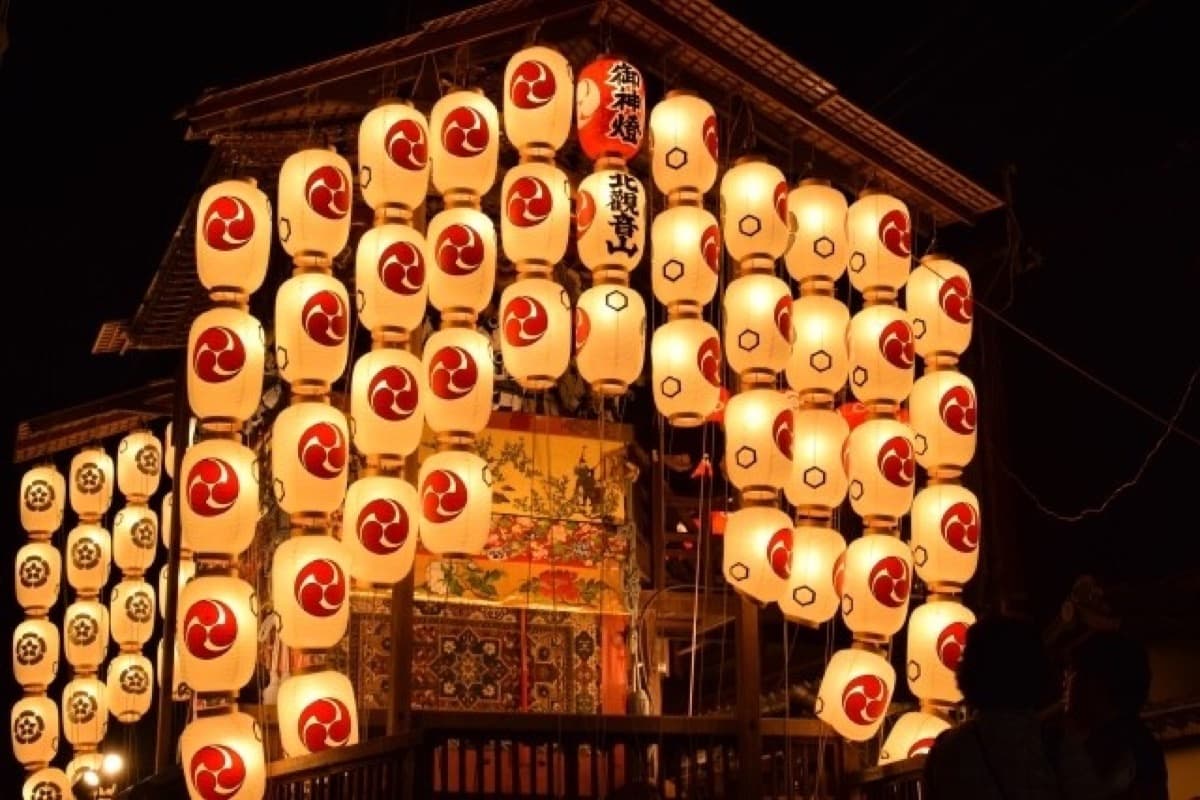
If you can only pick one thing, pick a Yoiyama evening. Across six nights — July 14–16 (before Saki) and July 21–23 (before Ato) — from around 6:00 PM the streets around Shijo, Karasuma and Kawaramachi close to traffic and fill with food stalls and yukata-clad locals, while the assembled floats glow under paper lanterns. Expect yakitori, takoyaki, kakigori, karaage, and a lot of beer.
Two extras worth seeking out: the Byobu Matsuri (folding-screen festival), where townspeople open their machiya ground floors to display heirloom screens free from the street (wander Shinmachi-dori), and chimaki — bamboo-grass amulets sold by each float's neighborhood to ward off illness for a year. For the most energy, go July 15 or 16; for a calmer night, the July 21–23 round is the smarter pick.
Yasaka Shrine: The Ritual Heart
Everything begins and ends at Yasaka Shrine. A chigo (sacred child) is chosen as a divine messenger and — by tradition — cannot set foot on the ground from July 13 until after he's paraded on the 17th; he leads the Naginata Hoko in the first parade. The month closes with a quiet purification at the Eki sub-shrine, where walking through the sacred reed ring is a satisfying end to a long July. Sacred dances from an Izumo troupe are performed on the nō stage from 18:30.
How to Get There
Most events sit in a tidy box of central Kyoto around Shijo-Karasuma, Kawaramachi and Yasaka Shrine — about a 5-minute train ride from Kyoto Station (Karasuma Line to Shijo Station, then walk east). Or use Hankyu Kawaramachi Station or Keihan Gion-Shijo Station. On peak days many streets close to cars and buses, so forget taxis and plan to walk.
Where to Stay for Gion Matsuri 2026
Book now — seriously. Hotels sell out months ahead (it's nearly as busy as cherry-blossom season). The most strategic base is around Shijo Kawaramachi, right on the parade routes and yoiyama streets. If it's full, look at Karasuma-Oike, Sanjo, or near Kyoto Station and ride the subway in. For atmosphere, a converted machiya townhouse a few blocks from the float-assembly streets is a different kind of trip. For daytime meals, Nishiki Market is a short walk from Shijo.
💬 From our Japan travel team
Gion Matsuri is one of Kyoto's peak crowding seasons. Accommodation in the city is very hard to find and prices run high. The good news: the transport network around Kyoto is excellent — Osaka, Nara, Kobe and other nearby cities are realistic bases if you're willing to commute in by train.
We offer many self-guided tours with Kyoto stays, but Gion Matsuri season products are expected to sell out early. If you're planning to attend in 2027, we'd strongly recommend booking as far ahead as you can.
Building Gion Matsuri Into Your Japan Itinerary
Minimum viable plan (3 nights in Kyoto):
- Night 1 (Jul 15): arrive, drop bags, head to yoiyama.
- Day 2 (Jul 16): float viewing, byobu matsuri, a second yoiyama night.
- Day 3 (Jul 17): first parade in the morning, mikoshi procession in the evening.
- Depart (Jul 18): on to Osaka or Tokyo.
Better plan (5–6 nights): add the Ato Matsuri to the back end — use Jul 18–20 for day trips to Nara, Arashiyama or Uji, then return for the calmer Ato yoiyama (Jul 22–23) and the Jul 24 parade. Note that Osaka's Tenjin Matsuri runs July 24–25 — the same days — so you can't easily do both parades. For a wider trip, fly into Tokyo, take the Shinkansen to Kyoto for the festival, then loop to Osaka or Hiroshima. See our Japanese summer festivals guide for the wider season.
Common Mistakes to Avoid
- Underestimating the heat. Kyoto in July is hot and humid, often over 30°C — carry water, wear light clothing, plan breaks.
- Trying to see everything. One yoiyama night, one parade, one mikoshi is plenty; all six nights plus both parades will wreck you.
- Showing up at 8:55 for the parade. Arrive 30–60 minutes early, earlier for a Shijo-Kawaramachi corner spot.
- Skipping the mikoshi. The floats are the headline; the portable shrines are the soul.
- Booking hotels too late. Central Kyoto near Shijo Karasuma sells out 6+ months out.
- Assuming the action is in the Gion district. The parade doesn't go through Gion — but Gion is still the best place for festival snacks and lantern-lit yoiyama around Yasaka Shrine and Hanamikoji-dōri.
FAQ: Gion Matsuri 2026
When is Gion Matsuri 2026?
Gion Matsuri runs July 1–31 every year in central Kyoto, with the two Yamaboko Junko parades always on July 17 and July 24. In 2027 those fall on Saturday July 17 and Saturday July 24 — weekend dates, so expect larger crowds than 2026's Fridays.
Do I need tickets to see the parade?
No — most events, including the Yamaboko procession, are free to watch. Paid reserved seats near Kyoto City Hall on Oike-dori are available if you want a guaranteed view.
What's the difference between Saki Matsuri and Ato Matsuri?
Saki Matsuri is the first half (parade July 17, 23 floats, biggest crowds). Ato Matsuri is the second half (parade July 24, around 10–11 floats, calmer, route reversed).
How early should I arrive for the July 17 parade?
At least 30–60 minutes before the 9:00 AM start, and earlier still for a corner spot at the Shijo-Kawaramachi tsuji-mawashi.
Is one Yoiyama night enough?
Yes, for most travelers one yoiyama evening is plenty. July 15 or 16 has the highest energy; July 21–23 is calmer.
Where exactly does the festival happen?
Mainly central Kyoto around Shijo, Kawaramachi and Oike streets, with ceremonies at Yasaka Shrine in the Gion district. The parade route itself does not pass through Gion.
Can I combine Gion Matsuri with Tokyo and Osaka?
Absolutely. The fixed dates make it easy to anchor a multi-city trip — most travelers spend 4–6 nights in Kyoto during festival weeks and add Tokyo before or Osaka after.
Plan Your Self-Guided Gion Matsuri Trip
The hard part isn't deciding to go — it's stitching the festival into the rest of Japan without burning out. We turn fixed-date events like Gion Matsuri into full self-guided itineraries: rail passes, hotel timing, and the day-by-day logistics that make a Kyoto July trip fun instead of stressful.
Schedule, routes and prices per Yasaka Shrine and the Kyoto City Tourism Association; confirm paid-seat booking and any changes on the official sites before you travel. Last updated: June 29, 2026.
Related Articles
Kyoto to Osaka: The Practical Guide for Self-Guided Travelers
13 min read
Japanese Summer Festivals 2026: The Best Matsuri & How to See Them
14 min read
Jidai Matsuri 2026 and Kurama Fire Festival 2026: A Practical Guide to Kyoto's October 22 Double Bill
15 min read