Japan Accommodation Tax 2026: A City-by-City Guide for Travelers
Kyoto's lodging tax now climbs to ¥10,000 a night, and a wave of new prefectural taxes lands in 2026. Here's the per-city breakdown — and how to keep it off your budget.
Planning a self-guided trip to Japan in 2026? You'll want to know about the accommodation tax before you book. The rules just shifted in a big way — especially in Kyoto — and the patchwork of city and prefectural rates can quietly add real money to your total accommodation cost if you're not paying attention.
The short version: the accommodation tax (shukuhaku-zei) varies city by city, tier by tier, sometimes night by night. Currently 17+ prefectures, cities, towns and villages levy one — including Tokyo, Hokkaido, Osaka Prefecture, Kyoto City, Hiroshima Prefecture, Fukuoka Prefecture, Nagasaki City and Kanazawa City — and more come online through 2026. It's collected by the hotel at check-in or check-out (not by your booking platform), calculated per person, per night, on top of the 10% consumption tax.
🏨 Quick Answer: Japan Accommodation Tax 2026
- Kyoto: new 5-tier system from March 1, 2026 — ¥200 up to ¥10,000 per person/night (luxury).
- Tokyo: exempt under ¥10,000; then ¥100 or ¥200.
- Osaka: exempt under ¥5,000; up to ¥500.
- Always extra: paid on-site, per person per night, usually not included in your online rate.
What Is the Japan Accommodation Tax?
The accommodation tax — sometimes called the hotel tax, lodging tax, or city tax — is a local levy charged by certain Japanese municipalities when you stay at hotels, ryokan, machiya and other registered accommodations. It's separate from Japan's 10% consumption tax: think of it as a small tourism surcharge that funds multilingual signage, station upgrades and crowd management. Some cities use a flat rate; others use tiered brackets based on your room price.
Who Pays It, and When
Pretty much everyone staying overnight at a licensed property in a taxing municipality — hotels, ryokan, business hotels, machiya, capsule hotels and registered minpaku rentals. Local residents, foreign tourists, business travelers: same rule. You pay it on site, not when you book — even prepaid bookings usually need a separate cash or card payment for the tax line. One important note: rates shown online almost never include this tax.
The Big 2026 Change: Kyoto City
If you're spending nights in Kyoto, this is the headline. The Kyoto accommodation tax has been completely restructured. The new rates take effect March 1, 2026 and apply to all stays beginning on or after that date, regardless of when the booking was made.
| Nightly room rate | Tax / person / night |
|---|---|
| Under ¥6,000 | ¥200 |
| ¥6,000 – ¥19,999 | ¥400 |
| ¥20,000 – ¥49,999 | ¥1,000 |
| ¥50,000 – ¥99,999 | ¥4,000 |
| ¥100,000 and over | ¥10,000 |
The top bracket is a big deal: luxury stays at ¥100,000+ jump from the old ¥1,000 to ¥10,000 per person per night. For most travelers booking mid-range business hotels or guesthouses, the bump is honestly small. For first-time visitors splurging on a top-tier ryokan, it stings. City officials have been explicit about the rationale: tourists must bear the cost of countermeasures against overtourism.
Tokyo Accommodation Tax
Tokyo pioneered accommodation taxes in Japan, implementing its system in 2002. It uses a simple three-band structure (per person per night, room-only rate excl. tax):
| Nightly room rate | Tax / person / night |
|---|---|
| Under ¥10,000 | Exempt |
| ¥10,000 – ¥14,999 | ¥100 |
| ¥15,000 and over | ¥200 |
Book a ¥9,500 business hotel near Ueno or Asakusa and you pay zero — plenty of self-guided travelers fall under this exemption without realising. Heads up for the future: Tokyo has proposed replacing the flat-rate system with a uniform 3% percentage-based tax starting in 2028.
Osaka Accommodation Tax
Following Tokyo's lead, Osaka introduced its tax in 2017. It now uses four tiers per person per night (excl. consumption tax):
| Nightly room rate | Tax / person / night |
|---|---|
| Under ¥5,000 | Exempt |
| ¥5,000 – ¥14,999 | ¥200 |
| ¥15,000 – ¥19,999 | ¥400 |
| ¥20,000 and over | ¥500 |
That ¥500 cap makes Osaka feel cheap next to Kyoto's new luxury bracket — even Osaka's highest rate is just 5% of Kyoto's top tier. Many travelers in Dotonbori-area business hotels under ¥5,000 pay nothing at all. It's one reason day-tripping into Kyoto from an Osaka base is a legit 2026 budget move.
Fukuoka Accommodation Tax
Fukuoka does things differently — it layers a prefectural and city tax together, the first region in Japan to implement "double taxation." It looks complicated but the math is simple in practice:
- Fukuoka City: ¥200 under ¥20,000; ¥500 at ¥20,000+ (each includes ¥50 prefectural tax)
- Kitakyushu City: flat ¥200 (includes ¥50 prefectural tax)
- Elsewhere in Fukuoka Prefecture: flat ¥200
Kanazawa & Other Established Cities
Kanazawa joined the list in April 2019, split by rates under/over ¥20,000 per night, and since October 2024 added a ¥5,000 exemption threshold (stays under ¥5,000 per person per night are waived). Other established taxing locations:
- Sendai (Miyagi): ¥300 for stays over ¥3,000/night
- Atami (Shizuoka): flat ¥200
- Takayama & Gero (Gifu): flat ¥200 each
- Kutchan / Niseko (Hokkaido): 2% on lodging since 2019, rising to 3% from April 1, 2026
- Also collecting: Hiroshima Prefecture, Matsue (Shimane), Tokoname (Aichi), and Nagasaki City
New Accommodation Taxes Coming in 2026
Several popular destinations are introducing the tax this year. If your itinerary includes mountain or onsen towns, budget for these.
Nagano Prefecture & Resort Towns
Nagano Prefecture launches a prefectural tax in June 2026: ¥200 per person/night for stays of ¥6,000+ (rising to ¥300 from 2029); stays under ¥6,000 are exempt. Several municipalities stack their own on top:
- Matsumoto City: flat ¥200 (includes ¥100 prefectural tax)
- Karuizawa Town: tiered ¥200 up to ¥700 at the ¥100,000+ band
- Hakuba Village: scales up to ¥1,900 per person/night for ¥100,000+ stays
Kumamoto, Miyazaki & More
Kumamoto City and Miyazaki City are approved for June 2026 (Kumamoto indicated at a flat ¥200). October 2026 brings Nasu Town (Tochigi) and Morioka City (Iwate). If your route includes Hakuba, Karuizawa, Nozawa Onsen, Niseko, Nasu or Morioka in 2026, double-check before you book.
How the Tax Is Calculated
- Based on the per-person nightly rate, excluding consumption tax and (in most cities) service charges
- Meal costs are usually excluded — important for ryokan with kaiseki dinners
- It's per person, not per room — two people in one room pay twice
- Charged per night, so longer stays add up
- The tier depends on your nightly rate, not your total bill
One Kyoto-specific catch: service charges do factor in there. A ¥99,000 base rate plus a 10% service charge tips you into the next bracket — worth doing the math.
Two Extras: Stacked Taxes & the Onsen Bathing Tax
In some areas — Hokkaido is the classic example — you pay both a prefectural (or "do") lodging tax and a separate municipal lodging tax, stacked on the same stay. It's the same pattern as Fukuoka's double layer, so check whether your destination has both a prefecture-level and a city/town-level tax.
♨️ Staying at an onsen ryokan? Add the bathing tax (nyuto-zei)
Ryokan and hotels with hot-spring (onsen) facilities also collect a separate bathing tax (入湯税), charged at check-in or check-out just like the accommodation tax. It's typically around ¥150 per person per night, and at most properties it applies whether or not you actually use the large public bath. It's a small amount, but it's on top of both the accommodation tax and the 10% consumption tax — so budget for it at onsen stays.
How to Budget for Your 2026 Trip
- Mid-range (¥10,000–¥20,000 hotels): ¥100–¥400 per person/night → ¥1,000–¥4,000 per person over 10 nights. Small money.
- Kyoto boutique (¥60,000, couple, 3 nights): ¥4,000 × 2 × 3 = ¥24,000 in tax alone.
- Kyoto luxury (¥100,000+): ¥10,000 per person/night — two guests, four nights = ¥80,000. A separate dinner budget.
Practical moves that work: stack your splurge in Tokyo or Hakone (Hakone has no city tax) rather than Kyoto; day-trip Kyoto from Osaka to sidestep the bracket entirely (you give up sunrise at Fushimi Inari, but save real money); and watch the bracket cutoffs — in Kyoto, ¥19,800 vs ¥20,000 means ¥400 vs ¥1,000. For a typical two-week Tokyo–Kyoto–Osaka–onsen trip, budget roughly ¥5,000–¥10,000 per person in total at mid-range rates. See our Japan trip cost calculator and daily budget guide to fold it in.
Common Mistakes to Avoid
- Assuming the OTA price is final. Booking.com/Agoda rates rarely include the tax — assume an extra line at check-in.
- Pricing across the bracket line. Kyoto punishes just-over-the-line stays (¥99,999 vs ¥100,000 = ¥4,000 vs ¥10,000). Ask the property to adjust by a few yen where possible.
- Booking unlicensed minpaku to dodge it. Doesn't work — in 2026 enforcement expanded to licensed minpaku, which now collect the same tax as hotels.
- Not carrying cash. Smaller ryokan and inns often only take cash for the tax line — keep a few thousand yen handy.
- Forgetting cutoffs vary by city. Tokyo exempts under ¥10,000; Osaka and Kanazawa under ¥5,000; Kyoto exempts nobody — even a ¥3,000 hostel bunk pays ¥200.
Where to Verify Before You Book
Don't trust random blog posts (including this one) as your final word — rates change. Cross-check against the official Tokyo Metropolitan Tax Bureau, the Kyoto City tax-change page (published in multiple languages), each prefecture's own tax bureau, and your booking confirmation, which should disclose the tax separately. The revenue isn't a slush fund: most goes toward sustainable tourism, multilingual signage, station improvements and overtourism countermeasures.
A self-guided Japan trip is still the best way to see the country in 2026 — the accommodation tax is just another line in the budget, like train fares or daily food. But it rewards a bit of planning. We build day-by-day itineraries that factor in the tax math, transit costs and seasonal quirks, so you can get the temple sunrise without paying Kyoto's top-bracket rate.
FAQ: Japan Accommodation Tax 2026
Is the Japan accommodation tax 2026 the same everywhere?
No — it varies a lot. Tokyo exempts rooms under ¥10,000, Kyoto taxes every stay, Fukuoka Prefecture stacks two layers, and many regions don't have it at all. Always check the specific city.
Do I pay the accommodation tax on Airbnb or vacation rentals?
Yes, if the property is a licensed minpaku in a taxing municipality. Unlicensed listings operate illegally; licensed private lodging in Tokyo, Osaka, Kyoto and elsewhere collects the same tax as a regular hotel.
Is the tax included in my online room price?
Usually not. Most hotels show the room rate excluding consumption tax and accommodation tax. Check your booking confirmation and assume you'll pay an extra line at check-in or check-out.
Are children exempt?
It depends on the city. Kyoto exempts school-excursion students with documentation; most other cities tax all guests once the rate exceeds the exemption threshold. Confirm with the property.
Will the Kyoto changes apply if I booked before March 2026?
It depends on the hotel's policy. Reservations made by February 28, 2026 often include the old tax in the rate with no separate charge; reservations made on or after March 1, 2026 are charged the new tax separately regardless of stay date. Check with your specific property.
Can I pay the accommodation tax by credit card?
Many hotels accept card for the tax line, but smaller ryokan and family-run guesthouses often want cash. Keep a few thousand yen on hand to be safe.
Do rates differ for foreign vs domestic guests?
No. Residents, foreign tourists and business travelers pay the same flat rate or tier. There's no separate "foreign tourist tax" here — the international departure tax is a different thing entirely.
Is there a separate onsen or bathing tax on top of the accommodation tax?
Yes. Ryokan and hotels with hot-spring facilities collect a bathing tax (nyuto-zei, 入湯税), usually around ¥150 per person per night, settled at check-in or check-out like the accommodation tax. It typically applies whether or not you use the public bath, and it's separate from both the accommodation tax and the 10% consumption tax. In some regions such as Hokkaido you may also pay a prefectural and a municipal lodging tax stacked together.
What's the cheapest way to keep accommodation tax low in 2026?
Budget business hotels under each city's exemption threshold (¥10,000 Tokyo; ¥5,000 Osaka/Kanazawa) pay nothing. Day-tripping expensive cities like Kyoto from cheaper bases also helps — and watch the bracket cutoffs.
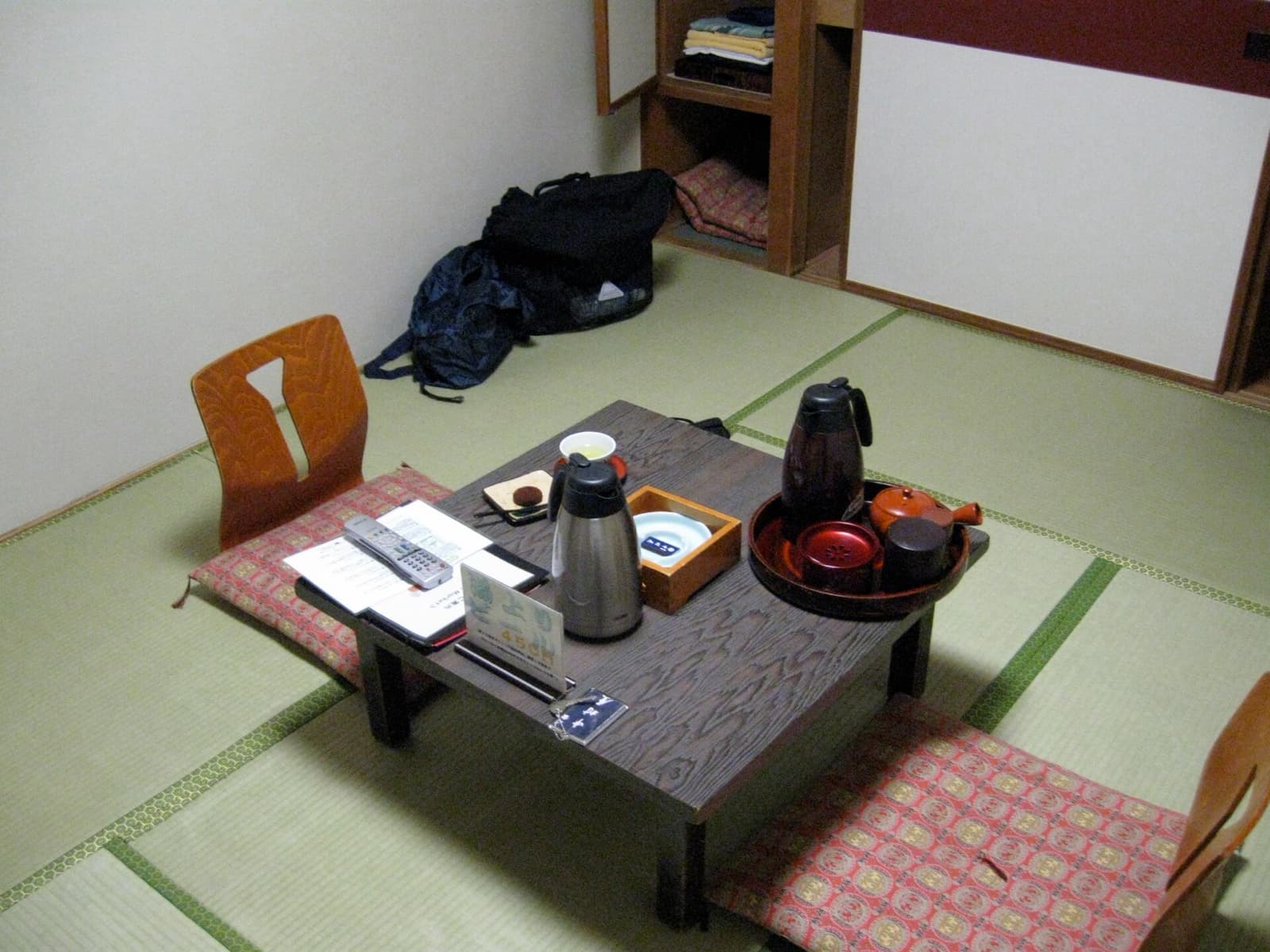
Photo: Ryokan room interior via Wikimedia Commons (CC BY 2.0). Rates per Kyoto City, Tokyo Metropolitan, Osaka and prefectural tax bureaus; verify current figures before booking. Last updated: June 2026.